

Exodus 25
The Grander Picture of the Tabernacle of Moses and Man’s Ultimate Destiny
Exodus chapter 25 and onward contains YHVH’s instructions to Israel to build a tabernacle or sanctuary so, in his own words, “I may dwell among them” (Exod 25:8). Is the construction of an elaborate tent in the desert merely a quaint, archaic and irrelevant historical event that occurred millennia ago, or is there a larger prophetic picture here that points to something much grander that relates to you and me? The answer to the latter question is a most definite and emphatic, “Yes!”
As a historical, contextual backdrop, let us first step back to the beginning of man’s creation. At that time, YHVH Elohim formed man in his image for the purpose of raising up a family of glorified sons and daughters to become like him, and to live with him forever in a glorified and elevated state of existence. To that end, he placed the first humans in an idyllic garden where he could walk and commune with them in the cool of the day—symbolic of a state of restful or comfortable and relaxed communion. Sadly, this one-on-one relationship did not last long, and man was thrust out of the garden (symbolic of YHVH’s dwelling place on earth) because of sin and the lack of man’s holiness without which no man can enter into much less remain in the presence of the holy (set-apart), perfect and sinless YHVH Elohim.
Moving forward in time, some 3,500 years later in the time of Moses, we arrive at the time where YHVH instructed the children of Israel to build another dwelling place for him that he might abide with his people once more. Instead of a garden, this was a movable tent called the Tabernacle of Moses, which contained a special room called the holy of holies. It was in this one spot where YHVH desired to dwell on earth again with his human children.
But there is one caveat. One cannot merely go blithely, casually or cavalierly waltzing into the holy presence of YHVH in a state of sinful impurity or unholiness. After all, would a person in their right mind deign to march into the presence of the pope, king of England or the Oval Office of the White House unwashed wearing filthy jeans and a holey T-shirt? This would be unthinkable. How much more then the Creator of the universe? No. There is a process of spiritual cleansing that must first occur and the tabernacle (along with the seven biblical feasts) reveals a seven step process, which is YHVH’s plan of redemption or salvation for man, for man to join in holy communion with a holy Elohim.
The tabernacle that YHVH commissioned the Israelites to construct was literally a giant, demonstrative and interactive gospel tract showing man the way to his Father in heaven. It was (and still is) a symbolic and metaphorical picture of the transformational cleansing process required to go from a state of spiritual uncleanliness to purity with the ever-present help of Yeshua the Messiah who came to show man the way to his Father in heaven (John 14:6). Amazingly, the tabernacle is also a picture of each of us, who, if we are willing, can follow Yeshua step-by-step into the presence of our holy (pure and sinless) Father in heaven.
To be sure, YHVH desires a personal relationship not only with corporate Israel, but also with each of us individually. Elohim’s chosen people, the nation of Israel, is comprised of individual entities each with their own unque relationship with the Creator. Coming into the inner sanctum of the holy of holies in the tabernacle (representative of YHVH’s heavenly throne room) should be the ultimate goal of each person, and it is YHVH’s highest desires and plan to lead each of us into his presence by way of Yeshua his Son, who is the way, the truth and the life and the only way to the Father (John 14:6).
The transformational of process of spiritual cleansing begins occurring when one comes to faith in Yeshua, repents of one’s sin, and then allows the Holy Spirit to commence a miraculous spiritual work on the inside of each of us. The Tabernacle of Moses is the three-dimensional gospel tract that outlines the progressive steps in this cleansing process that ultimately transforms a person into the higher and ultimate dimensions of a spiritual reality that is beyond that of this physical existence. Moreover, the tabernacle outlines the steps required for the indwelling presence of YHVH’s Spirit which activates our personal spirit that resides deep inside of us thus drawing us upward to our Father in heaven. As such, we literally become a living Tabernacle of Moses or, as Paul characterizes it, a temple of the Holy Spirit. This is a mystery that few humans, including Christians, understand, but that has been hidden in plain sight in our Bibles for thousands of years!
To the degree that we allow YHVH to work in us, to cleanse and refine us, is to the degree that we advance along the progressive steps upward toward our Father in heaven as outlined in the Tabernacle of Moses.
If we will be honest with ourselves, most of us are not as far along in this process as we think. There for YHVH’s grace go each of us! But at least we have the road map of the tabernacle to show us the way onward and upward. There are no shortcuts to Elohim, and this journey will take a lifetime, and even then, each of us will still need the grace of Elohim as well as the imputed righteousness of Yeshua to compensate for our lack of righteousness. Despite our best efforts, each of us will fall short of “the mark for the prize of the high calling of Elohim in Messiah Yeshua” (Phil 3:14). This is because the righteous are scarcely saved (1 Pet 4:18), and all of our righteousness is as filthy rags (Isa 64:6). When we finally come to this realization and humble ourselves before YHVH Almighty, and we allow him to begin cleaning us spiritually (a process called “sanctification”) from the inside out, it is then that he can begin his spiritually transformational work deep inside each of us and lift as he raises us up (Jas 4:10) to seat us in heavenly places with Yeshua (Eph 2:6). It is then that we will be fully born again as new, glorified and immortalized children of Elohim and adopted into his eternal family (Rom 8:12, 23; 9:4; Gal 4:5; Eph 1:5).
This is the ultimate message of the entire Bible of which the Tabernacle of Moses is an illustrative, symbolic and prophetic depiction, so that even a child can visualize it. Sadly, this is also a truth and message that the mainstream Christian church has largely overlooked, even though, and curiously so, many churches, cathedrals and basilicas the world over are patterned to one degree or another after the Tabernacle of Moses.
Exodus 25:8–9, A sanctuary…tabernacle.
How the Tabernacle of Moses Relates to YOU
Before launching into a study of the Tabernacle of Moses, let’s first ask ourselves a question. When teaching our little children and the things of life, do we hand them the multi-volumed set of Encyclopedia Britannicas? Of course not. They wouldn’t get past page one. We give simple story books with giant print and a plethora of pictures that help them to understand basic concepts like the alphabet, colors, the names of animals and so on. YHVH Elohim, our Father in heaven, did the same thing when teaching his children of Israel—and us too—about his amazing and life transforming plan of salvation. Instead of a storybook, he had the Israelites construct the Tabernacle of Moses, which reads like simple gospel tract. But curiously, the more one dives into and explores its depths, complex and expansive of truth and divine revelation into the mind and heart of YHVH Elohim and the Person of Yeshua the Messiah will progressively reveal themselves layer by layer leading to the heart and soul of our Father in heaven with the end result of abiding forever in his glorious presence.
Yet there is another way to look at the Infinite (Elohim) trying to communicate with the finite (humans). If you were the Creator of the universe, what means would you use to communicate with those that you had created through love in your likeness and image? In a remote and somewhat dissimilar way that nevertheless transmits a certain idea, it is like a human standing over an anthill trying to communicate with the ants. How do you do it? Similarly, how does an all powerful, Spirit Being, loving Father in heaven relate to his mortal children who are but mere specks of dust without vaporizing them into oblivion with his raw power by his presence? The difficulty is compounded when fearful and estranged humans do not want to hear the voice of Elohim, which is what happened when YHVH Elohim’s voice thundered from Mount Sinai. The children of Israel begged him not to talk face-to-face with them lest they die. They asked the Almighty One to speak to them instead through Moses (Exod 20:19).
When man committed his first sin at the tree of the knowledge of good and evil in the garden, he was cut off from a spiritual relationship with their holy and sinless Creator. The Garden of Eden pictured this halcyon state between YHVH and man. Because of sin and rebellion on man’s part, this relationship was ruined, and YHVH expelled the first humans from the idyllic Eden, and direct communications between man and his Maker were hampered if not largely cut off. However, Elohim had a plan to restore the loving relationship he had with his earthly children before their rebellion and fall. But if men refuse to hear you when you speak, what are you do?
For certain, the Almighty does not lack for ways to communicate with his human children. Man is without excuse when it comes to hearing Elohim, for even the heavens declare the glory of the Creator and the plans he has for mankind (Ps 19:1ff). The visible things of this creation shout loudly about the spiritual mysteries heaven desires to reveal to its earthly subjects (Rom 1:18–20); therefore, only blind fools refuse to acknowledge YHVH’s existence (Pss 14:1–3; 53:1–3). Furthermore, from time to time over the millennia, Elohim has chosen to speak directly to some of his select servants through dreams, visions, signs, wonders, angels, and once he even spoke through a donkey! But how does he speak to a whole nation, if that nation is plugging its ears and refusing to hear its Master’s voice?
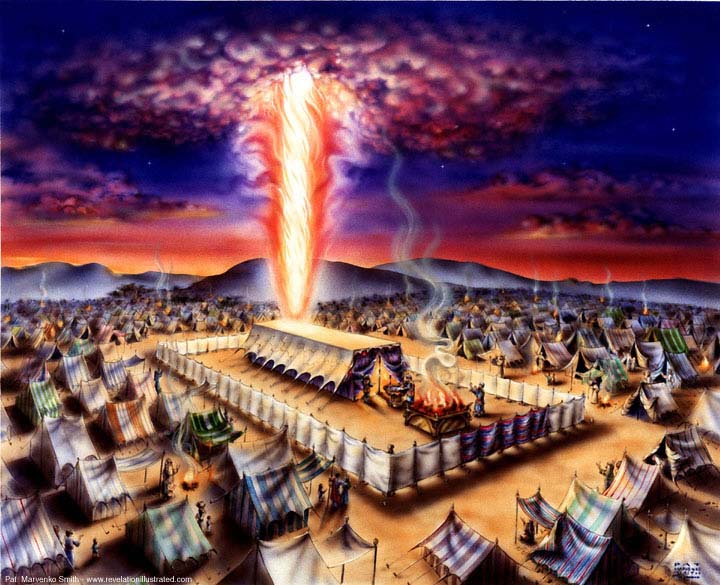
Enter into the picture the Tabernacle of Moses or mishkan, which YHVH commissioned the children of Israel toconstruct in circa 1450 b.c. at the foot of Mount Sinai. It took the Israelites about a year to build. It was the first job assignment that YHVH gave to the children of Israel after their Exodus from Egypt. The tabernacle was literally a three-dimensional gospel message tract. It was the visual demonstration of the whole salvation message of the Bible in a building—the blueprint of the plan of the redemption of wayward, sinful man. It was a functioning masterpiece of artwork demonstrating the Father’s love for his people, and of his desire to commune and to communicate with Israel—his treasured possession, those he had hand picked and called out from the 70 nations of the world. Not only did the tabernacle involve the sense of sight, but the other four senses as well: sound, smell, touch, and taste. It also engaged and even challenged the heart, emotions, mind and the spirit of man to focus on one’s need to be spiritually reconciled to his Creator. The Tabernacle of Moses was a vehicle for the Creator of the universe to communicate with man using a panoramic, multidimensional, panoply of communication devices all of which pointed to the coming Messiah, the Redeemer of mankind, who would die for the sins of the world in order to restore man into a loving relationship with his ever-loving, gracious and longsuffering Father in heaven.
This is the story of the tabernacle in which theatrical plays are present through the props of pageantry with containing costumed actors each performing his carefully choreographed role on cue. Even a child can comprehend the message of this play, yet it contains mysteries and truths so deep that only in eternity itself will they be revealed to their fullest extent to those who have been initiated into higher spiritual levels of divine revelation through the tabernacle’s symbolic and metaphorical rites and ceremonies, which were illustrative prophetic shadows of future momentous events relating to the redemption of mankind. To understand it, is to understand the message of the whole Bible from Genesis to Revelation.
Let’s now enter into the world of the Tabernacle of Moses. Welcome aboard!
The Steps of Redemption Within the Tabernacle
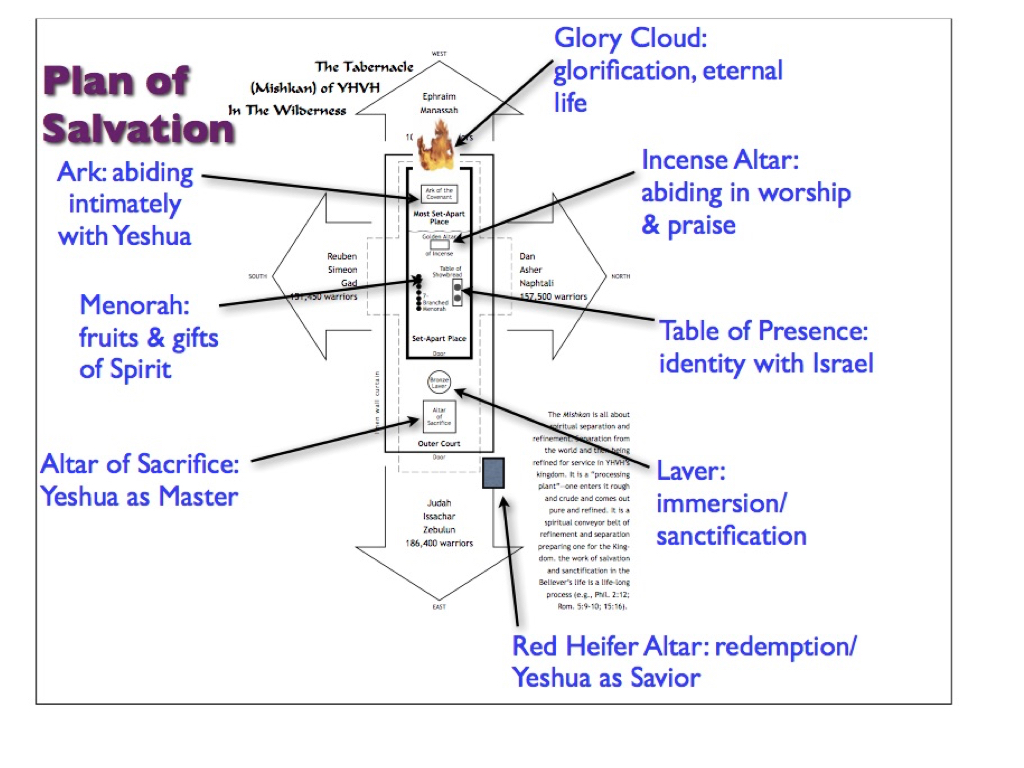
Contained in Tabernacle of Moses are seven (the biblical number signifying perfection of completion) and eight (the biblical number signifying new beginnings) progressive steps that reveal the Creator’s plan of redemption or salvation for mankind from the first step of initial salvation to becoming a glorified resurrected, immortal and forever child of Elohim.
First Step of Eight. Each of us is born in a state of separation from his Creator because all humans were cut off from Elohim due to man’s original sin. Before being reconciled to YHVH, each of us is lost and wandering about in our own personal wilderness of sin. Along the way, we suddenly come upon a beautiful site. We see the good news or gospel message, the light of YHVH’s divinely reveled Truth, the message of the cross, which is symbolized by the multi-colored door and the luminescent walls of the Tabernacle of Moses in the bleak, desolate and monochromatic desert wilderness. As one takes his first steps to become separated or set-apart from the confusion, darkness, chaos, emptiness, lostness and death of the surrounding wilderness of this world, one first encounters the altar of the red heifer located outside the tabernacle (in later years located on the Mount of Olives opposite the temple, Mishnah Parah 1:1ff). There the red heifer was slaughtered and burned and its ashes were used as a sin offering to bring about purification for uncleanness (Num 19:1ff). Yeshua was likewise crucified outside of the camp of Israel and the gates of Jerusalem (Heb 13:10–13). This altar represents the work of Yeshua at the cross. One cannot enter the tabernacle until one has been redeemed and purified by the blood of Yeshua. Even the Israelites killed the Passover lamb outside their homes on the afternoon of the fourteenth of the month of the Abib. The blood was then smeared on the doors of their homes. Once they entered the blood-smeared doors and were inside their homes, they were safe from the destroyer of YHVH, who simply passed over them. Likewise, when we enter through the gates of the tabernacle (which are crimson in color, as well as blue, white and purple—colors which point to the four Gospels and the four aspects of Yeshua’s mission as Redeemer), we do so saved and purified. This first step in YHVH’s plan of redemption is symbolized by the Passover (Pesach), which is the first of YHVH’s seven annual appointed times (or moedim).
Second Step of Eight/First Step of Seven. Upon entering the tabernacle one immediately comes to the altar of sacrifice. After the lamb was sacrificed on the afternoon of the Passover, that evening (the beginning of the fifteenth day of the first month, which was also the first day or a high Sabbath of the Feast of Unleavened Bread/Chag HaMatzot), the Israelites ate the Passover lamb. Similarly, at the altar of sacrifice the Levites would eat those animals sacrificed there. This pictures the fact that the saved believer must continue to “eat the flesh” and “drink the blood” of Yeshua to stay in communion with him (John 6:35–58), and that when one sins after one is saved they must continue in a state of repentance and overcoming through the blood of Yeshua the Lamb of Elohim (1 John 1:7–9). On that evening, one not only ate lamb, but unleavened bread after having put all leavened food out of one’s home. This pictures the believer walking forward spiritually as they are putting sin out of their life. To the degree that one eliminates sin from one’s life is the degree to which one has communion with our Father in heaven. Therefore, the altar of sacrifice in the tabernacle is a metaphorical picture of both the Passover meal and the first high Sabbath of the Feast of Unleavened Bread.
Third Step of Eight/Second Step of Seven. At the bronze laver one ritually washed in preparation for entering into service in the tabernacle sanctuary itself. This represents being baptized for the remission of sins, being washed in the water of the Word of Elohim and receiving the Set-Apart or Holy Spirit of Elohim. This corresponds with the children of Israel crossing the Red Sea and being baptized unto Moses, who was a prophetic type of Yeshua (1 Cor 10:2). This occurred during the Feast of Unleavened Bread, and most likely on the last high Sabbath of that week-long festival.
Fourth Step of Eight/Third Step of Seven. One now enters the tabernacle itself and next finds oneself at the menorah, where the light of the Spirit of Elohim shines in the hearts and minds of men. Here as one is growing in spiritual maturity, one begins becoming fruitful as they learn to walk in the fruit of the Spirit, and become empowered with the gifts of the Spirit to reach a lost world. Once separated, redeemed, washed and transformed by the Word and Spirit of Elohim, one becomes a spiritual light that is shining into this dark, lost world. Humans are the lesser light (like the moon) reflecting the greater light of the Yeshua, who is the Sun of Righteousness (Mal 4:2). This occurred for the first-century believers on the Feast of Pentecost (or Chag haShavuot).
Fifth Step of Eight/Fourth Step of Seven. Now we come to the table of show bread containing twelve loaves of unleavened bread neatly arranged in two stacks of six each. This step portends a future time when Yeshua’s people prepare themselves to meet him at his second coming. It is at this time that the awakening and reunion or regathering of the twelve tribes of Israel occur untied around Yeshua, the Bread of Life occurs. This is all pictured prophetically by the Day of Trumpets (or the Shouting or the Shofar Blast).
Sixth Step of Eight/Fifth Step of Seven. The next step of progression in the tabernacle is the altar of incense in front of the curtain that leads to another room called the holy of holies. At this step the focus is on intimacy and intercession, purity of heart, oneness and relationship with the Father through prayer, praise and worship. This speaks of thefinal redemption (jubilee) where YHVH’s people will be regathered to worship him in total freedom without the distractions of the world, flesh and the devil (who have been judged). The altar of incense and Day of Atonement (Yom Kippur) are pictures of this.
Seventh Step of Eight/Sixth Step of Seven. We have now entered the inner sanctum of the tabernacle called the holy of holies which represents the heavenly throne room of YHVH Elohim. This step speaks of total peace (shalom) and Sabbath rest during the Millennium between YHVH and his beloved saints, the bride of Yeshua. It is a time of feasting and rejoicing; a time of Torah-teaching and learning, of spiritual bread and fruitfulness. The ark of the covenant and the Feast of Tabernacles (Chag haSukkot) picture this step.
Eighth Step of Eight (Eternity Begins)/Seventh Step of Seven (perfection or completion has occurred in YHVH’s plan of salvation for man). This step pictures being totally set-apart to YHVH for eternity. This is the ultimate goal, or summum bonum of YHVH for his redeemed children. At this point the saints experience the ultimate deliverance from spiritual darkness as they are bathed in the divine and eternal light of New Jerusalem, which is the Sun of Righteousness who is the Lamb of YHVH in whom there is total light and no shadows. The shekinah glory of YHVH Elohim above the ark of the covenant signifies this glorious time of which the seventh feast, The Eighth Day (Shemini Atzeret) is a prophetic picture.
Thus, there are seven appointed times or feasts and seven steps in the mishkan, but eight steps in all picturing perfection and completion and new beginning in the New Heaven, New Earth and New Jerusalem.
Exodus 25:8, That I may dwell with them. It is the heart of Elohim—to dwell with his people that he has created in his own image. Imagine that! He wanted to dwell with Adam and Eve in the garden until their sin and rebellion cut them off from fellowship with him. In the process of time, YHVH instructed his special people to construct the Tabernacle of Moses, which contains the ways and means by which sinful humans could have their sins atoned for and come back into a right relationship with their holy Creator, so that he might again dwell with them forever. Everything in the tabernacle pointed forward to Yeshua the Messiah through whose atoning death repentant and believing humans reverse the curse of a broken relationship that Adam and Eve left in the wake of their sin. The tabernacle showed man the way back to the Father through a relationship with Yeshua, so that relationship with Elohim might once again be restored and heaven and earth might dwell together in love, harmony and peace. Those people who have made this spiritual transaction and made peace with their Creator are now the spiritual temple or dwelling place of Elohim, who lives in them by means of his Holy Spirit as both Paul and Yeshua inform us (1 Cor 3:16; 2 Cor 6:16; John 14:16–18, 26; 15:26; 16:13–14).
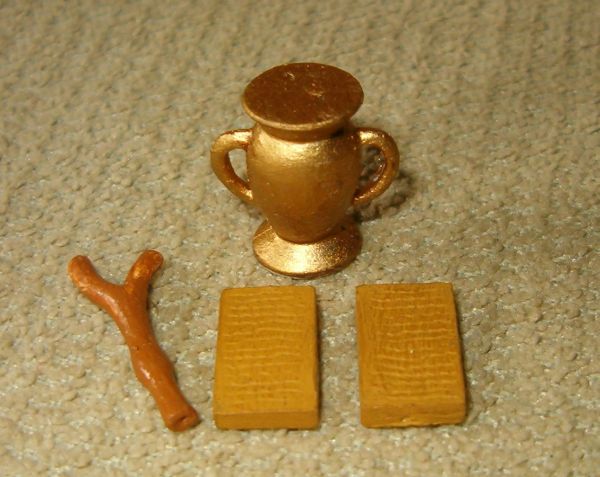
Exodus 25:10–22, Ark. The ark of the covenant was a small box of acacia wood overlaid in gold, which contained the golden pot of manna, Aaron’s rod that budded and the two tablets of stone containing the ten statements (or the Ten Commandments) of Elohim. Against the ark was leaned a scroll with the complete Torah written on it (Deut 31:26).
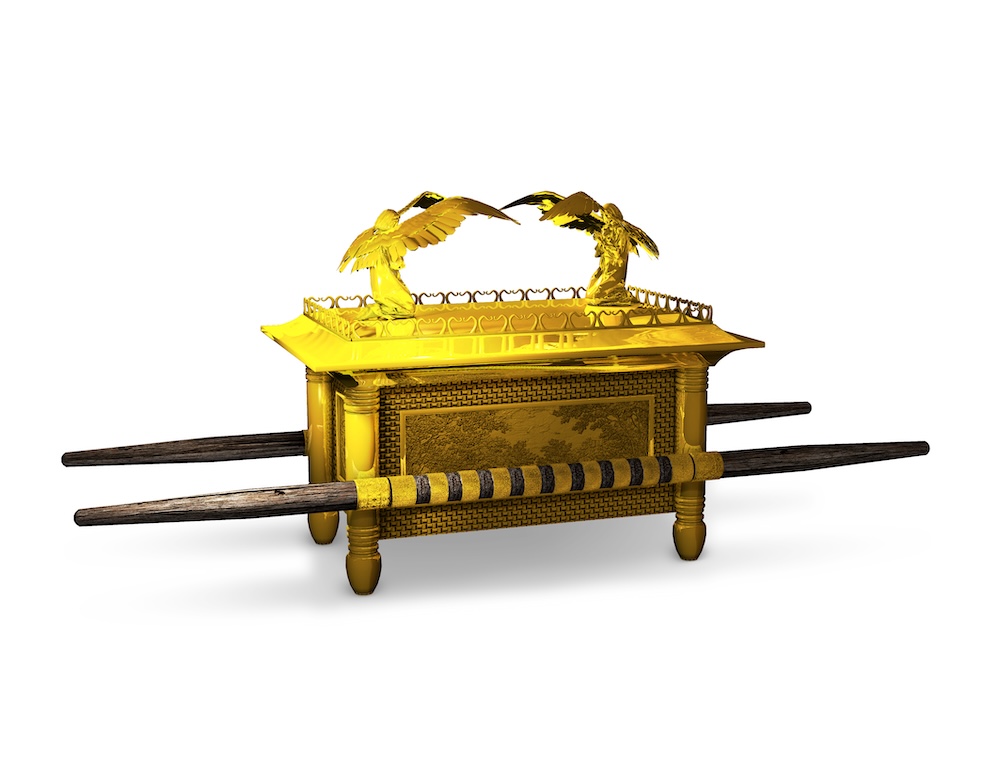
Covering the ark was a golden cap called the mercy seat or kapporet, which is related to the word kippur as in Yom Kippur, the Day of Atonement. Both words share a common Hebrew linguistic root, which is the word kapar, and which according to The Theological Wordbook of the Old Testament (The TWOT)means “to make an atonement, make reconciliation or purge.” Thus the mercy seat or the golden “lid” covering the ark of the covenant located in the holy of holies or d’veer (i.e., the inner shrine of the Tabernacle of Moses) in Hebrew is the word kapporet. This was “the place of atonement or the place where atonement was made.” The TWOT defines what happened at the kapporet as follows:
“It was from the…mercy seat that [YHVH] promised to meet with the men [of Israel] (Num 7:89). The word, however, is not related to mercy and of course was not a seat. The word is derived from the root ‘to atone.’ The Greek equivalent in the LXX is usually hilasterion, “place or object of propitiation,” a word which is applied to [Messiah] in Rom 3:25. The translation ‘mercy seat’ does not sufficiently express the fact that the lid of the ark was the place where the blood was sprinkled on the day of atonement. ‘Place of atonement’ would perhaps be more expressive.”
The mercy seat covering the ark that contained the Torah is a vivid symbolic picture of YHVH’s mercy triumphing over his judgment against man’s sin (Jas 2:13). Each of us deserves death for violating YHVH’s commandments, for the wages of sin is death (Rom 6:23), and sin is the violation of YHVH’s Torah commands (1 John 3:4). Yet when we repent of our sins and place our faith in Yeshua’s atoning death on the cross as payment for those sins, YHVH forgives us and grants us his merciful grace.
Everything in, on and around the ark pointed to Yeshua, who is man’s Savior and Redeemer. Inside the ark was the golden pot of manna, which points to Yeshua who the bread of life—the Word of Elohim made flesh. Aaron’s rod that budded speaks of Yeshua’s role as man’s ultimate heavenly High Priest thanks to his atoning and life-giving work at the cross. The two stone tablets and the Torah scroll prophetically point to Yeshua, who was the Word of Elohim from the foundation of the world (John 1:1, 14), and whose words or instructions in righteousness the saints are instructed to follow (John 14:15; 1 John 2:3–6; Rev 12:17; 14:12).
Overshadowing the mercy seat were two golden cherubim with outstretched wings. This is a prophetic picture of YHVH’s throne in heaven, which is surrounded by cherubim and other living creatures that sing his praises and minister to him non-stop (Rev 4).
The ark of the covenant is the gold-covered acacia wood box with the pure gold crown or mercy seat upon which are the two gold cherubim that represented the very throne and glorious presence of YHVH himself. Inside the box were the tables of the Torah, Aaron’s rod that budded (Num 16) and the golden pot of manna (Exod 16:32–34). Against the ark was leaned a scroll of the complete Torah (Deut 31:26).
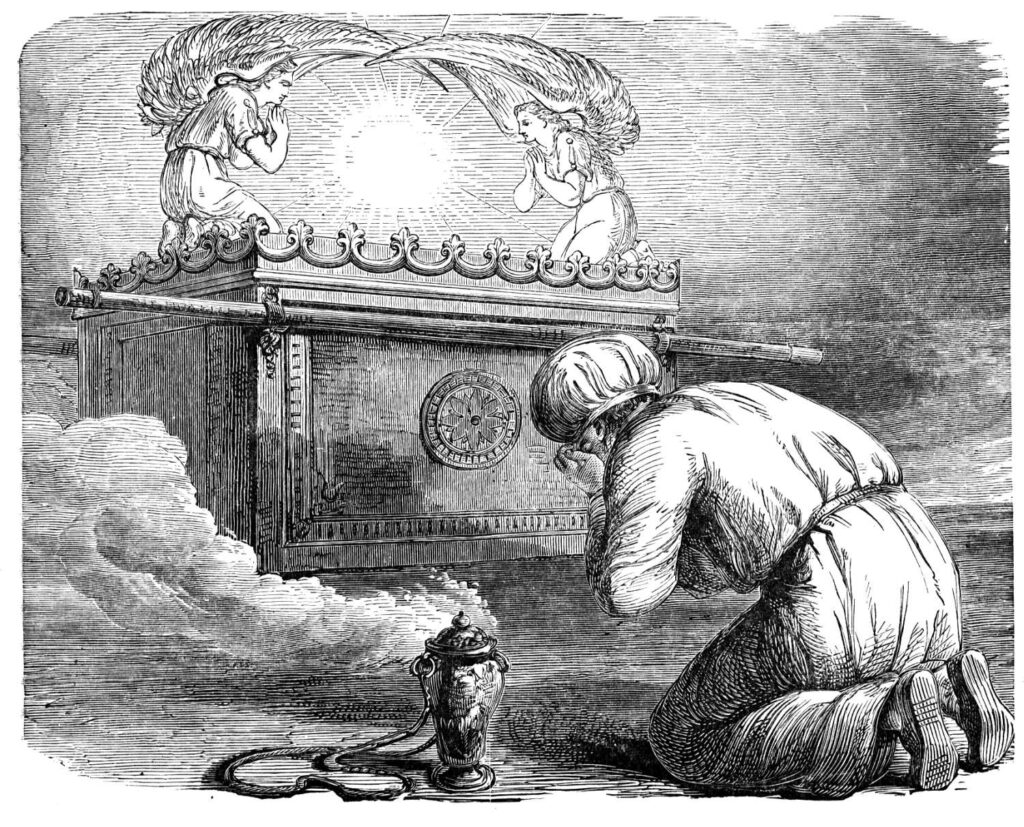
Once a year, on the Day of Atonement, the high priest entered this innermost room of the tabernacle to make atonement for his sins and those of the nation of Israel (Lev 16:14–19). The most set-apart place was also called the oracle (Heb. dveer), for it was here that YHVH often met with and talked to Moses giving him instructions on how to govern the Israelites (e.g., Exod 25:21–22).
The gold-covered wooden ark of the covenant box prophetically symbolizes resurrected and glorified humanity raised to that place of holy perfection and purity by the work of Yeshua and the mercy of YHVH. Two spiritual realities characterize the resurrected and glorified saints of Yeshua. They are spirit and truth (John 4:23); namely, the truth of Torah of the Written Torah (the box contained the two stone tablets) and that of Yeshua the Living Torah who is the Manna or Bread of Life. In addition, Aaron’s rod that budded (also in the ark of the covenant box) pictures the authority and fruitfulness of the royal priesthood of believers (2 Pet 2:5-9) through the work of Yeshua on the cross (see also Rev 11:17; 12:14). Additionally, the Torah scroll leaning up against the ark illustrates to us that without total dependence on Yeshua (i.e., his work at the cross and partaking of the spiritual manna of Yeshua’s broken body) we cannot properly obey YHVH’s Torah. Only with Yeshua living in the heart of a regenerated believer by the power of his Spirit can one keep YHVH’s Torah-word. Without the Torah leaning on Yeshua, the Torah becomes the dead letter of the law (2 Cor 3:6)!
Furthermore, as the high priest sprinkled the mercy seat with blood seven times on Yom Kippur even so Yeshua when redeeming man bled seven times: once at Gethsemane, once from the scourging, then from the crown of thorns, from the nail in the left hand, the nail in the right hand, the nail in the feet and finally from the spear in his side.
Exodus 25:21, The testimony. This is the Torah in written or codified form or what became known biblically as “the Book of the Law of Moses” (Josh 8:31) or simply “the Law of Moses” (Josh 8:31; 1 Kgs 2:3; Ezra 3:2; Neh 8:1; Dan 9:11; Mal 4:4; Luke 2:22; John 7:23; Acts 13:39; 1 Cor 9:9). In the eyes of Yeshua and Luke, the author of the Books of Acts, the terms “the Law of Moses” is synonymous with the first with the first five books of Moses (Luke 24:44; Acts 28:23) which is synonymous with the Torah. Thus terms the Torah, the Book of the Law of Moses and the Law of Moses are different ways of saying the same thing.
Prior to being written down, the Torah was merely YHVH’s oral instructions to men passed on down from teacher to student or from father to son. In fact, the primary definition of the Hebrew Torah is “instructions, teachings or precepts.” In fact, concretely at its verbal root, this word is pictures a teacher pointing to his students and teaching them something. Linguistically, “law” is not the primary definition of the word Torah!
So Moses, under instructions from Elohim, wrote YHVH’s oral instructions or Torah down as it was transcribed to him on Mount Sinai (Exod 24:12) and to which additions were made on an as-need basis as YHVH subsequently spoke to Moses his earthly habitation in the tabernacle’s holy of holies (Exod 25:22).
Exodus 25:22, There I will meet with you. Between the two cherubim was the glowing, anointed, manifest presence of YHVH often referred to by the Hebrew word shekinah, although this word is not actually found in the Bible. The holy of holies was the earthly throne room of Elohim. It was also prophetically pointed to the glories of the New Jerusalem, which is, in reality, heaven on earth.
The manifest presence of Elohim is the last of seven “items” or, more correctly, areas in the tabernacle that point to spiritual realities in the life of the redeemed believer. The manifest presence is also the one ingredient that is missing in all the other religions of the world. Yes, many of the world’s false religions have their signs, wonders and supernatural experiences, but these are cheap demonic counterfeits and imitations of the real thing—the actual presence of the Almighty Creator—Yehovah Elohim. In the end, despite all that these false religious systems promise, they bring shame, confusion, guilt and eventual death and eternal separation from man’s Creator.
In the Tabernacle of Moses, the first six items were made with human hands. Six is the number of man. The seventh “item” is the presence of YHVH, which YHVH’s neither be fabricated by the hand of man nor conjured up in his imaginative, fairy tale philosophies. YHVH divine presence is not virtual reality; rather it transcends anything that is earthly and physical. Those few humans who have experienced a small taste of YHVH’s presence know the difference between the false and real! Coming in YHVH’s presence is a result of repentance, holiness, obedience and humans seeking Elohim with all one’s hearts, while following the protocols he has laid out, which, when followed, lead to him. There is no other way.
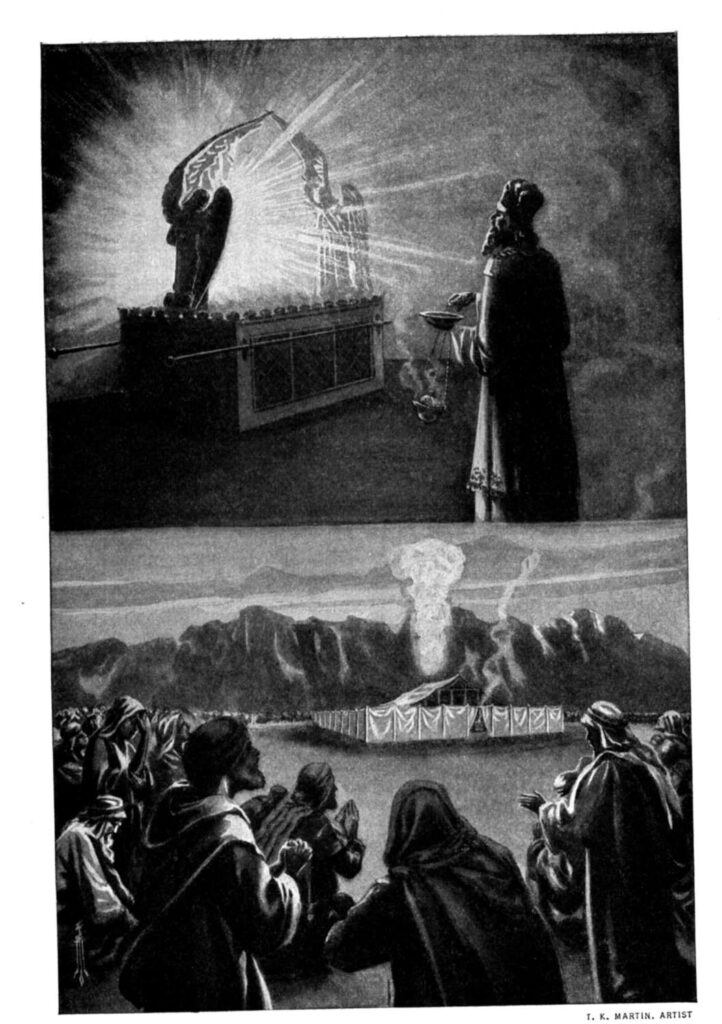
Moreover, the presence of Elohim is what is missing in every other of the world’s religious systems. It was even missing in the Second Temple of the Jews, and it is missing in rabbinic Judaism to this day. So why would anyone want to follow a powerless religious system that is devoid of the presence and glory of YHVH Elohim?
In YHVH Elohim’s presence, a human is miraculously and powerfully changed and transformed spiritually from the inside out. Despite man’s countless, tireless and innovative efforts and often curious ways to circumvent this process, there is no other way, except the way of the tabernacle.
Your way, O Elohim, is in the sanctuary; Who is so great a Elohim as our El? (Ps 77:13)
One thing I have desired of YHVH, that will I seek: that I may dwell in the house of YHVH all the days of my life, to behold the beauty of YHVH, and to inquire in His temple. (Ps 27:4)
So I have looked for You in the sanctuary, to see Your power and Your glory. (Ps 63:2)
There I will [Heb. ya’ad] meet with you…I will commune [Heb. d’bar]…I will give you. This entire verse is pregnant with spiritual meaning relating to the holy of holies, which was YHVH’s point of contact between heaven and earth. From this place he desired to meet with Israel, to speak with them, and to give them all of his written instructions or commandments, that is, his Torah-instructions. The holy of holies is an earthly shadow picture of YHVH’s heavenly sanctuary—the “true tabernacle” after which the Tabernacle of Moses was merely an earthly pattern or “a copy and shadow of heavenly things” (Heb 8:2, 5; Heb 9:23–24). Heaven’s tabernacle is “the greater and more perfect tabernacle not made with hands” (Heb 9:11) Beyond this, to what did the Tabernacle of Moses point? (See Rev 8:1–5; 9:13; 11:19.) In the Tabernacle of Moses, Elohim promised to commune with or speak to his people from above the cherubim, whose golden wings arched over the mercy seat. Again, this is an earthly copy of heaven’s Elohim’s heavenly throne room (Rev 4:1–11).
The word mercy seat or kapporet was in reality an ornate lid or cover for the ark of the covenant. Its more accurate name according to the Hebrew is “place of atonements,” for it was here, on the Day of Atonement (Yom Kippur), that the high priest sprinkled blood from the altar of sacrifice to make atonements (plural) for his sins as well as for those of his family members as well as the entire nation of Israel. The ark of the covenant and its mercy seat lid represented the throne of Elohim in heaven. Only the high priest was allowed into the holy of holies. The redeemed saints of Yeshua are now the new, non-Levitical priesthood (1 Pet 2:9; Rev 1:6; 5:10). Believers who are in a personal relationship with Yeshua the Messiah are now permitted access into heaven’s holy of holies, so that they may commune or speak with him their Father in heaven (John 14:6; Heb 10:19–22; also 4:14–16; 9:11–28).
In the Tabernacle of Moses, there was a veil or curtain separating the holy place from the holy of holies that prevented the regular priests from entering the latter. In a spiritual sense, through Yeshua’s atoning death on the cross, that veil has been ripped open, so that the redeemed of Yeshua can now go directly into heaven’s holy of holies, where the presence of YHVH Elohim abides. There they can converse with their heavenly Father through communicative prayer and through the meditative study of his Written Word (Heb 10:19–22 cp. Pss 27:4; 63:2).
Prayer is one of the ways by which we can come into the presence of Elohim. When we pray, Yeshua instructed his disciples to pray to their Father in heaven (See Matt 6:9). When Yeshua’s disciples enter into the presence of our Father in heaven through prayer, these prayers are like sweet incense (Rev 8:3–4). Praise and worship is another way by which the saints can enter into the presence of Elohim (Pss 100:4; 116:17.) When YHVH’s people praise him, he is pleased to find a place among them (Ps 22:3).
But thou art holy, O thou that inhabitest the praises of Israel. (Ps 22:3, KJV)
But You are holy, enthroned in the praises of Israel. (Ps 22:3, NKJV)
The holy of holies was the place where YHVH met with his people through Moses and Aaron the high priest. Now, by the blood of Yeshua because of the spiritual relationship that the saints have with him, they are able to come boldly, as YHVH’s children, before the mercy seat of his heavenly throne. This they do through prayer, praise and worship. This is now how one communes and meets with Elohim, and how he does the same with his people.
This is what YHVH meant by the first clause in this verse: “There I will meet [Heb. ya’ad] with you” (Exod 25:22). The Hebrew word for meet is ya’ad meaning “appoint; fix, assemble, betroth or gather.” It is Elohim’s intentional desire and design to meet with his people above the mercy seat, or place of atonements, which is where the blood of the sacrificed animal was sprinkled, and the incense from the golden censor was released by the high priest. This was a place of divine appointment where man and his Creator met.
And there I will meet with you, and I will speak with you from above the mercy seat, from between the two cherubim which are on the ark of the Testimony, about everything which I will give you in commandment to the children of Israel. (Exod 25:22)
Man was expected to come here for an appointed meeting, and Elohim promised to meet man there. As noted above, Yeshua is our Great High Priest who, through his shed blood atonement for our sins, opened the way for us to enter into the very throne room of the Father—something the ceremonial rituals of the Tabernacle of Moses prophetically portended.
The holy of holies was an earthly picture of Elohim’s throne in heaven. It is through the blood of Yeshua and the grace of Elohim that the redeemed saint can now come before Elohim’s heavenly throne (Heb 4:16), and offer up their the sweet smelling incense of our prayers, praise and worship (Rev 5:8–10; 8:1–4).
The Hebrew word ya’ad is the root and verb form of this Hebrew word, while mo’ed is noun form of the same word. Mo’ed means “divine appointment.” The word feasts in Leviticus 23:1–2 is the word mo’edim, which is the plural form of mo’ed. YHVH has given us his seven feasts, which he calls divine appointments, and it was then that he promised to meet with his people on a corporate level (Lev 23:1–44). Observing these feasts, like coming into the holy of holies, is yet another way to commune or meet with our Father in heaven, to hear the voice and to receive the instructions in righteousness of the One in heaven, who sits on the throne of mercy surrounded by the cherubim.
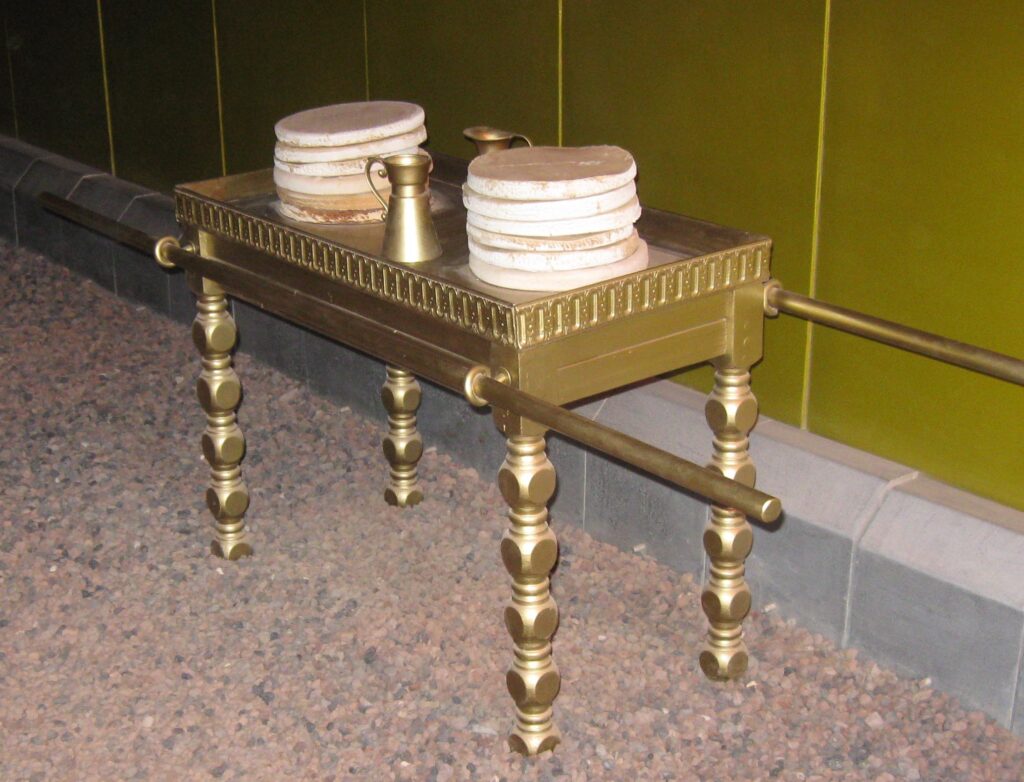
Exodus 25:23, A table of acacia wood. The table of showbread or the table of the presence. On the right side of the tabernacle opposite the menorah was the table of showbread. It was constructed of acacia wood overlaid in gold, which speaks of the two-fold nature of Messiah—both human and divine, with a crown of gold, which metaphorically points to Yeshua being the head of the body his redeemed followers. How is this? On the table were placed twelve loaves of bread representing the twelve tribes of Israel in communion with each other and YHVH. The twelve loaves represent the whole house of Israel fellowshipping around Yeshua, the Bread of Life. These loaves were replaced with fresh loaves every Sabbath (Lev 25:5–9), and it is on the seventh day Sabbath when YHVH gathers his saints in fellowship with one another and in worship of him. The showbread is also called the bread of presence, for the term showbread in the Hebrew literally means the bread that is “in front of, before or in the face of” Elohim.
The golden table with 12 loaves of unleavened bread in two-stacks baked fresh weekly and replaced on the Sabbath represents the whole house of Israel in fellowship or communion with one another and their Creator. Yeshua is the bread of life that all must eat to have relationship with him (John 6:32–35, 53–58). This table is a prophetic picture of Yom Teruah (the Day of the Shofar Blowing or Shouting) that announces the arrival of the Bridegroom (Yeshua at his second coming) to meet his bride (the saints who have spiritually prepared themselves). This marks the moment when Israel will begin to be regathered, the two sticks representing the two houses of Israel will rejoined (Ezek 37:15–28) at Yeshua’s second coming and afterwards into the Millennium.
The table of showbread was again made of acacia wood overlaid in gold, which symbolically represents the two-fold nature of Messiah Yeshua (both human and divine) as well as the two-fold nature of redeemed man (both physical and spiritual being who are being transformed into the image and righteousness of Yeshua). Upon the table were two stacks of six unleavened bread loaves each representing the two houses Israel (Judah and Ephraim) showing that both houses were equal in YHVH’s view, and both will eventually be redeemed, reunited and deleavened spiritually from the influences and effects of sin.
Scripture refers to this sanctuary furnishing in some places as the table of showbread (hashulcan lechem panim) or literally the table of the bread of the presence and in other places as just the showbread or lechem hapanim, which literally means “bread of the presence.” Fresh bread was placed on this table each Sabbath (Lev 24:8). This speaks of intimate communion between YHVH and his people Israel—both houses united in Yeshua and meeting with him on the Sabbath where the fresh bread of the Word of Elohim is to be broken. (Consider the following Scriptures in this light: 1 Pet 2:3, 5, 9; John 6:32–58; Lev 23:3; 1 Tim 3:15; Heb 10:25.)
The bread, which represents the body of Yeshua, was made of fine flour and sprinkled with frankincense. Frankincense is both sweet and bitter. Yeshua’s life was bitter so that redeemed believers might enjoy the sweetness of redemption and become a sweet fragrance to YHVH.
The Scriptures do not specifically state that the bread on the table of the presence was unleavened. However, early Jewish tradition states that it was (see Josephus’ Ant. iii.6.6 [143]).
It is possible that the showbread could have been leavened as were the two loaves offered on Shavuot, and the bread of the peace offering (Lev 7:13). If they had been, then it is unlikely that they would be a picture of Yeshua who was the sin-free as symbolized by the unleveaned bread sin offering.

Exodus 25:31–39, Menorah of pure gold. The seven-branch candelabra called the menorah was beaten out of a solid ingot of pure gold and stood on the left side of the holy place inside the tabernacle. It was the only light in the tabernacle’s holy place. The menorah had seven branches with three on either side of a central stem. Each branch had three decorative cups, a knob and a flower resembling that of an almond blossom. The cups were called lamps and each was filled with the purest olive oil and contained a wick that was lit. The menorah was lit each day, and each of the six outer lamps were designed so that when lit its flame pointed toward the central stem. The menorah had tools including tongs and spoons to tend the wick. These implements were used to clean and to prepare the lamps and to remove the previous day’s ashes.
The menorah is a prophetic picture of Yeshua, the Tree of Life, who likened himself to a vine and his followers to branches (John 15:1–7). It also pictures the idea that the saints are members of the body of Yeshua (1 Cor 12:12), and are established in him (2 Cor 1:21). His followers are connected to him, draw sustenance from him, and the spiritual light of their lives point toward him in all that they do. Believers are to be “on fire” for doing the work of Yeshua. The Spirit of Elohim directed by the Torah—both pictured by the olive oil—fuels that fire. On the Day of Pentecost in Acts chapter two, the believers in the upper room received fire of YHVH’s Spirit and had his Torah-law written in their hearts. Through the empowerment of the Spirit—both the fruits and the gifts—the saints were able take the light of the gospel to the world. Proof of the saints’ mission to spread the light of Yeshua’s gospel to the world is punctuated by the fact that the menorah (not the cross) is the biblical symbol for Yeshua’s church of believers (Rev 1:12, 20) who are to be like lights on a hill (Matt 5:14).

While the menorah represents the tree of life, the menorah’s oil represents the Spirit of Elohim in the life of the disciple of Yeshua. It also represents Yeshua the tree or vine with believers as the branches grafted in to the “trunk” of the tree or Yeshua and receiving the Spirit of life from him. As a result of Yeshua’s Spirit in the saint’s life, the fruits and gifts of the Spirit of Elohim will shine like a menorah on a hill into the surrounding darkness of this world. Gold represents the pure (divine) character of Yeshua as well as that of the believer whose character is being transformed and refined. Prophetically the menorah points to the Day of Pentecost or Feast of the Harvest of First Fruits (Shavuot), when the Spirit of Elohim was poured out upon YHVH’s people and the Torah-law was written on their hearts empowering them to walk in the paths of Torah-light/righteousness (Ps 119:105, 172) and to share the good news or gospel with others.
It is estimated that the menorah was constructed of 90 pounds of gold, which is 1440 ounces. If gold is $4,000 per ounce the menorah would have been worth $5.76 million in the value of the gold alone, not including the workmanship to construct it.
Some scholars believe that the light of the menorah was angled to point only forward, and it was the only light in the holy place. If the menorah represents the saints, then its placement suggest that the saints are to go forward in their spiritual walk, not backward. When one follows the light, they are moving forward. To walk back is to walk into the darkness.
The almond tree after which the menorah is patterned is the first fruit tree that blossoms in the spring in Israel. Similarly, Yeshua is the firstborn among many brethren.
The seven branches of the menorah, which are a picture of Yeshua, corresponds to the seven spirits of YHVH in Isaiah 11:2 and Revelation 4:5.
As should be clear by now, the menorah contains multiple and often overlapping layers of spiritual symbolism.
The wicks of the menorah were made from the priests’ worn out or discarded garments. From this we learn that we cannot discard the work of yesterday’s servants of Yeshua, for we stand on their shoulders and use the truth they have taught us to light the spiritual path ahead for us. So what legacy are leaving behind for those who are following us?
Matthew Henry says in his biblical commentary on Exodus 27:20 that the pure oil signifies the gifts and fruits of the Holy Spirit, which all believers receive from Yeshua the Messiah who is the oil-anointed One. Messiah is the vine to which we are attached, for we are the arms and branches (John 15:1–2) and the branches are attached to the sustenance-carrying vascular system of the main trunk (as pictured by the hollow-tubed seven-branched gold menorah). Again, the menorah is another picture of Yeshua who is the tree of life to which each redeemed believer must be attached. Only then will we be lights shining the fruits and gifts of the Spirit into the darkness of men’s lives as Yeshua commanded us to be (i.e., menorahs on a hill, Matt 5:14–16). That is why the symbol of the elect body of believers is the menorah as we see in Revelation 1:13 and 20.
Exodus 26
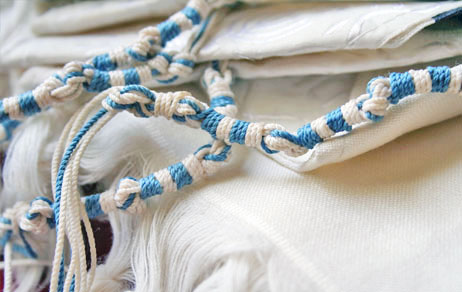
Exodus 26:1, Blue [tekelet] yarn. The blue used in the construction of the Tabernacle of Moses was a special type of blue called tekelet blue which is akin to sky blue—a heavenly color that reminds us of our Father in heaven. This was also the same color as the tzitzits or fringes that YHVH commanded the Israelites to wear on the fringes of their garments to remind them of their covenantal agreement with Elohim and to obey his commands (Num 15:37–41).
The tekelet blue tzitzits also reminded the Israelites of the tabernacle, which contained the seven steps of the YHVH plan of salvation for man, which all symbolically and prophetically pointed to Yeshua the Messiah who would come in the course of time as man’s Redeemer or Savior.
Additionally, the veil separating the tabernacle’s holy place and the holy of holies as well as the main door of the tabernacle itself contained tekelet blue (Exod 26:31, 36).
Wearing the tekelet blue fringes also called to the Israelites’ attention their special relationship with Elohim. How was this? Because they were wearing heaven’s colors, and through their spiritual relationship with him, through the Messiah, they would not only be permitted to wear the colors of YHVH’s earthly and heavenly abode, but could actually become his earthly abode as human temples of his Holy Spirit (1 Cor 3:16; 2 Cor 6:16).
The word tekelet is used nearly 50 times in the Tanakh and almost always refers to the colors used in the tabernacle and later the temple, as well as to the special blue used in the priestly garments. It was also the royal blue of kings (1 Chron 2:7; Est 1:6; 8:15).
This blue, according to Jewish tradition came from a sea animal in the Mediterranean called the chillazon. The problem is that no one now knows the identity of this animal. To this day, some rabbinic experts think this blue derives from a marine mollusk, while others thing it was from a squid. Whatever the case, this special blue was highly prized by ancient royalty. It is therefore fitting that this should be the color of heaven and of the King of kings, and that his children should wear it as a badge of honor identifying themselves as the children of the Almighty King, YHVH Elohim.
Although, tekelet is the only word for blue found in the Tanakh, in the modern Hebrew dictionary, which is based largely on ancient Hebrew, tekelet is a specific shade of blue—azure, turquoise or even a purplish or violet blue. This is in contradistinction to kachol, which is the more generic word for dark blue or b’hiyl, which is the word for light blue.
Every place in the Scriptures were blue is used, it is this special shade of sky, turquoise or azure or tekelet blue. For example,
- YHVH asked the Israelites to donate tekelet blue cloth for the tabernacle’s construction (Exod 25:4).
- The curtains of the tabernacle contained tekelet blue (Exod 26:1, 4).
- The veil separating the holy place and the holy of holies contained tekelet blue (Exod 26:31).
- The veil separating the holy place and the holy of holies contained tekelet blue (Exod 26:31).
- The outer door of the tabernacle contained tekelet blue (Exod 26:36).
- The priestly garments (Exod 28:5, etc.).
- The coverings for the tabernacle implements when being transported (Num 4:6, etc.).
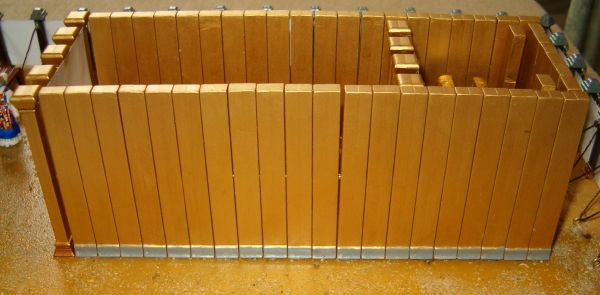
Exodus 26:15–30, Boards. The wooden boards that formed the vertical walls of the Tabernacle of Moses are easily overlooked for the more elaborately ornamented central furnishings of the tabernacle such as the alter, menorah and ark of the covenant. Yet upon closer analysis, the very boards that form the tabernacle’s walls are full of rich symbolic significance that speak of the redemption, salvation, righteousness that defines who the saint through Yeshua truly is. Let’s explore this oft neglected subject.
The walls of the tabernacle were constructed of vertical boards (20 on a side and 6 on the back) and were made of acacia wood covered in gold. The remained upright thanks to heavy silver bases in which they were set. The boards were held upright also thanks to five horizontal acacia wood bars also overlaid in gold that ran the length of the walls. The boards standing tall speak of YHVH’s upright saints. For example, Jeshurun meaning “upright” was a symbolic name for Israel (Deut 32:15; 33:5; 33:26; Isa 44:2). YHVH’s people are called to walk upright or righteous lives are called to be the temple of YHVH (1 Cor 3:16; 6:19; 2 Cor 6:16) as well as spiritual to be like spiritual pillars in YHVH’s eternal New Jerusalem temple (Rev 3:12).
There is no end to the symbology in the Tabernacle of Moses. Wood overlaid with gold in silver bases is symbolic of redeemed humanity with the divine nature of Yeshua. It also speaks of the two-fold nature of Yeshua who was both human and divine. The five wooden bars prophetically symbolize the five-fold ministry of apostles, prophets, evangelists, shepherds and teachers for the edifying or building up and perfecting of the saints—the body of Yeshua (Eph 4:11–13). Five can also refer to the five books of YHVH’s Torah—his instructions in righteousness, which shows believers how to walk uprightly before YHVH.
As already noted, the boards of acacia wood overlaid in gold formed the walls of the sanctuary. The boards stood vertically and were held upright by five long rods running the length of the sanctuary through rings on the outside of the boards. Each board was set in a silver base weighing approximately 125 pounds. Silver is a biblical metaphor for redemption. Wood represents humanity while gold coupled with silver speaks of redeemed humanity covered in righteousness reflecting the divine nature of YHVH. Man stands firmly on the foundation of Yeshua’s redemptive work at the cross. Redeemed men are no longer prisoners to sin and Satan, but were purchased or redeemed by the price of the precious blood of Yeshua (1 Pet 1:18–19). This means that the blood-bought saint now legally belongs to Yeshua the Messiah.
Exodus 26:31, Blue. Heb. tekelet. (See notes at Exod 26:4.)
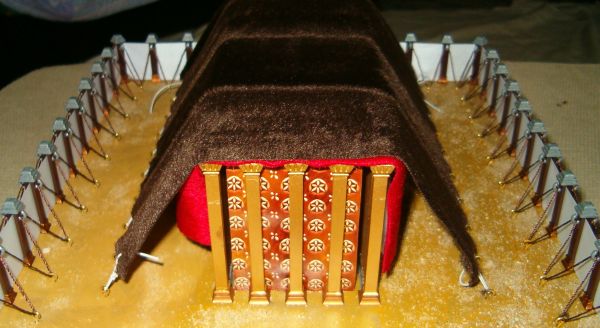
Exodus 26:36–37, Door of the tent. As with every other part of the Tabernacle of Moses, the door is rich is rich in symbolic and prophetic significance all pointing to Yeshua the Messiah and relating to the glorious message of the gospel in its full ramifying panoply.
This second of the three tabernacle doors or curtains had the same colors as the door to the outer courtyard (blue, crimson, white and purple) and was also woven of fine linen. This door was the same similar in size to the tabernacle’s outer door, though it was a different dimension than the first door, for it was taller and narrower. This teaches us that the view of Yeshua becomes higher, and the way to the holiest place becomes narrower and the requirements become more stringent as one draws closer in proximity to YHVH’s glorious presence. As one grows and matures spiritually, the way of life, the path of righteousness and the way to intimacy with the Father gets narrower and the standards are elevated.
Five wooden pillars covered in gold supported by bronze bases held the curtains up. As with the wooden board walls of the sanctuary, the wood-covered gold speaks of the righteousness of the saints. Bronze symbolically represents Elohim’s judgment, while the five upright posts can speak of both the five books of YHVH’s Torah as well as the five-fold ministry. The Torah forms the basis for YHVH’s instructions in righteousness, while it is the divinely commissioned role the apostles, prophets, evangelists, shepherds or pastors and teachers are to instruct the saints in the Truth of YHVH’s Torah so that the saints will unified as they become like Yeshua (Eph 4:11–13), who himself was the physical embodiment of the Torah or the Living Torah-Word of Elohim who was made flesh (John 1:1, 14). The five-fold ministry is like a hand pointing the way to Yeshua. How is this? The apostle is like the thumb. The other fingers cannot work properly without it. It has more flexibility than the rest and can do things that the others cannot do. The prophet is like the index finger and points out people’s faults and then points people in the direction that they are to walk in. The evangelist represents the middle finger which extends or reaches outward the farthest to bring people to YHVH. The shepherd (or pastor) is the finger on which the marriage ring is placed. This speaks of the gentleness and love of the gospel message. The teacher, like the little finger that can fit into small places to dig stuff out (e.g., one’s nose and ears) digs out nuggets of truth in hard to reach places in the Scriptures—the word of Elohim.
Again, the five pillars were made of acacia wood overlaid in gold, which speaks of both Yeshua’s humanity and his divinity. The pillars were set in bases of bronze which symbolically signify YHVH’s righteous judgments. Every human will eventually stand before the judgment seat Yeshua who will determine their rewards in the afterlife based on their works whether they were good or bad (2 Cor 5:10).
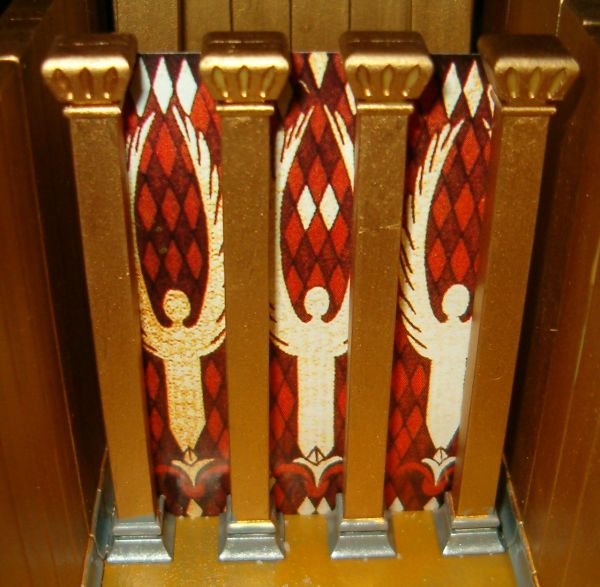
Exodus 26:31–37, A veil. The veil or parochet was another door-like curtain that divided the holy place and the holy of holies. It was woven of fine linen of the same four colors as were the previous two curtains—blue, crimson, purple and white, except this veil had cherubim embroidered into it. The holy place was a picture of returning to the Garden of Eden, which had cherubim guarding its entrance (Gen 3:24), except the saints’ ultimate destiny will not be the Garden of Eden but the city-garden of the New Jerusalem in the new heavens and new earth.
It was this same veil that was rent from top to bottom in the second temple in Jerusalem at the time of Yeshua’s crucifixion (Matt 27:51). The writer of the Epistle to the Hebrews teaches a correlation between the tearing of Yeshua’s flesh on the cross and the tearing of the veil, and that this event opened the way for believers to be able to enter into the most set-apart place and to come boldly before the throne of Elohim through the shed blood of Yeshua (Heb 10:19–22 cp. 4:14–16).
This veil to the most set apart place(also known as the oracle or deveer) contained the four colors of the other two veils: crimson, blue, purple and white. Unlike the other doors or veils, this veil had embroidered cherubim on it. It hung on four pillars of overlaid gold acacia wood. The pillars were set in bases of silver with the curtain hanging by rings of gold.
This veil is what separated men from the manifest and glorious presence of Elohim. At Yeshua’s death when the veil in the temple was split from top to bottom (Matt 27:51) this symbolically opened the way for his redeemed saints to be able to enter the holy of holies by and through the redemptive work of Yeshua on the cross (Heb 10:19–22).
Exodus 26:36, Blue. Heb. tekelet. (See notes at Exod 26:4.)
Exodus 27
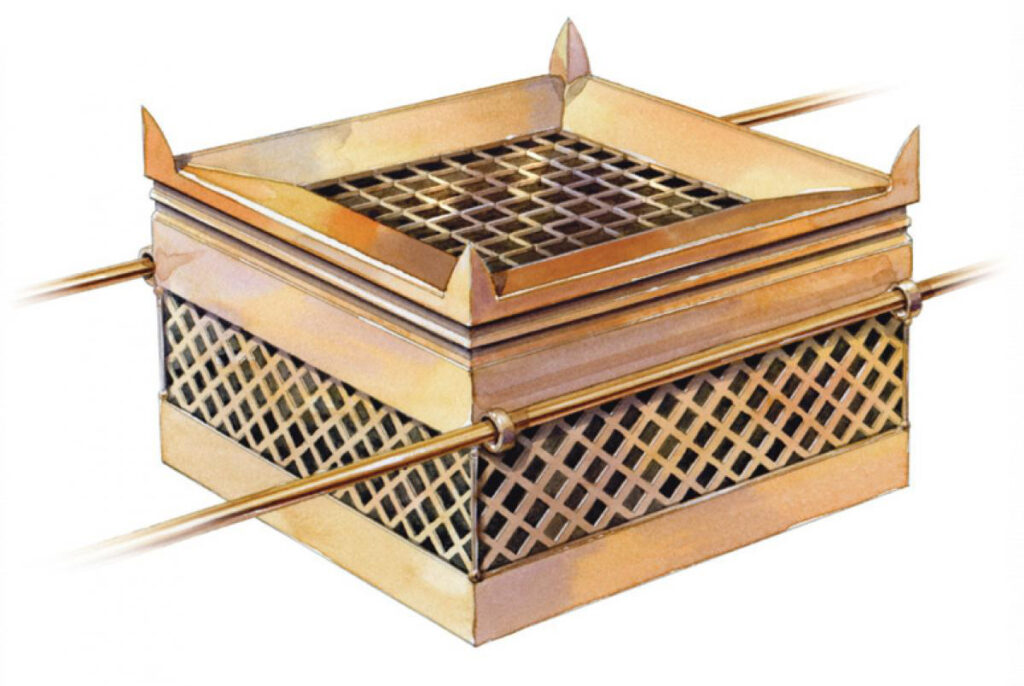
Exodus 27:1–8, An altar. As we continue our tour of the Tabernacle of Moses, the Torah takes us next to the bronze altar of sacrifice located just inside the tabernacle’s door. Everything occurring in the tabernacle revolved around this altar—EVERYTHING! This is the first furnishing that one encounters when entering the tabernacle’s outer courtyard. This is highly significant prophetically and spiritually. Why? This is because that altar of sacrifice points to the “altar” of the cross on which Yeshua the Messiah died as an atonement for our sins. This is one truth that the mainstream Christian church has gotten wonderfully right; namely, the cross and what happened there is the central point of the gospel message. This is an inescapable truth that is presented in the Testimony of Yeshua.
The altar of sacrifice’s construction, like all of the other furnishings in the tabernacle, was highly symbolic. It prophetically tells a story that in every way it points out attention to the redemptive work that Yeshua would accomplished through his death on the cross some 1,5000 years later. Let’s explore this first of seven tabernacle furnishings piece by piece. First, it was made of acacia wood overlaid with bronze, which is a prophetic picture of Yeshua the Messiah the man (symbolized by the wood) bearing the judgment (symbolized by the bronze) for men’s sins on the cross. Next, the blood of the sacrifice was poured out on the ground at the base of the altar symbolically picturing Yeshua shedding his blood at the cross. Third, two lambs were offered on the altar daily morning and evening (Exod 29:38–42). This pictures the saint’s need to come humbly before our Father in heaven morning and evening in prayerful and worshipful devotion as living sacrifices (Rom 12:2) to confess our sins, to praise and thank him for saving us from the penalty of our sins, which is death (Ps 51:16–17; Heb 13:15; 1 John 1:7–9; Rom 6:23).
Let’s now dig deeper into man’s sin issue and how it was symbolically at the bronze altar which points us to the ultimate solution to the problem: the cross.
The Tabernacle of Moses introduces us through prophetic symbolisms and rituals the Person and work of Yeshua, who is the way into spiritual life, light and truth. Before embarking on this path of life, one must first recognize that one’s sin liability keeps one from a having personal relationship with the Creator. The broken fellowship with our Father in heaven due to our uncleanness because of our sin is the reason for severed relationship. For one to have a relationship with a sinless, perfect, totally set-apart or holy Elohim,the sin problem has to be dealt with. Sin must be atoned for along with the resulting guilt, shame and the resulting death penalty that sin brings. In the Tabernacle of Moses, the legal liability and effect of sin is first addressed and dealt with at the altar of the red heifer located outside the gate of the tabernacle, which represents the work of Yeshua at the cross (Heb 13:10–13). There the sinner was made ritually clean thus allowing him to enter the actual tabernacle in a state of purity. Upon entering the tabernacle, the newly purified person come face-to-face with the altar of sacrifice where both kosher animals and unleavened bread (made of the finest flour and the purest olive oil) were offered, and a wine libation was poured out twice daily (morning and afternoon, Num 28:1–8). These all picture the body of Yeshua being broken and slain for sinful man and our need to “eat” his body and “drink” his blood in a spiritual sense to which the communion elements of the Lord’s supper taken on the Passover during the seder meal symbolically point (John 6:35–58). What can we learn from this? Once one is initially saved at the cross, one must live in a continual, abiding and daily relationship with Yeshua the Messiah. It is not sufficient “to get saved,” to get your get-out-of-hell card ticked punched, and then play “being the church-going Christian game,” while waiting for the rapture to take you to heaven. Being a disciple of Yeshua is involves a total life-long, transformative lifestyle commitment of laying one’s life down his servant and of “eating” and “drinking”all that he has to offer and all that he is. This is a 24/7, life-long journey with no rest stops along the way!
The fire on the altar that was kept burning continually and never allowed to go (Lev 6:13) out speaks of intense, passionate, zealous and continual commitment on the part of the disciple in following Yeshua in every area of one’s life. Additionally, before ministering at the altar, a priest was required to wash his hands and feet at the bronze laver (Exod 30:17–21), and to put on the priestly robes (Lev 6:10). These activities are prophetic shadows that point to the ministry of Yeshua before the throne of the Father in heaven. There, as our Heavenly High Priest, he, in an ultimate state of purity and perfection is ever making intercession for his saints and reconciling us to the Father (Eph 2:18; 1 Tim 2:5; Heb 7:25–26; 8:1–2, 5–6; 9:11–22; 10:19–22; 1 John 2:1).
Going deeper in our exploration of the altar of the sacrifice, we learn that the twice each day an offering (called the morning shacharit and the afternoon minchah offerings) of a yearling lamb was sacrificed on the north side of the altar, or its left side as viewed from the holy of holies, which represents the throne of Elohim. (Furthermore, north is significant since Scripture indicate that the third heaven where Elohim dwells is located in the northern region of the sky [Isa 14:13].) The lamb’s blood was then sprinkled round about the altar as an atonement for sin, while a wine libation was poured out onto the altar, and unleavened bread was cooked and offered at the same time on the altar (Num 28:1–8; Lev 1:11). The fact that the lamb was killed on the north or left side of the altar is prophetically significant, since it points to Yeshua’s first coming as the Suffering Servant Messiah, the Lamb of Elohim. The left side is significant, since the left hand (usually the weaker hand), in Jewish thought, represents grace and mercy, while the right hand (usually the stronger hand) represents strength, power and judgment. At his first coming, Yeshua was like a lamb led to the slaughter (Isa 52:13–53:12, especially note 53:7), as he spilled his blood as an atonement for men’s sins (Isa 53:5–6, 10). Upon his death and glorious resurrection, he returned to heaven where he took his rightful place as the right arm of YHVH Elohim (Acts 7:55–56; Rom 8:34). At Yeshua’s second coming, however, he will come, this time not as a lamb led to the slaughter, but in power and glory as a regnal warrior on a white war stallion to judge the wicked and to reward the righteous. After that, he will assume his rightful position as King of kings and Lord of lords over the earth during the Millennium as revealed in the Book of Revelation.
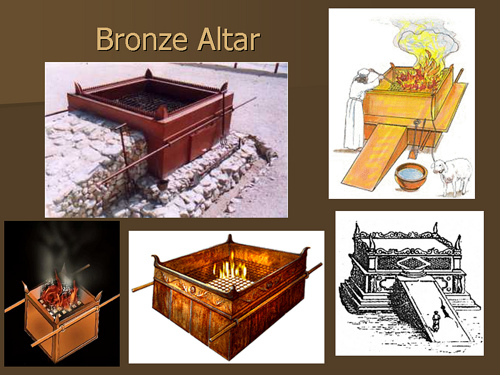
Now let’s consider the actual construction of the altar of sacrifice to see how it pointed prophetically to Yeshua in other ways. First, it was constructed of acacia wood overlaid in bronze. Wood and trees represent men (Ps 1:1, 3; Jer 5:14). Second, bronze speaks of judgment. Yeshua, a man who worked (by trade he was a carpenter) in wood (representing humanity), died on a tree and took the fire of Elohim’s judgment upon himself for humanity’s sins.
Next, all the animals slaughtered in the sacrificial system were similar, in modern terms, to the minimum amount due on a credit card statement of a bill so huge one cannot possible pay the balance; therefore, one is able only to afford to pay the minimum amount due until somehow, miraculously, someone will step in to pay the full amount. Yeshua paid that monstrously huge sin debt for each of us at the cross. All of the sacrifices in the Tabernacle of Moses were merely tiny down payments on the vast sin bill that each sinner owed for his sins and which would ultimately be paid by Yeshua’s death on the cross. The penalty for sin is death, and this debt can only be paid by the death of the sinner. Once he is dead, then what? No more life. This is why Yeshua had to pay the price for man, so that we might live forever and not die forever. How could Yeshya’s death pay for all of humanity? After all he was only one man. This is possible only because the Bible reveals in numerous places that Yeshua was the Creator of man (John 1:3, 10; Heb 1:2, 10; Col 1:16) thus making his death life more valuable than all that he ever created, even as the builder of the house is more valuable than the house he builds (Heb 3:6).
Not only did Elohim conceive of the sacrificial, but he validated once it was enacted. The very first sacrifice offered on the bronze altar was lit by fire from heaven (Lev 9:22–24). This signifies that the blood of Yeshua delivers us from the wrath of Elohim, and that our Father in heaven thankfully accepts Yeshua’s offering for man’s sin (Rom 5:9).
YHVH miraculously sent fire from heaven initially to light the sacrifice on the altar (Lev 9:22–24), but it was up to the Levitical priests to maintain that fire subsequently. This fire had to be constantly tended, fed including removing the old ashes to keep the fire burning. Similarly, when a person comes to faith in Yeshua, he must seek the fire of YHVH’s Holy Spirit to light the sacrificial altar of his life (Rom 12:2) to be endued with power from on high (John 14:16–18, 26; 15:26 cp. Luke 24:49). Without the miraculous and dynamic power of heaven’s Holy Spirit igniting one’s faith, then all of one’s religious activities no matter how well-intentioned will be the dead works of human religiosity. Those who refuse to receive the transformative power of Yeshua’s Spirit are feeding from the tree of knowledge and not the tree of life, They are practicing cold, dead, legalistic and humanistic religious practices are those the Bible describes as “having a form of godliness but denying its power” (2 Tim 3:5). Thus when a person is redeemed spiritually and born again by the Spirit of Elohim, he has to first receive the Spirit of Elohim, and then maintain that spiritual fire in his life to ensure that it does not die out due to lack of spiritual fuel from abiding relationship with Yeshua, or get choked out due to the ashes of sin, the religious traditions of men (Mark 7:9–13), dead religious works or the cares of this world (Matt 13:22). The spiritually fires either have gone out or are barely smoldering in the lives of those who have grown lukewarm in their faith (Rev 3:14–21), and have lost their first love for Yeshua (Rev 2:4), as well as the joy of their salvation (Ps 51:12). From one end of the Bible to the other, YHVH is continually warning his people about succumbing to spiritual declension, lukewarmness and lassitudeness. As in physics, the law of entropy is equally applicable in the spiritual realm. Everything eventually goes from a state of order to disorder unless an outside energy source is continually being introduced into the system to deep it from declining into a state cold chaos. For the saint, that outside energy source is Yeshua the Messiah and his Holy Spirit at work in one’s life. This can only occur with the full, willing, purposeful intention and determined cooperation of the saint to keep the spiritual fires burning in his or her life! A horse can be led to water, but it is up to the horse to drink.
How does one keep the fires of faith burning brightly? Offerings were made on the altar of sacrifice in the morning and in the evening. This teaches us that minimally twice daily the saint needs to come before YHVH’s throne in heaven and at the altar to there leave their prayers and confess their sins (1 John 1:9), while drawing close to our loving Creator in daily communion and devotion of service to him.
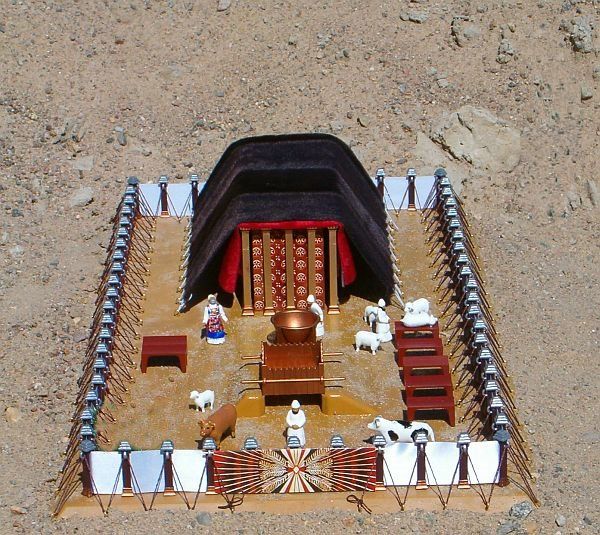
Exodus 27:9–19, Court of the tabernacle. The tabernacle’s outer court was approximately 150 feet long by 75 feet wide (or 11,250 square feet, which is about one-fourth of an acre) in size.

The curtains of the outer court (Exod 27:9–19) were made of fine white linen and was seven-and-a-half feet tall. The linen curtains are a symbolic picture of the robes of righteousness the bride of Yeshua will wear on her wedding day (Rev 19:8).
Sixty pillars supported the outer curtain and were set in heavy bronze (or brass) bases topped by silver capitals. These pillars represent redeemed humanity wearing robes of righteousness. Wood or trees is biblical Hebraism or metaphor humanity, while bronze symbolizes divine judgment against man because of sin, while silver symbolized redemption or Elohim’s ransom price for man’s sin.
At approximately seven and-a-half feet tall, the curtain was just high enough so that a tall man could not peer over the top and see inside. The curtain was made of fine-twined white linen, which stood in stark contrast to the surrounding gray-brown drab desert. Again, white linen represents the saints’ robes of righteousness. The priests wore white linen robes (Exod 28:39–43), and the bride of Yeshua is also expected to adorn herself such garments (Rev 19:8). YHVH’s people are called a nation or kingdom of priests (Exod 19:6; 1 Pet 2:9; Rev 1:6; 5:10; 20:6). It is true that a person’s righteousness is as filthy rags (Isa 64:6), and one’s sins have separated them from Elohim (Isa 59:2), but YHVH has made provision for the stain of man’s sins to be washed away so that becomes white as wool or snow (Isa 1:18) through the cleansing and redemptive blood of Yeshua (Matt 26:26; Rev 1:5; 1 John 1:7; Eph 1:7; 1 Pet 1:2, 19).
This outer courtyard curtain formed a barrier between man and Elohim. This curtain separated the profane and polluted wilderness world that lay outside from the sacred, pure and holy world that lay inside the tabernacle’s walls. The curtain’s height an unsaved man, no matter how tall is or how elevated spiritually he thinks he may can enter therein. Yet the way of salvation is not impossible for him to achieve, yet it is just beyond his reach through his own human efforts. He can receive heaven’s free gift of salvation on by entering the tabernacle through the prescribed way—through the door of the curtain.
Additionally, the curtain was supported by 60 (6 x 10) pillars. Six is the biblical number of man while ten represents ordinal perfection.
Moving on, the pillars were set in bronze bases and capped with silver capitals. Again, bronze represents Elohim’s judgment against man’s sin, and silver is the biblical metaphor for redemption or sinners being redeemed from deserved judgment (Ezek 18:4; Rom 3:23; 6:23). Examples of bronze being a biblical metaphor for divine judgment against sin include the brass serpent on the pole in Numbers 21. This was a picture of Yeshua taking upon himself the judgment for man’s sins (John 3:14–17). The silver capitals represent the ransom price YHVH laid upon each of the children of Israel age 20 and upwards (Exod 30:11–16). Moreover, the small amount of silver that each Israelite paid for a ransom for their sins was but the minimum price due on each person’s huge and impossible-to-pay sin debt charged on each man’s spiritual credit card. Thankfully, Yeshua redeemed each sinner not with gold or silver, but with his precious blood (1 Pet 1:18–19).
Next, the ropes holding up the posts and pillars were made of goat hair. This is another picture of the redemptive sacrifice of Yeshua and of the price of man’s sin paid by his shed blood, since goats were one of the kosher animals used offered on the altar of sacrifice.
Finally, the outer curtain was white and luminescent from the light of the divine the glory cloud that hovered over the tabernacle at all times. This glowing curtain separated the bleak and drab wilderness outside from the paradise inside; darkness from light, profane from the set-apart (kadosh), death from life, confusion from order. At the same time, the gate wasa four-colored woven tapestry prophetically representing the Person and work of Yeshua the Messiah. The four colors were purple representing royalty or kingship, white speaking purity or righteousness, blue was a metaphor divinity or heaven and red for the blood of Yeshua. The door pointed to Messiah who is the doorway to salvation (John 10:7, 9), the way, life and truth (John 14:6), and the only way to the Father in heaven (John 14:6). The tabernacle’s gate was wide, but not tall—just above the height of a tall man. Similarly, Yeshua’s arms were open wide while hanging on the cross. It is his desire that none perish due to sin (2 Pet 3:9). He loved us while we still in our sin (Rom 5:8), but each sinner must of his or her own free will enter that gate and accept the free love-gift of heaven’s salvation from the consequences of sin which is death (Ezek 18:4; Rom 6:23).
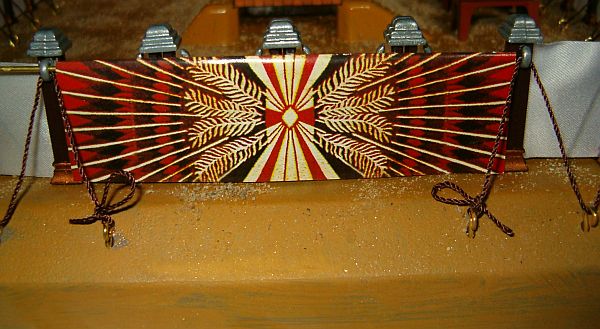
Exodus 27:16–17, Gate of the court. The door of the outer court’s curtain contained three colors woven into white linen fabric. They were blue, purple, crimson with a white background. These four colors speak of different attributes of Yeshua, who is the “door” to salvation (John 10:1–18). These four colors combine to form a full picture of Yeshua, the Redeemer and Savior of Israel. Only through him can man come to the Father in heaven including obtaining salvation, eternal life and inclusion in the glorious New Jerusalem symbolized by the glory cloud over the tabernacle’s holy of holies. The four colors also seem to correspond to the four faces of the living beings around the throne of Elohim (Ezek 1:1ff).
Crimson symbolizes the human aspects of Yeshua. This is because red is the color of man as well as red clay from which YHVH created man (Heb. adam). Some Bible commentators believe this points to the Gospel of Mark, which reveals the nature of Yeshua at the pashat (or the simpleor plain level) of biblical understanding. According to Hebrew roots commentator and linguistic scholar James Trimm, Mark presents the Messiah as the servant who purifies the Gentiles (Isa 52:13, 15) or the “my servant the Branch” (Zech 3:8), who is symbolized by the face of the ox (Ezek 1:10) with the ox being a servant or a beast of burden. Mark does not begin with an account of the birth of Messiah as do the Gospels of Matthew and Luke because, unlike the birth of a King, the birth of a servant is unimportant. All that is important is his work as a servant which begins with his immersion by John the Immerser. Thus Mark’s simplified account omits any account of Yeshua’s birth or preexistence and centers on his work as a servant who purifies the people of the nations.
The color white symbolizes the righteousness of Yeshua. Some Bible commentators believe this points to the Gospel of Luke, which reveals the nature of Yeshua at the remez (or the hint) level of biblical understanding. Trimm notes that Luke wrote a more detailed account for the high priest Theophilus (a Sadducee). The Sadducees were rationalists and sticklers for details. Luke presents Yeshua as the “Son of Man” and as “the man whose name is the Branch” (Zech 6:12), and who is presented as a high priest and is symbolized by the face of the man (Ezek 1:10). Luke wants to remind by remez (or by implication) Theophilus about the redemption of the filthy high priest Joshua (Zech 3:4) and its prophetic foreshadowing of a “man” who is a heavenly High Priest, and who has the authority purify even an earthly high priest.
Purple symbolizes the regal or kingly aspects of Yeshua. Some Bible commentators believe this points to the Gospel of Matthew, which reveals the nature of Yeshua at the drash (or the allegorical or homiletical) level of biblical understanding. This seems to point to the lion of the tribe of Judah—another name for Yeshua (Rev 5:5). Trimm suggests that Matthew presents his Gospel account of Yeshua’s life as a midrash to the Pharisees where he ties various passages from the Tanakh to the story of Yeshua (e.g., Matt 2:13–15 presents an allegorical understanding of Hos 11:1). Matthew also presents Messiah as a king righteousness or the Branch of David descended from King David and the root of Jesse (Jer 23:5–6 and Isa 11:1–10).
Finally, blue symbolizes the heavenly or divine aspects of Yeshua. Some Bible commentators believe this points to the Gospel of John, which reveals the nature of Yeshua at the sod (or the mystical) level of biblical understanding. According to Trimm, John writes about numerous sod-level or mystical topics including light, life, truth, the way and the Word of Elohim. For example John 1:1 presents a sod understanding of Genesis 1:1. John 3:14; 8:28 and 12:32 present a sod understanding of Numbers 21:9 (q.v., James Trimm at www.nazarenespace.com).
