

Exodus 1
Exodus 1:7, Increased abundantly…multiplied. This was a partial fulfillment of Jacob’s prophecy in Genesis 48:16 and 19.
Exodus 1:11, Taskmaster…afflict them. The Hebrew word behind taskmaster literally means “gangs of government officials who exacted or levied tribute or taxes from the Israelites by forcing them to work as serfs.” These government bureaucratic goons forced the Israelites, through affliction, into compulsory service involving government works projects. The Egyptians imposed a fascistic and socialistic system upon the Israelites, which was a form of slavery.
Exodus 1:19–21, Midwives said. The righteous, Elohim-fearing midwives (v. 17), chose to obey Elohim rather than to follow government edicts that violated the laws of the Creator. This necessitated them lying to the Egyptians to preserve the lives of the innocent babies. This teaches us that it is not only acceptable to lie in certain circumstances, but it is even commendable in YHVH’s eyes, in order to preserve life (see also Josh 1:17 where Rahab lied to protect the Israelite spies from certain death, and 1 Sam 20:6 where David had Jonathan lie for him to save his life from the murderous Saul). For their work of preserving innocent lives, YHVH blessed the midwives with houses, households or a honorable family lineage (vv. 20–21). In reality, the midwives were pro-life, anti-abortion activists who were involved in civil disobedience for righteous purposes (On the subject of what is biblically righteous civil disobedience, see my notes at Rom 13:1).
Shiphrah…Puah. (See my article at Rom 13:1 on civil disobedience.) Respectively these names mean “brightness; from the root to glisten” and “glitter, brilliance.” One wonders whether these were the midwives’ literal names or symbolic names given to them later by Moses, the writer of books of the Torah, to indicate the beautiful and glorious nature of their work in saving the lives of the Israelite boy babies from abortive deaths at the hands of the evil secular authorities. After all, Moses himself was saved from death in a similar manner. The saving of life from abortion is indicative of the value that the Hebrews and later Christians place on human life because, after all, humans are made in the image of Elohim as the Bible reveals. To kill a human, except in self defense or in accordance with the Torah’s stipulations regarding capital punishment, is an affront to Elohim himself of whom man is a reflection, and who is called to be an imager of the divine. Where as the evolutionary, atheistic and secular humanistic and materialistic philosophy views man simply as an animal or material substance and nothing more, the supernaturalistic, biblical view sees man as being subdivine. These two views are diametrically opposed to each other and project very different philosophies to the people that hold them. Each of these opposing philosophies radiate different ethos and a set of mores to the respective societies and cultures that reflect each of them.
Exodus 2
Exodus 2:16; 3:1 (also 18:1), Priest [Heb. kohen] of Midian. The Hebrew word kohen means “priest, principal officer or chief ruler.” In the days prior to the Levitical priesthood, the Bible considers a father to be the priest of his family (see Exod 19:22, 24). Since Torah mentions three times that Jethro was the priest of Midian, evidently he was more than just a spiritual leader to his family; he was likely also a regional, priestly leader.
Exodus 2:15, Land of Midian. Midian is located in located east of the Sinai and across the Gulf of Aqaba in the modern country of Saudi Arabia (cf. The Works of Philo, “On the Life of Moses,” 1.47; Gal 4:24). The Sinai Peninsula was at times under Egyptian hegemonic control, while Midian was outside of Egyptian control making it a safe place of exile for Moses out of the reach of Egyptian legal justice. There is biblical evidence that points to the fact that this same land of Midian was also where Mount Sinai was located and was in Arabia (e.g., Gal 4:25), and not the traditional sight in the Sinai Peninsula where St. Catharine’s Monastery is now located.
Exodus 2:18, Reuel. Moses’ father-in-law had several names including Jethro (Exod 3:1) and Hobab (Num 10:29). Jethro was a descendant of Abraham through Midian, his son by Keturah (Gen 25:1–2). It’s likely that Jethro was knowledgeable about Abraham’s Yehovist faith and thus was able to train Moses, who for all practical purposes, was an Egyptian, was raised in the Egyptian religion and culture and would have known little about YHVH and his Torah-law. As such, YHVH strategically placed Moses in a spiritual boot camp for forty years where he not only learned to manage physical sheep in preparation for his leading the children of Israel, but he was trained by a godly priest eventually to become the Levitical priest over Israel.
Exodus 2:22, Gershom. A sad piece of Bible trivia is that some of Moses’ descendants didn’t follow in his righteous steps. Gershom’s sons became idol worshipers (Judg 18:30–31). Many of the children of righteous men in the Bible didn’t follow in the footsteps of their fathers in remaining faithful to Elohim.
Examples rotten apple children falling from good fruit trees include Isaac (Esau), Aaron (Nadab and Abihu), Samuel’s sons (1 Sam 8:1–3), and some of David’s children as well as the children of many of the other righteous kings of Judah.
What’s more, the Bible tells us nothing about the spiritual status of the sons of any of the prophets or apostles. Whether they remained faithful to YHVH or not, we don’t know. If they had been notable in their service to YHVH, it seems that Scripture would have recorded this notable fact.
One thing seems certain. Most of the high visibility servants of YHVH were solitary figures. Little if anything is known about their spouses, families or children, who, in general, seemed to play no major role in the key figure’s ministry activities.
Interestingly, there are also several examples of righteous sons coming from unrighteous fathers and vice versa. This is the case with several of the kings of Judah.
All this is to say that just because a child was raised well in a godly family doesn’t guarantee they will continue to serve Elohim and walk in righteousness. Conversely, just because a child was raised in an ungodly, even wicked family, doesn’t mean they will become wicked and ungodly.
Salvation is an individual matter. YHVH calls and chooses whom he will, and it’s up to the individual to respond to that calling. Some will respond, but most will not. As Yeshua said, many are called, but few are chosen (Matt 22:14), the spiritual gate is wide that leads down the wrong path, while the gate that leads down the straight path to salvation and eventually into the kingdom of Elohim is narrow (Matt 7:13). One thing is certain though. The Father’s arms are open wide for his prodigal children to return to him, and so should ours (Luke 11:15–31).
Gershom and Eliezer. Gershom was Moses firstborn son (Exod 2:22; 1 Chron 26:24). Moreover, the Scriptures records what happened to Gershom later in his life. In the Book of Judges (Judg 18:30) we find a reference to a “Manasseh” (in the KJV and NKJV), but according to the LXX and Latin Vulgate this is an erroneous translation. Instead, this Bible text should say “Moses” and not Manasseh (as the NKJV notes in the margin). The Masoretic rabbinates later changed Mosheh to Manasheh to hide the fact that Moses’ son was an idolater and idol maker. The NIV correctly states Moses, not Manasseh, and explains why the Jews changed Manasseh in its footnotes (see the NIV Study Bible). Elsewhere (1 Chron 23:15) states that both Gershom and Eliezer where Moses’ sons.
Exodus 3
Exodus 3:1, Tending the flock. Moses spent forty years in the wilderness of Midian tending the flocks of Jethro, his father-in-law. After this phase of his life, YHVH called and commissioned Moses to lead the children of Israel out of Egypt and then to shepherd them through the wilderness en route to the Promised Land. This was the very same wilderness where Moses had shepherded Jethro’s sheep for forty years, so he knew the area’s geography well. Moses’ job as a physical shepherd prepared him for the next phase of his life—his ministry as a spiritual shepherd.
Often YHVH chooses individuals as his servants based on their vocational background, which provides training for the spiritual ministry to which he then calls them. For example, David was a shepherd before he became the king over Israel. Amos was a picker of fruit and a shepherd who called the nation of Israel back to return to YHVH by producing good spiritual fruit and to come back into a relationship with their Creator, who was Israel’s true spiritual Shepherd. John the Baptist was a priest calling the Jews to repent of sin and to become a holy nation. Yeshua was a carpenter before he became a builder of the spiritual house of Israel (Heb 3:3–6; 1 Pet 2:5). Several of Yeshua’s disciples were commercial fishermen before becoming “fishers of men” (Matt 4:19) or apostolic evangelists. Paul was a tent maker helping to raise up the fallen tabernacle of David (Acts 15:16). Sometimes our physical vocations may be an indicator of and preparatory to our eventual spiritual calling.
Being a shepherd of physical sheep is a most suitable profession to prepare one for tending YHVH’s spiritual sheep. A shepherd has to put the needs, comfort, care and protection of the sheep above his own needs and wants. This is one reason why the Scriptures refer to those who care for and protect YHVH’s spiritual sheep as shepherds or pastors.
There are many similarities between physical and spiritual shepherds, and physical and spiritual sheep. Unless one has been a physical shepherd and cared for physical sheep or parented children, it is unlikely that these reasons will be readily apparent. This is why being a parent is a one of the qualifications for being an elder or deacon in the church (1 Tim 3:2, 4, 12; Tit 1:6).
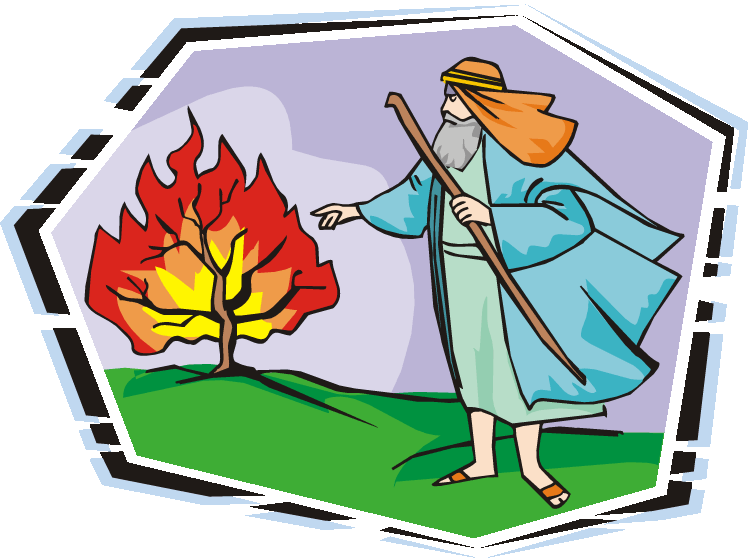
Exodus 3:5, Take your sandals off. In the Orient, it is common to take off one’s shoes before entering a house, since people typically would sit on a mat or a rug (as opposed to a chair). To keep these mats from getting soiled by dirt, sandals were left outside. The idea of defilement from the shoes led to the custom of removing shoes when entering sacred place, which the Moslems practice to this day when entering a mosque. It is because of this, that the Messenger of YHVH asked Moses to take off his sandals at the burning bush (Manners and Customs, pp. 74–75), since this spot, at that moment, represented the dwelling place of YHVH.
Moreover, the removal of one’s sandals was an act of submissive worship to YHVH. When coming into the Presence of Elohim, Moses removed his sandals (as did Joshua, Josh 5:15), and the priests ministered barefoot in the tabernacle. Not only this, the priests covered their genitals when ministering in YHVH’s Presence (Exod 28:42), or when ascending to the altar of sacrifice (Exod 20:26). Not only was this a modesty issue to prevent the Israelites from descending into the perverse sexual religious rites of the surrounding heathen nations, but this, as with the removal of shoes, was a sign of reverence. In the world of the Bible, genitals symbolized power over children and sandals represented power over land. It was considered prideful and irreverent to display signs of reproductive ability and land ownership before YHVH (Social World of Ancient Israel, p. 10, by Matthews and Benjamin).
Holy ground. Holy is the Hebrew word qodesh meaning “sacredness or separateness.” That which is qodesh is the opposite of that which is common, profane, worldly, polluted or vile. The biblical record is clear: only YHVH can make something holy either by his presence or because he declares something to be qodesh. Men have no authority to call something holy unless YHVH has declared it so. Thus the idea of holy water, the Holy See, the holy mother of God, the holy rosary, the holy Koran and many other things that men have declared to be holy are not technically holy by biblical definition and according to biblical criteria. Several things that the YHVH calls holy in the Bible that most Christians ignore include are YHVH’s feasts and weekly Sabbath (Exod 12:16; 16:23; Lev 23:2), YHVH’s people or the nation of Israel when they obey him (Exod 19:6; Deut 26:19), the Tabernacle of Moses (Exod 26:33), the anointing oil (Exod 20:25), where YHVH’s holy people dwell when they obey him (Deut 23:14), YHVH’s Hebrew name which most Christians do not even know much less use (1 Chron 16:35; Ps 103:1), YHVH’s covenants with his people (Luke 1:72), Yeshua the Messiah (Acts 4:27, 30), the Scriptures or Bible (Rom 1:2) and YHVH’s Torah-law (Rom 7:12). How many of the things in this list does the mainstream church either ignore or reject as being holy, and how many things does the church call holy that YHVH in his Word does not call holy? Let us recall the words of Yeshua when rebuking the religionists of his day for all of their man-made traditions that ignored the Word of Elohim. “And he said unto them, Full well ye reject the commandment of Elohim, that ye may keep your own tradition…Making the word of Elohim of none effect through your tradition, which ye have delivered: and many such like things do ye” (Mark 7:9, 13). May we endeavor to elevate in our lives and thinking those things that YHVH as declared to be holy and reject as being holy those things that YHVH has not called holy.
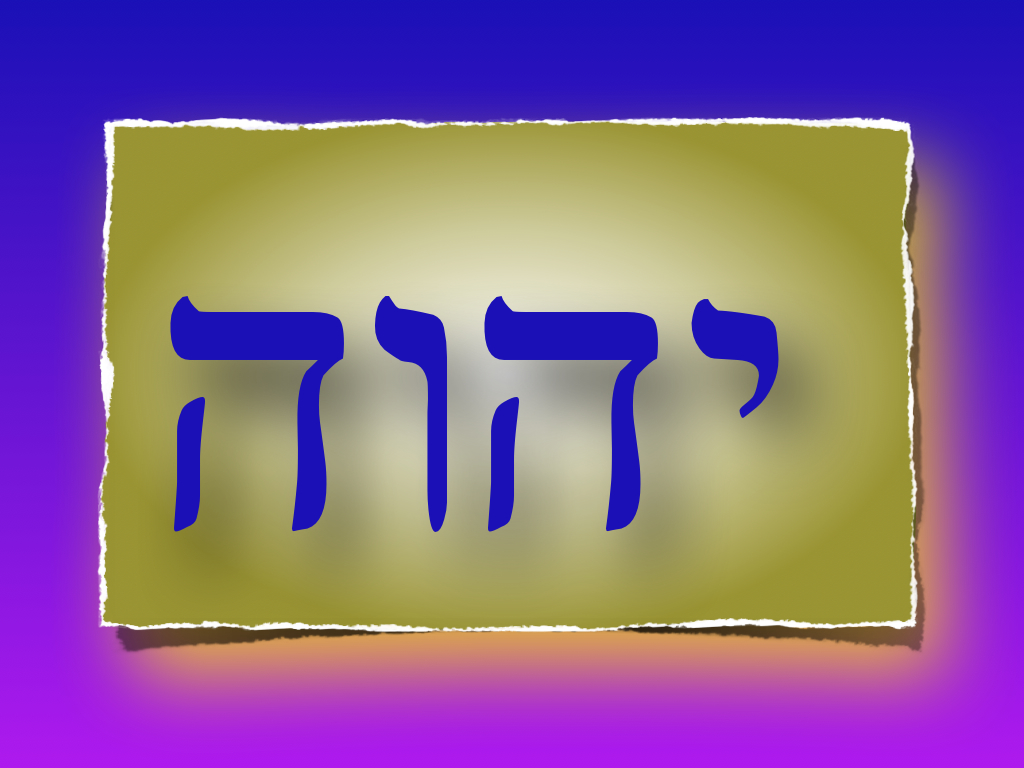
Exodus 3:14–15, I AM THAT I AM. The name YHVH is Elohim’s memorial name forever. It reflects the fact that he is; that he is undefinable in human terms, and that he has always existed. This is the name by which he is to be remembered and not forgotten as is the case with the modern rabbinic Jews which have a non-biblical doctrine forbidding the use of the Hebrew names of Deity. Exodus 3:14 and 15 read as follows:
14 And Elohim said unto Moses, I AM THAT I AM (EHYEH ASHER EHYEH הוהא רשא הוהא): and he said, Thus shalt thou say unto the children of Israel, I AM (EHYEH הוהא) hath sent me unto you. 15 And Elohim said moreover unto Moses, Thus shalt thou say unto the children of Israel, YHVH (הוהי) the Elohim of your fathers, the Elohim of Abraham, the Elohim of Isaac, and the Elohim of Jacob, hath sent me unto you: this is my name [Heb. shem] for ever, and this is my memorial [Heb. zeker] unto all generations.
Here are some examples of how various Bible versions translate the name of YHVH:
- I Am That I Am (KJV)
- I Am Who I Am (NAS, NIV, NKJV
- I Am That Which I Am (YLT)
- I Shall Be As I Shall Be (The ArtScroll Stone Edition Tanach)
- I Will Be What I Will Be (The Gutnick Edition Chumash, JPS)
- I Will Be There Howsoever I Will Be There (The Schocken Bible)
- I Am the Being (LXX, Brenton)
Exodus 3:15 states that YHVH is Elohim’s memorial name that Moses was to use when referring to I AM THAT I AM. I AM THAT I AM is Elohim’s actual name and what he calls himself, but men are to refer to him as YHVH, which means “the existing one, the one who is, the one who will be.” Both the former and latter are forms of the Hebrew verb hayah meaning “to be.” YHVH instructed that YHVH was to be his memorial name forever. In other words, humans were to use YHVH to remember him by. There is no indication anywhere in the Bible that it was YHVH’s intention that his name was to be forgotten or hidden through euphemization. The word memorial in Exodus 3:15 is the Hebrew word zeker and means “memorial, remembrance or memory.” There is nothing here to indicate that his name was to be forgotten.
It must be noted here that we don’t refer to YHVH as I AM, for were we to do so it would be necessary to say “I AM,” and in all reality, we aren’t the I Am, but YHVH is the I AM. Just so there is no confusion when communicating YHVH’s name in every day speech, the Bible uses, not the Hebrew ehyeh meaning “I AM,” but the form of the verb which means “He Is.” In this way, every time we say his name, we are glorifying him, and not inadvertently glorifying ourselves.
Instead of getting all vexed and confused on how exactly to pronounce Elohim’s name, let us just learn to love, worship and obey YHVH! These are the weightier matters of the Torah (Matt 23:23; 1 Cor 13:1–13). The last thing that YHVH wants is for his children to cause division and strife over how to pronounce his name!
The name YHVH, referred to as the tetragrammaton, is the personal name of the Creator and occurs some 6800 times in the Tanakh. The exact pronunciation of this name has been lost down through the ages, and there is debate among well-meaning individuals on how to pronounce this four consonant Hebrew name. Because there are no vowels in this name, scholars can only speculate and make educated guesses about what the vowels between the consonants should be. No one knows for sure how to vocalize the consonants Y-H-V-H. The best scholarly opinions on this subject are just that—educated guesses.
Instead of getting all worked up about how exactly to pronounce Elohim’s name, let us just love, worship and obey YHVH! Again, these are the weightier matters of the Torah (Matt 23:23; 1 Cor 13:1–13). This is the distinguishing mark a true disciple of Yeshua (John 13:35), and what will separate the goats from the sheep (Matt 25:37–44)—not how we pronounce YHVH’s name!
Exodus 3:2; 13:21; 14:20
The Burning Bush and the Messenger of YHVH
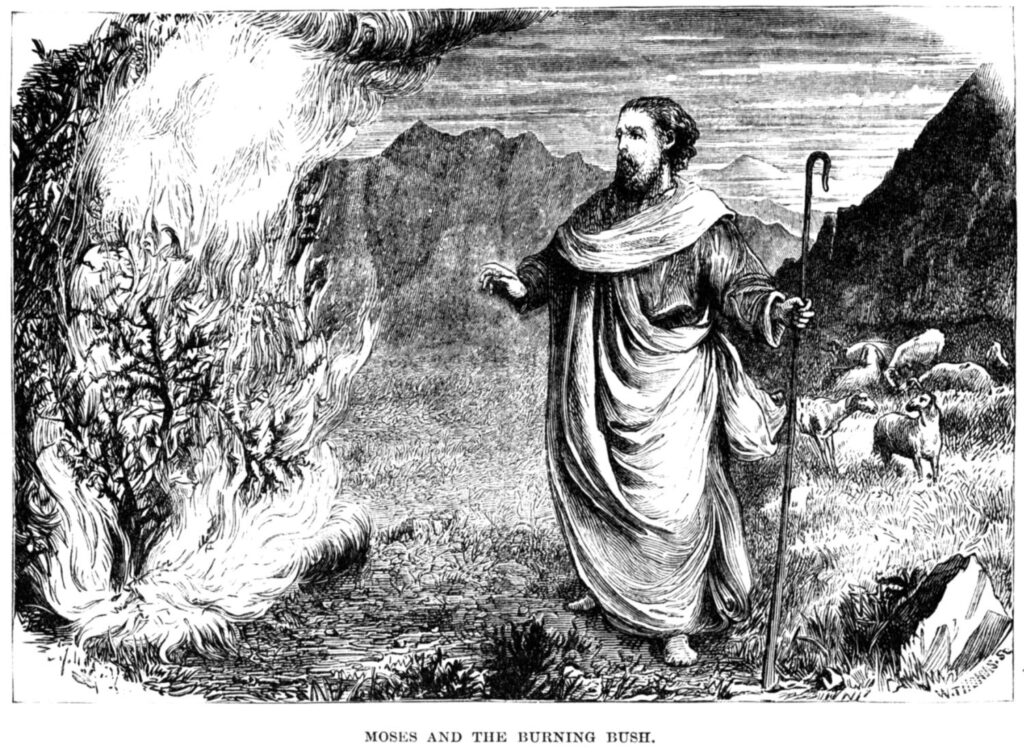
From the first to the last book of the Old Testament, an enigmatic figure keeps making an appearance onto the stage of Israel’s long history—usually at critical moments. Scripture calls this divine entity “the angel of the LORD/YHVH.” The appearance of this unnamed personage was not infrequent. He drops in on Israelites numerous times and he is mentioned fifty times. Was he a single divine entity or were there several “angels of YHVH?” Was he a literal, stereotypical angel or something more? We will explore this question.
One of his epic appearances occurred prior to Moses leading the children of Israel out of Egypt at a burning bush that refused to be consumed by fire. Such a spectacle would render any passerby immobile and gawking with mouth agape. It was here that the shepherd Moses not only came face to face with the Angel of YHVH, but received some secret intelligence along with a divine calling. Let’s dive in and explore this subject.
In Exodus 13:21 we read,
And YHVH went before them by day in a pillar of a cloud, to lead them the way; and by night in a pillar of fire, to give them light; to go by day and night.
Then in Exodus 14:19 it is written,
And the angel of Elohim, which went before the camp of Israel, removed and went behind them; and the pillar of the cloud went from before their face, and stood behind them.
Who was this “Angel” of Elohim (elsewhere he is called “the Angel of YHVH”)? Angel is an unfortunate translation. The Hebrew word for angel is malak/ךאלמ and simply means “a heavenly or a human messenger.”Prophetically this word can refer to human messengers such as the one coming in the spirit of Elijah prior to Messiah’s coming, as well as to the Messiah himself (as in “the Messenger/Malak of the covenant” in Malachi 3:1). Then in Genesis 32:22–30 Jacob wrestles with a man Scripture identifies as the “Malak of YHVH” (Hos 12:3–5), and whom Jacob also called Elohim (verse 30). This same Individual redeemed Jacob (Gen 48:18), and is identified with “the Malak of Elohim…the Elohim of Bethel” (Gen 31:11 and 13). He again appeared to Moses at the burning bush (Exod 3:2). After this, we find him leading children of Israel through the wilderness. Again who is this personage of divine origination?
Stephen in Acts 7:37–39 identifies the Messiah (i.e., “that Prophet” Moses mentioned in Deut 18:15) with this same “Angel” or Heavenly Messenger which spoke to the children of Israel from Mount Sinai and who gave them the “living oracles,” who the Israelites later rejected for pagan gods. Paul elsewhere said of that same Personage that the Israelites did “all drink the same spiritual drink: for they drank of that spiritual Rock that followed them: and that Rock was Messiah/Christ” (1 Cor 10:4).
Moreover, Yeshua declared to the Jews that he was the I AM, YHVH or Messenger of YHVH of the burning bush incident who spoke to Moses (Exod 3:2, 14). The Jews knew that Yeshua was declaring himself to be YHVH, which is why they picked up stones to kill him, for they considered such a declaration to be a blasphemous (John 8:59). A human calling himself God? Scandalous to be sure! Yeshua went on to state that the Israelites never heard the voice of the YHVH the Father, nor saw his face at anytime (John 5:37). This would include the time period of the children of Israel. If it wasn’t the Father who spoke to the Israelites, then who did? That leaves only one other person—the Word of Elohim that was with Elohim and who would latter become flesh and dwell with men as Yeshua the Messiah (John 1:14)—God in the flesh (Phil 2:5–11; 2 Cor 4:4; Col 1:15–16; 1 Tim 3:16; Tit 2:13; Heb 1:8).
Concerning the pillar of fire that led the Israelites through the wilderness, we see that it gave them light. Light in the Scriptures is often a biblical a metaphor for the Torah (Pss 19:8; 119:105; Prov 6:23). We know that Yeshua the Messiah is the Light of the World (John 8:12), and that he is the Word of Elohim in living form (personified, John 1:1, 14).
Furthermore, in Nehemiah 9:12 and 19 we read,
Moreover thou leddest them in the day by a cloudy pillar; and in the night by a pillar of fire, to give them light in the way wherein they should go…Yet thou in thy manifold mercies forsookest them not in the wilderness: the pillar of the cloud departed not from them by day, to lead them in the way; neither the pillar of fire by night, to show them light, and the way wherein they should go. (emphasis added)
While light in the Scriptures often allegorically refers to the Torah, the term the way (Heb. derek,ךרד) can be a metaphor for “the way of Torah righteousness.” The Scriptures uses the term way(s)/derek as a reference to the Torah in the following passages (and many more as well):
Therefore thou shalt keep the commandments of YHVH thy Elohim, to walk in his ways, and to fear him. (Deut 8:6)
And now, Israel, what doth YHVH thy Elohim require of thee, but to fear YHVH thy Elohim, to walk in all his ways, and to love him, and to serve YHVH thy Elohim with all thy heart and with all thy soul. (Deut 10:12)
For if ye shall diligently keep all these [Torah] commandments which I command you, to do them, to love YHVH your Elohim, to walk in all his ways, and to cleave unto him. (Deut 11:22)
And a curse, if ye will not obey the [Torah] commandments of YHVH your Elohim, but turn aside out of the way which I command you this day, to go after other gods, which ye have not known. (Deut 11:28)
I have chosen the way of [Torah] truth: thy judgments have I laid before me. (Ps 119:30)
I will run the way of thy [Torah] commandments, when thou shalt enlarge my heart. (Ps 119:32)
Teach me, YHVH, the way of thy statutes; and I shall keep it unto the end. (Ps 119:33)
The Messenger of Elohim from within the pillar of fire not only directed the Israelites in the way they should go (Exod 13:21; Deut 1:33), but the Messenger spoke to Moses from within the pillar as well,
And it came to pass, as Moses entered into the tabernacle, the cloudy pillar descended, and stood at the door of the tabernacle, and YHVH talked with Moses. And all the people saw the cloudy pillar stand at the tabernacle door: and all the people rose up and worshipped, every man in his tent door. And YHVH spake unto Moses face to face, as a man speaketh unto his friend. And he turned again into the camp: but his servant Joshua, the son of Nun, a young man, departed not out of the tabernacle. (Exod 33:9–11)
And YHVH descended in the cloud, and stood with him there, and proclaimed the name of YHVH. (Exod 34:5)
And YHVH came down in a cloud, and spake unto him, and took of the spirit that was upon him, and gave it unto the seventy elders: and it came to pass, that, when the spirit rested upon them, they prophesied, and did not cease. (Num 11:25)
And YHVH appeared in the tabernacle in a pillar of a cloud: and the pillar of the cloud stood over the door of the tabernacle. And YHVH said unto Moses…(Deut 31:15–16a)
What can we gather from all the above texts pertaining to the Messenger of YHVH (improperly translated “Angel” of the LORD)? This same Divine Messenger thundered out the words of the Written Torah from Mount Sinai, he gave divine revelation to Moses out of the pillar of fire, he lit the path of the Israelites through the wilderness with both physical and spiritual light. He led them in the physical and spiritual way they should go as they were trekking through the wilderness. This fiery Messenger who gave both physical and spiritual light to the Israelites is nothing else but another manifestation of the complete, supernal light which shone upon this earth during the first three days of creation—a light which will once again shine at the end of days in the New Jerusalem replacing the physical sun (Rev 21:23; 22:5). This divine Torah-light was concealed after day three of creation, but was hidden in the Written Torah and in the Person of Yeshua the Messiah, the Living Torah. This same Light was none other than the fiery Messenger who led the Israelites through the wilderness, and who became the Torah-Word of Elohim made flesh. Yeshua was torch bearer of Truth to the world in the first-century and to this day. As the fiery Messenger led the Israelites out of the land of Egypt and out of the house of bondage through the wilderness, this same Torah light, concealed to most, but revealed to those who have eyes to see, is still leading and guiding us through the wilderness experience of your life as you are heading to the Promised Land of the kingdom of Elohim in the New Jerusalem.
This same “Angel” or Messenger from heaven who was the second person of the Godhead and who would become Yeshua the Messiah appeared numerous other times to godly Old Testament saints including Abraham, Hagar, Jacob, Joshua, Samson’s parents, David, Elijah, Zechariah and even to Balaam and his donkey!
Exodus 4
Exodus 4:3, Serpent. Serpents and staffs were powerful symbols and are biblical metaphors for evil spiritual entities. What lessons can we learn from Moses’ power encounter with Pharaoh’s magicians?
A serpent is often a biblical metaphor for Satan or demonic powers (e.g., Gen 3:1; Luke 10:19 cp. 9:1 and Mark 16:18; Rev 12:9; 20:2). Pharaoh, as ruler over Egypt (a metaphor for this world), was a symbol of Satan who is the ruler of this world. A rod or a staff can be a biblical metaphor for power, authority, rulership or judgment (Gen 38:18; Exod 4:17, 20; Ps 2:9; Rev 19:15).
In this verse, YHVH was giving Moses authority over the powers of Satan and his forces. When Moses cast down his rod, it became a serpent, and Moses was immediately able to assume control over the serpent at will for the purposes of advancing YHVH’s spiritual kingdom. This seems to have been YHVH’s way of showing Moses that he was giving him supernatural authority over Pharaoh (Satan) in fulfilling his divine commission to liberate the children of Israel.
The staff changing into a serpent reminds us of the authority that Yeshua gave his disciples to cast out demons and to heal diseases (Luke 9:1; 10:19; Mark 16:15–18).
Furthermore, later on YHVH instructed Moses to construct a bronze serpent and place it on a pole, which when the Israelites looked on it, they were healed of the bites of the fiery serpents (Num 21:8). Here the serpent represents sin, since it is Satan the serpent who introduced sin to man in the Garden of Eden, which resulting in “the fall” of man and brought upon each of the curse of death because of sin. Yeshua took that curse on himself when he was lifted up on the cross of judgment even as Moses lifted up the bronze serpent in the wilderness (John 3:14). As a result, Yeshua defeated Satan the serpent at the cross (Col 2:15; Gen 3:15; Rom 16:20), even as Moses’ serpent defeated the serpents of the satanic Pharaoh’s magicians. Likewise, we as the servants of Yeshua the Messiah have the same authority over demonic powers (Luke 9:1; 10:19; Mark 16:15–18) as Moses did when we act on alignment with the will of YHVH.
Exodus 4:6, Put your hand in your bosom. This second sign was to demonstrate Moses’ authority over sickness, disease and sin. Authority over sickness by healing the sick was a key component of Yeshua’s ministry as well. Leprosy is another biblical metaphor for sin; both are highly contagious (Lev 13–14). Only Yeshua’s death on the cross can heal men of this spiritual disease as the Torah’s cleansing ritual for leprosy metaphorically symbolizes (Lev 14:4–7).
Exodus 4:9, Blood on the dry land. This was the third sign or witness that YHVH gave Moses as confirmation of his divine commission. The Scriptures instruct us to confirm a matter in the mouth of two or three witnesses (2 Cor 13:1). The Nile River was like a god to the Egyptians because it was the source of much of Egypt’s economic wealth, since it watered that country’s crops and made that nation rich and powerful. Bringing the judgment of death upon the Nile’s waters was a judgment against one of Egypt’s gods and the source of its economic might.
Exodus 4:3–9, A summary. The three signs that YHVH had Moses perform to Pharaoh were merely warning shots against a wicked and unrepentant nation instructing them to submit to YHVH’s will. YHVH was telling the Egyptians that if they refused to obey his prophet, he would unleash demonic spirits, and plagues of sickness and economic destruction on that nation. These are YHVH’s judgments against a nation that refuses to repent. Of course, Egypt refused to obey YHVH, and so he not only brought these judgments against Egypt, but much more, such that Egypt was totally destroyed. The same fate befalls end times satanic and antichrist worldwide system that the Book of Revelation calls Mystery Babylon the Great. As YHVH used Mosess to destroy Egypt, so he will use Yeshua, his Son, to destroy Babylon the Great.
Exodus 4:10, Slow of speech. This doesn’t necessarily mean that Moses had a speech impediment, for Stephen tells us that he was “mighty in words” (Acts 7:22). Perhaps, with practice, Moses became might in words. Moreover, Moses struggled to speak Hebrew fluently, since he was raised speaking the Egyptian language. Likely Moses spoke Egyptian fluently and without an accent having been raised in an Egyptian home. His inability to speak publicly seems to be emphasized by the fact that he used Aaron as his spokesman even to Pharaoh, who would have spoken Egyptian, a language in which Moses would have been fluent.
Exodus 4:20, Sons. The names of Moses were Gershom (Exod 2:22) and Eliezer (1 Chron 23:15).
Exodus 4:21, I will harden Pharaoh’s heart. There is an interesting interplay in the Torah’s narrative regarding the a condition of Pharaoh’s heart. At times, Scripture records that Pharaoh hardened his own heart (Exod 7:23; 8:15, 32; 9:34), and at other time times, we read that Elohim hardened Pharaoh’s heart (Exod 7:3, 13, 22; 8:19; 9:7, 12, 35; 10:1, 20, 27; 11:10; 14:4, 5, 8). Who is in control of Pharaoh’s heart? Pharaoh or Elohim? Initially, it appears that Pharaoh had control over his heart disposition, but as time progressed, his heart became totally sold out to rebellion against YHVH. When he crossed this line, it was a point of no return for Pharaoh, and so YHVH simply used him to accomplish his purposes. Paul discusses the sovereignty of Elohim with regard to the free will of men in Romans 9:15–18. YHVH can save whom he wishes (Mark 10:26–27 cp. Rom 9:18) and condemn whom wishes (Rom 9:18, 22). It is true that YHVH loves the whole world (John 3:16) and is not willing that any should perish, but desires all to be saved (2 Pet 3:9). At the same time, there are people who refuse Elohim’s love and choose to remain in their sinful rebellion. These are the wicked that he has reserved for the day of his judgment (Job 21:30; Prov 16:4; Rom 9:22; Jude 4). However, YHVH sets before humans two paths: life and death. All have the freedom and ability to choose the path of righteousness, leading to life, or wickedness leading to death (Deut 30:15–20). When Pharaoh chose the path of wickedness and death and hardened his heart to go in that direction, YHVH simply complied with the dictates of the king’s heart and used him to accomplish his sovereign and divine purposes. In the Exodus record relating to the condition of Pharaoh’s heart, we see that initially sometimes Pharaoh hardened his own heart, and sometimes it was YHVH who did it. In the end, however, it was YHVH who exclusively hardened Pharaoh’s heart. This is because by this time, Pharaoh had already predetermined to harden his heart, and YHVH was simply manipulating Pharaoh according to his sovereign purposes. YHVH was no way violating Pharaoh’s freewill or freedom of choice, but was merely acting in accordance with the choices Pharaoh and already made.
Exodus 4:22, Israel, my son, my firstborn. The nation of Israel was YHVH’s firstborn son among the nations of the world. As such, YHVH through Moses was first declaring the birth of Israel as a nation, and secondly, that Israel was preeminent among nations in YHVH’s eyes. This was an in-your-face declaration to Pharaoh, sovereign of the world’s mightiest nation at the time, to move over, for a greater nation was on the rise that would replace Egypt. This was a bold move on Moses’ part, and one that no man in his right mind could make unless he were either full of ultra-arrogance and delusions of grandeur, or else he truly had been commissioned, authorized and sent by the Creator of the universe on a divine mission. Had Moses not had YHVH’s backing, Pharaoh could have pronounced a death sentence on Moses then and there. Not only this, Moses, as the leader of the nation of Israel, was declaring spiritual war on Pharaoh and Egypt in the name of YHVH Elohim when he gave him the ultimatum to free the Israelites or face YHVH’s judgment.
Exodus 4:25, Cut off the foreskin. Presumably, Moses would have already been circumcised by his mother when he was a baby, thus he was consecrated in YHVH’s eyes. However, for Moses to continue forward in his ministry call, it was necessary for him to consecrate his minor sons through the ritual act of circumcision in accordance with the Abrahamic Covenant. What is the lesson in this for us today? Simply this. A servant of YHVH must get his own spiritual house in order before pointing an accusing finger at someone else. If he doesn’t, he will be revealed as an arrogant, two-faced hypocrite, thus bringing disrepute to YHVH as a laughing stock of the devil resulting in hindering the advancement of his kingdom. YHVH required this of Moses before confronting Pharaoh accusingly.
The cutting away of the flesh of the foreskin symbolically signifies the death of the carnal man from following idols of the flesh and dying to its lusts. The foreskin being at the forefront or the leading edge of a man’s anatomy is a graphic illustration of cutting away the filthy flesh and going forward spiritually in a clean, righteous and sanctified state. Moreover, one’s willingness to undergo the procedure of circumcision indicates a willingness go forward as the Creator’s spiritual bondservant.
Zipporah. Why did Moses expect Zipporah to circumcise his sons? This is a question that has puzzled many Bible students over the years. To answer this question, we must understand the role of the mother in ancient Near Eastern culture during Bible times. The mother was the sole manager of the household. Because ancient Israel was a subsistence economy, a household’s resources had to be managed carefully, and this was the woman’s responsibility. She directed the preservation and storage of food and allotted food rations to each family member to ensure that everyone in the household was fed and that the food lasted until the next harvest cycle. “In the world of ancient Israel, a man’s home was his wife’s castle She had the domestic authority which he did not” (Social World of Ancient Israel, p. 25, by Matthews and Benjamin). The mother’s dominant role over the household including the children may explains why Moses expected Zipporah to circumcise his two sons (Exod 4:25–26).
For the mother, childbearing and teaching children were synonymous roles. The Book of Proverbs shows the dual role of the mother (Prov 1:8; 6:20; 23:22–25; 31:1–9).
A mother’s intimate bond to her children not only lasted through pregnancy and infancy, but also through the weaning process, which often didn’t occur until the child was four years of age. After teaching them how to walk, talk and dress themselves, she taught the child the domestic skills of gardening, cooking herding, weaving and making pottery (Social World of Ancient Israel, p. 28, by Matthews and Benjamin).
Exodus 4:31, They bowed their heads. When YHVH intervenes supernaturally on behalf of his people in a convincing and powerful manner to deliver them in their affliction, what more can man do but to bow their heads in worship?
Exodus 5
Exodus 5:1, Feast. Feast is the Hebrew word chagag meaning “to hold a feast, hold a festival, make pilgrimage, keep a pilgrim-feast, celebrate, dance, stagger.” This a general term referring to one of the biblical pilgrimage festivals (i.e. Passover/Unleavened Bread, Feast of Weeks and Feast of Tabernacles). Specifically, this was referring to the Feast of Unleavened Bread, which ended up being the night when the children of Israel existed Egypt after just having celebrated the Passover.
Exodus 5:14–20, Divide and conquer. This is the strategy of Satan to defeat his enemies. This is what Pharaoh (a biblical metaphor for Satan) did to the Israelites. He set the people against their leaders and vice versa, and ultimately against Elohim.
Exodus 5:21–23, And they said to them. When YHVH commissions his servants, often they encounter obstacles in executing his orders. This serves to humble YHVH’s servants, so they will be less likely to rely on their own carnal prowess, schemes and abilities to fulfill his commission for them and thus to become more reliant on YHVH to help them to overcome the obstacles. Furthermore, obstacles are a test of the faith of YHVH’s servants. Will they trust him and rely on him to help them overcome the obstacles, or will they, in fear and discouragement, give up defeated? This is part of the refinement and honing process that YHVH’s chosen vessel go through to hone their leadership skills, so that they will be righteous and godly leaders.
Exodus 5:22, Now you shall see. YHVH was about to set the enemy’s strategy of divide and conquer (see notes at vv. 14–20) on its head. YHVH is in charge and will be glorified, and his people will come out victorious if they keep their eyes on him and follow his instructions (Rom 8:28–29).
