
Whereby are given unto us exceeding great and precious promises: that by these ye might be partakers of the divine nature, having escaped the corruption that is in the world through lust. (2 Peter 1:4)
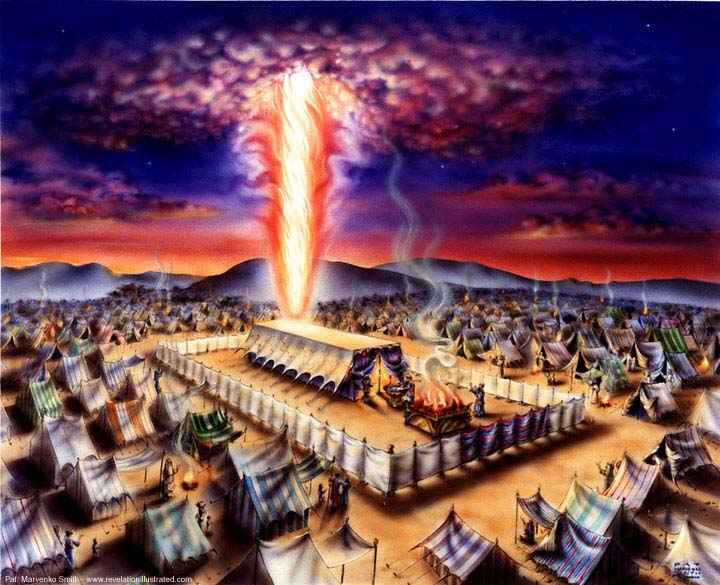
The Tabernacle of Moses from its entrance to its innermost room symbolically represents one’s progression in their spiritual journey starting with initial salvation progressing to the glorification of the physical body and eternal life in YHVH’s eternal spiritual kingdom. Understanding the pattern and steps to him that our Father in heaven has laid out in the tabernacle will give us deep revelation about where we have come from, where we are and where we must go to transcend this earthly existence while aiming at the heavenly goal that has been laid out before us.

Let’s now review the progressive steps in chronological order that YHVH has laid out in the tabernacle of Moses that is the blueprint of our journey toward him.
Entering through the front door of the tabernacle and progressing toward the holy of holies is from the human perspective represents the path one takes in their journey upward toward Elohim; it is the perspective of moving from the human to the spiritual plane of existence or that of the earthbound looking heavenward, and from a child gazing upward and longingly toward his father. However, from YHVH Elohim’s view from the glory cloud that has hovering over the holy of holies just above the ark of the covenant, the perspective would be different. It was from the inside looking out, or from heaven looking downward. From a father looking downward toward his beloved children. We will discus the contrasting viewpoints between the human and divine in a moment.
In the outer courtyard of the tabernacle, all the rituals and furnishings therein pointed to death and judgment, as well as to washing or cleansing. These prophetically foreshadowed salvation through Yeshua’s atoning death on the cross, with Yeshua being the door to salvation, and one’s need to accept his death on the cross for one’s sins followed by the need of baptism for the remission of sins.
In the set-apart (kadosh or holy) place inside the tabernacle, everything pointed to life, light, food, fragrant incense, the fruits and gifts of the Set-Apart or Holy Spirit, or, in other words, life in a spiritual relationship with Elohim subsequent to one’s taking the beginning steps in the salvation process.
In summary, the outer court symbolically represents the basic salvation requirements that heaven stipulates for the redeemed believer in Yeshua, while the holy place speaks of spiritual growth and maturity, and of moving upward from spiritual babyhood and then growing into spiritual adulthood or maturity.
To understand this process of growing in spiritual maturity, it is necessary to comprehend the tripartite composition of the human being. Paul speaks of man being subdivided into three parts—spirit and soul and body (1 Thess 5:23). The Tabernacle of Moses represents the tripartite nature of man in symbolic form. The tabernacle’s outer court relates more to the physical or bodily realm of the person, while the holy place represents the soul or intellectual, volitional and emotional aspects of one’s inner or psychological makeup. Finally, the holy of holies portrays man approaching YHVH through the realm of a person’s inner or personal spirit.
As one progresses into the tabernacle, it is as if YHVH is drawing a person into an ever deeper relational walk with him starting at the most basic level progressing upward until one is finally communing with YHVH on a Spirit-to-(human personal)-spirit level (in the most holy place). It is the Father’s desire that his children progressively grow until each of us is communing with him at the highest spiritual level (see John 4:23–24; 1 Cor 2:10–12; Prov 20:27).
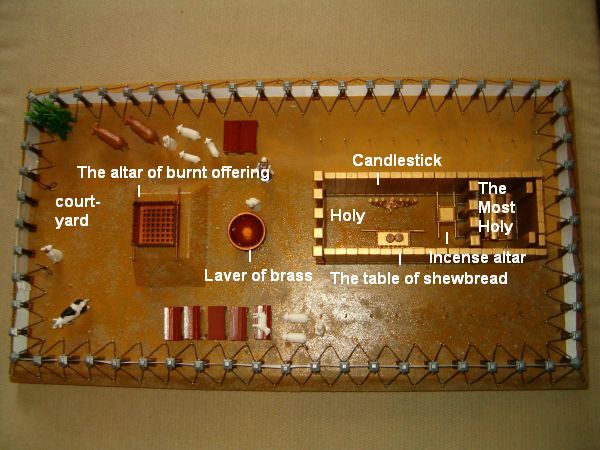
This forward progression in one’s spiritual journey toward our Father in heaven from the tabernacle’s entrance to its innermost room is but one way to view a person’s spiritual progression into the realm of the Spirit of Elohim. From YHVH’s perspective, looking from the inside of the tabernacle outward, the view changes. Although one must enter the tabernacle through the outer gate and then go through various rites and rituals relating to a cleansing process before being allowed into the tabernacle itself, at the same time, we see YHVH starting to work with the person from the inside out. That is to say, when a person initially comes into a spiritual relationship with his Creator, YHVH first regenerates the person spiritually by putting his Set-Apart Spirit into one’s personal spirit. In a sense, if the tabernacle is a picture of the tripartite subdivision of a person’s life (spirit and soul and body), then YHVH starts working from the inside out beginning in one’s personal spirit, which is one’s personal holy of holies that is inside of them. From there, the Set-Apart Spirit goes to work on the person’s soul (mind, will and emotions) to transform it spiritually into the mind or image of Yeshua (Rom 8:28–29; Rom 12:2 cp. Rom 7:13–8:17). This process will last a person’s lifetime. Finally, at the resurrection of the righteous saints at Yeshua’s second coming, the children of Elohim will receive their redeemed and glorified or god-like body (1 John 3:1–2) and be adopted into the family of Elohim (Rom 8:15, 23; Eph 1:5). At this time, they will become full-fledged, immortal spirit-children of Elohim (John 1:12; 1 John 3:1–3). Though the Bible teaches that humans can become sons of Elohim and be like him as part of his divine family, man can never be equivalent to Elohim in the fullest sense (Isa 45:5, 6, 12, 18–19, 21–23). Only Elohim is the Creator, is without a beginning, and is all powerful, all knowing and all present. Man will never attain to this level.
The miraculous and transformational process of man metamorphosing from being a physical and human creature to becoming an immortal and glorified child of the Most High, in theological terms, is called theosis, a Greek word meaning “deification or the act of becoming like deity.” This is an ancient Christian concept that is still held by many in the Eastern Orthodox Christian Church and refers to the spiritual process that occurs resulting in the deification of man. The goal of theosis is to become “like” (though not equal to) Elohim and to become eventually united with our Father in heaven in a deep familial way. Theosis is the biblical concept of a redeemed or spiritually regenerated individual “becoming a partaker YHVH’s divine nature” (2 Pet 1:4), and being adopted into the family of Elohim (see the verses below). It is about man becoming like Elohim and becoming part of the family of Elohim as a child of Elohim (John 10:34; Ps 82:1; 1 John 3:1–3).
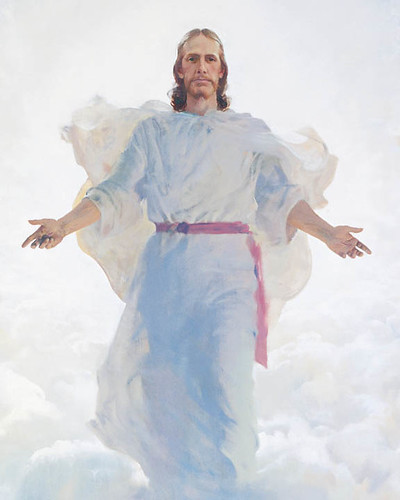
A person’s theosis process is an internal work of the Ruach haKodesh (the Set-Apart or Holy Spirit) and begins with repentance of sin, and then identification with Yeshua as the Son of Elohim at one’s baptism for the remission of sins. As one takes these initial first steps of becoming a son of Elohim at one’s baptism, it is then that one becomes a new creation through Yeshua and the work of his Set-Apart Spirit (Gal 2:20; 2 Cor 5:17). At that time, one is begotten or conceived as an embryonic child in the womb of the Holy Spirit. Later one, when one receives one’s glorified body at the resurrection of the righteous dead, one will be fully born or born again and adopted into the family of Elohim as a full-fledged son of Elohim, for, as the Scripture says, we will be like him, for we will see him as he is as John informs us in this first epistle:
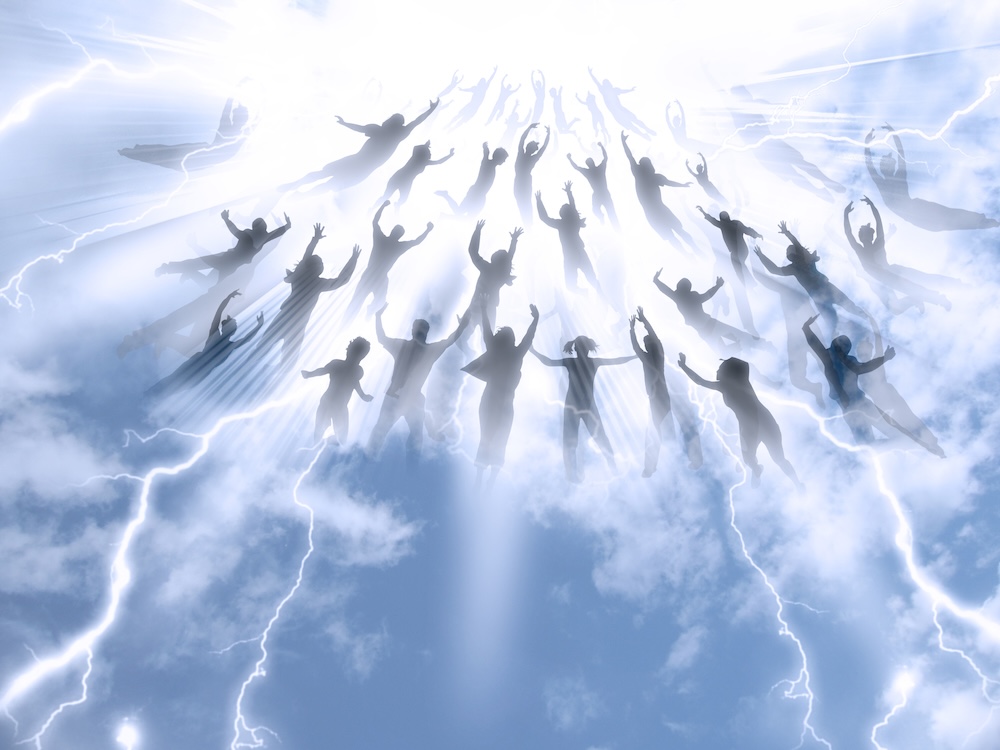
Behold, what manner of love the Father hath bestowed upon us, that we should be called the sons of Elohim: therefore the world knoweth us not, because it knew him not. Beloved, now are we the sons of Elohim, and it doth not yet appear what we shall be: but we know that, when he shall appear, we shall be like him; for we shall see him as he is. And every man that hath this hope in him purifieth himself, even as he is pure. (1 John 3:1–30
Paul refers to theosis in several places when he uses the term adoption.
For you have not received the spirit of bondage again to fear; but you have received the Spirit of adoption, whereby we cry, Abba, Father. (Rom 8:15)
And not only they, but ourselves also, which have the firstfruits of the Spirit, even we ourselves groan within ourselves, waiting for the adoption, to wit, the redemption of our body. (Rom 8:23; also 9:4)
To redeem them that were under the law, that we might receive the adoption of sons. (Gal 4:5)
Having predestinated us unto the adoption of children by Yeshua the Messiah to himself, according to the good pleasure of his will… (Eph 1:5)
The apostolic writers make further reference to theosis in several other places as well.
But as many as received [Yeshua], to them He gave the right to become children of Elohim, to those who believe in His name: who were born, not of blood, nor of the will of the flesh, nor of the will of man, but of Elohim. (John 1:12–13)
Grace and peace be multiplied to you in the knowledge of Elohim and of Yeshua our Master, as His divine power has given to us all things that pertain to life and godliness, through the knowledge of Him who called us by glory and virtue, by which have been given to us exceedingly great and precious promises, that through these you may be partakers of the divine nature, having escaped the corruption that is in the world through lust. (2 Pet 1:2–4)
Behold what manner of love the Father has bestowed on us, that we should be called children of Elohim! Therefore the world does not know us, because it did not know Him. Beloved, now we are children of Elohim; and it has not yet been revealed what we shall be, but we know that when He is revealed, we shall be like Him, for we shall see Him as He is. (1 John 3:1–2)

So, as we can seen, there are two spiritual processes going on at the same time in a person’s life as portrayed by the model of the Tabernacle of Moses. At the beginning of one’s spiritual walk, a person starts out in the physical dimension in the outer courtyard and then ends up in the spiritual dimension as represented by the holy of holies. The process of transcending from the physical to the spiritual plain is a lifelong process that involves spiritual cleansing from sin and unrighteousness that brings one progressively closer to YHVH Elohim as one becomes more and more like him until one is united with Elohim through “marriage” to Yeshua in the New Jerusalem. This is theosis.
At the same time, YHVH starts working in a person from the inside out by first redeeming one’s spirit, then one’s soul (the human mind, will and emotions) during one’s lifetime, and finally one’s body at the resurrection of the dead at the second coming of Yeshua. These two processes are occurring contemporaneously and synergistically to form a complete spiritual transformational work in one’s life resulting in a physical human being becoming an immortal child of Elohim, who has the character of Yeshua. Such a person is one that YHVH Elohim will be pleased to spend eternity with in the New Jerusalem, which is spiritually pictured by the glory cloud of YHVH’s presence that hovers over the holy of holies of the Tabernacle of Moses.
For theosis to occur, one must first have their personal inner spirit spiritually activated by Elohim. In one’s indigenous or innate spiritually unregenerate sin state, one is like an unlit candle that YHVH must supernaturally light with the divine light of his Set-Apart Spirit through a spiritual relationship with Yeshua. A person then become “sons of light” as opposed to children of spiritual darkness (John 12:36; Luke 16:8; Eph 5:8; 1 Thess 5:5). The Scriptures speak of this process.
But there is a spirit in man: and the inspiration of the Almighty giveth them understanding. (Job 32:8)
Who knoweth the spirit of man that goeth upward, and the spirit of the beast that goeth downward to the earth? (Eccl 3:21)
The burden of the word of YHVH for Israel, saith YHVH, which stretcheth forth the heavens, and layeth the foundation of the earth, and formeth the spirit of man within him. (Zech 12:1)
For what man knoweth the things of a man, save the spirit of man which is in him? even so the things of Elohim knoweth no man, but the Spirit of Elohim. (1 Cor 2:11)
A person cannot enter into a relationship with YHVH, who is a Spirit, through one’s soul (i.e., one’s mind, will and emotions). To do so is merely a human attempt to earn one’s own salvation. This is called humanism and is what drives all the false, non-biblical religions of the world as well as, to one degree or another, some religions purporting to be Bible-based (i.e., Christianity and Judaism). Elohim is a Spirit, and one must relate to him through the Spirit.
But the natural man does not receive the things of the Spirit of Elohim, for they are foolishness to him; nor can he know them, because they are spiritually discerned. (1 Cor 2:14)
But the hour cometh, and now is, when the true worshippers shall worship the Father in spirit and in truth: for the Father seeketh such to worship him. Elohim is a Spirit: and they that worship him must worship him in spirit and in truth. (John 4:23–24)
For a person to enter into a spiritual relationship with their Creator, one must do so through one’s spirit as opposed to the mind, will and emotions of one’s soul. This means that one’s spirit must be activated at the time of one’s spiritual birth. When this occurs, one receives in oneself the Spirit of Elohim, which activates and controls the personal spirit in that person, which in turn controls the soul (the mind, will and emotions), which in turn controls the body directing it what to think, say and do.
When we are begotten or conceived from above by the Spirit of Elohim, our personal spirit is activated is activated in a dynamic and powerful way with heaven’s divine light and energy.
The spirit of a man is the lamp of YHVH, searching all the inner depths of his heart. (Prov 20:27)
But there is a spirit in man, and the breath of the Almighty gives him understanding. (Job 32:8)
The Spirit bears witness with our spirit that we are children of Elohim (Rom 8:16)
That He would grant you, according to the riches of His glory, to be strengthened with might through His Spirit in the inner man, that Messiah may dwell in your hearts through faith (Eph 3:16–17)
Now we have received, not the spirit of the world, but the Spirit who is from Elohim, that we might know the things that have been freely given to us by Elohim. These things we also speak, not in words which man’s wisdom teaches but which the Set-Apart Spirit teaches, comparing spiritual things with spiritual. But the natural man does not receive the things of the Spirit of Elohim, for they are foolishness to him; nor can he know them, because they are spiritually discerned. (1 Cor 2:12–14)
But you have an anointing from the Set-Apart One, and you know all things.…But the anointing which you have received from Him abides in you, and you do not need that anyone teach you; but as the same anointing teaches you concerning all things, and is true, and is not a lie, and just as it has taught you, you will abide in Him. (1 John 2:20, 27)
And every spirit that does not confess that Yeshua the Messiah has come in the flesh is not of Elohim. And this is the spirit of the Antimessiah, which you have heard was coming, and is now already in the world. (1 John 4:3)
The Tabernacle of Moses is a glorious picture or template of this spiritual process that occurs deep within the minds and hearts of those who willingly submit to heaven’s transformational process. This is the way of the tabernalce (Ps 77:13)! Most humans refuse YHVH’s invitation to be transformed spiritually from the inside out because of their spiritual blindness, rebellion, stubbornness, pride and the deceitfulness of the pleasures of sin. For those who submit to YHVH’s plan of spiritual redemption, the process is difficult, but the end results are glorious! As we read in Scripture,
But as it is written, Eye hath not seen, nor ear heard, neither have entered into the heart of man, the things which Elohim hath prepared for them that love him. But Elohim hath revealed them unto us by his Spirit: for the Spirit searcheth all things, yea, the deep things of Elohim. (1 Cor 2:9–10)
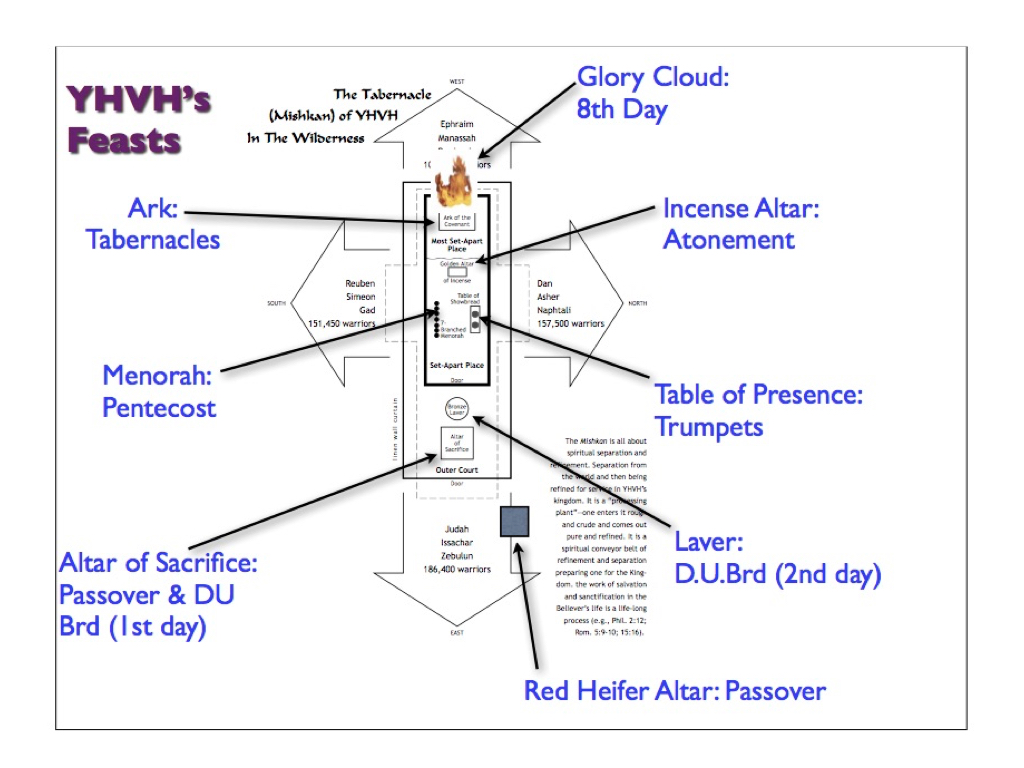
What’s more, the three pilgrimage festivals (Exod 34:18–22), when all Israel would go up to where YHVH had placed his name (Deut 16:2, 6, 11, 15), suggest this three-part spiritual progression in a believer’s life as well. The ceremonies occurring in the outer courtyard picture Passover and the Feast of Unleavened Bread, the menorah in the holy place symbolized by the Feast of Week, and the ark of the covenant in the holy of holies symbolizes the Feast of Tabernacles. We see, therefore, that the three pilgrimage feasts picture a person’s upward spiritual journey toward Elohim as one draws ever closer to him with the occurrence of each successive feast.
Sadly and to the shame of the mainstream Christian church, these truths are not taught, although they are hidden in plain sight in the pages of everyone’s Bible for all who have eyes to see, ears to hears and hearts to embrace.
So where would you place yourself in the tabernacle in terms or your spiritual progression toward Elohim in heaven? What object or location in the tabernacle best represents where you are at in your spiritual journey toward inclusion in YHVH Elohim’s eternal and spiritual family? Consider the mind blowing fact that, in ultimate reality, each of us should be everywhere in the tabernacle all at the same time.
In light of these spiritual truths, why did YHVH take such great pains to construct a physical layout of the steps that each of us must take in our own spiritual journey toward ultimate spiritual intimacy and oneness with him as represented by the holy of holies in his tabernacle, which also represented his dwelling place on earth among his chosen people (Exod 25:8)? It should be evident by now that YHVH is trying to reveal through illustrative means the deep spiritual mysteries of his plan of salvation and man’s ultimate spiritual destiny to those who have ears and eyes to hear and see and hearts to perceive.
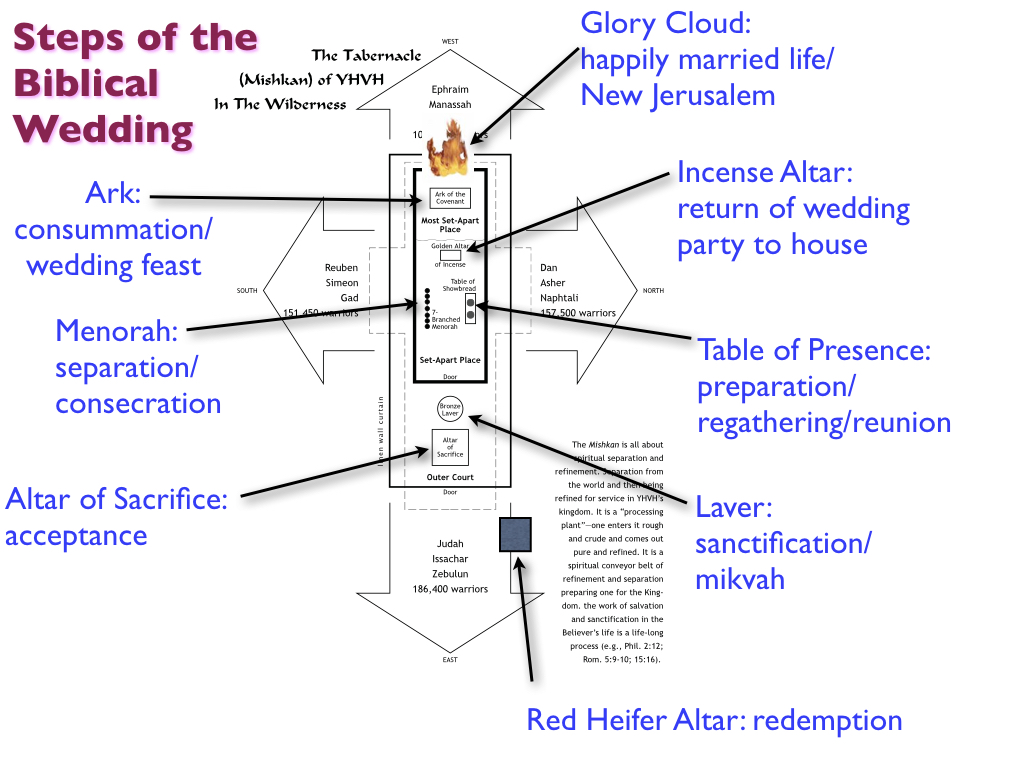
In conclusion, it is also interesting to note that there are also three stages in the Hebraic or biblical wedding. They are the betrothal, the consummation and the celebration stages. In the “godhead,” the Bible reveals that there are also three aspects or subdivisions. They are the Father, Son and the Set-Apart or Holy Spirit. Additionally, John talks about three classes of believers, which are children, young men, and fathers (1 John 2:12–14), which appear to represent three stages of spiritual progression or maturity.
All of these sets of three (the three parts of man, the three subdivisions of the Tabernacle of Moses, the three pilgrimage feasts, the three parts of the biblical wedding) all relate to each other and to YHVH’s plan of redemption of humans as he brings each person into an intimate and eternal spiritual relationship with himself through Yeshua the Messiah.
