

Genesis 32
Genesis 32:10, I am not worthy/I have been diminished [Heb. kato-n’tey]. “In some Bible versions, in the word kato-n’tey ,the letter tet is written smaller or diminished to show the utter humility and sense of unworthiness Jacob felt toward YHVH as he prayed for mercy and protection from Esau (The Wisdom in the Hebrew Alphabet, p. 123 by Michael Munk).
Genesis 32:13–15, Present for Esau his brother. This was a generous gift of great value. Possibly, Jacob out of righteousness, felt the need to make restitution to his brother for having “stolen” the birthright. This demonstrates the need for saintly people to right their wrongs in order to maintain a good witness to their unsaved or heathen neighbors. Of course, Jacob’s motives were not totally based on making restitution for past wrong. He was also trying “to save his skin,” so to speak, by appeasing his brother who wanted to murder him (v. 20).
Genesis 32:28, Israel.
The Meaning of the Name “Israel”
According to the top Hebrew lexicons, the words making up the name Israel can have several meanings:
- He rule (as) El (God).
- He contends with El.
- El persists, perseveres.
- Let El persist or contend
- To prevail or have power with El.
- The name Israel is comprised of two Hebrew words: sarah and el.
- Sarah (is a primitive verb root meaning “to prevail.”
- El means “God” and is the short form of the word Elohim (God).
Interestingly, the name Israel contains a couple of other Hebrew words although the lexicons do not indicate any lexical connection between them and the name Israel. These words are:
- Yashar meaning “straight or upright.
- Sar meaning “a head person, captain, ruler, chief, master or prince.” Sar is used in the famous Prince of Peace passage in Isaiah 9:6—a notable prophetic reference to Yeshua the Messiah.
Because of the similarities between the Hebrew words Israel and yashar and sar, some Bible students have taken the liberty to see within the name Israel some other meanings that the lexicons do not recognize. It is interesting to note these similarities, but whether there is a lexical connection between these words or not, we let the Hebrew language experts debate this issue.
Genesis 32:24–32, Jacob wrestling with the Messenger of YHVH.
Who Did Jacob Wrestle With? An Angel or the Pre-Incarnate Yeshua?
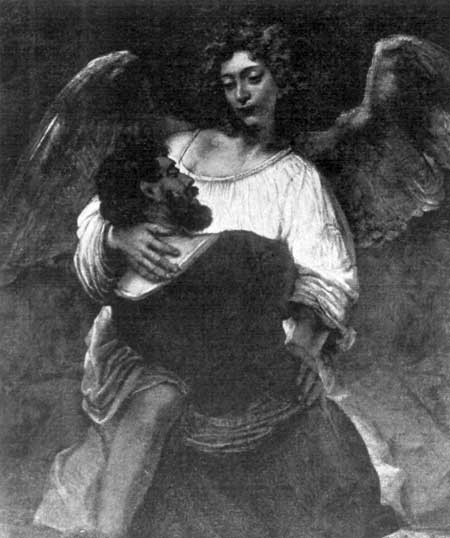
It is one of the classic Old Testament Bible stories. Along with Noah’s ark, David and Goliath, Jonah and the big fish, every Sunday school student has heard of the story of the patriarch Jacob wrestling all night with an “angel.” But who was this heavenly being? Was he actually a stereotypical angel as the text in Genesis 32 suggests, are is there more to this story? This is where Christians and Jews differ in their conclusions. Let’s explore this classic Old Testament story a little deeper. The truth may astound you and will likely help to deepen your faith!
And Jacob was left alone; and there wrestled with a man [Heb. iysh] or heavenly messenger [i.e., Heb. malak]. (KJV; cp. Hos 12:4)
In the following passages, we see that this man was Elohim.
You have power with Elohim and with men, and have prevailed. (verse 28, based on the KJV)
…for you have striven with the Divine [lit. Elohim] and with man and have overcome. (verse 28, The ArtScroll Stone Edition Tanach and Chumash)
Then Jacob says that he has “seen [Elohim] face to face” (KJV, CJB and The Soncino Edition Pentateuch, second edition). The two standard Orthodox Jewish versions of the Torah, The ArtScroll Stone Edition Tanach and The ArtScroll Stone Edition Chumash, and Samson Raphael Hirsch’s Torah commentary The Pentateuch (by Judaica Press)all read, “For I have seen the Divine face to face.” Here they have incorrectly translated the Hebrew word Elohim as “the Divine”(OHBP OHVKT/Elohim panim).
Which translation of the word Elohim is the correct one? Before resorting to human sources to solve this dilemma, let’s allow the Word of Elohim itself to interpret this passage, thus giving us clarity as to its exact meaning. Hosea 12:2–5 is the Bible passage that sheds light on this issue.
[YHVH] hath also a controversy with Judah, and will punish Jacob according to his ways; according to his doings will he reward him. He took his brother by the heel in the womb, and by his strength he had strove with [Elohim]. He strove with an angel [Heb. malak or heavenly messenger in many instances referring to YHVH himself, as noted elsewhere in this work] and prevailed: he wept, and made supplication to him; he found him in Beth-El, and there he spoke with us; and [YHVH Elohim] of hosts; [YHVH] is his name. (based on the KJV)
The Stone Edition Tanach renders this passage as follows (starting in verse four):
In the womb he seized his brother’s heal, and with his strength he struggled with [an angel of] God; he struggled with an angel and prevailed; [the angel] wept and beseeched him: ‘In Beth-el He will find us and there He will speak with us.’ HASHEM is the God of Legions; HASHEM is His remembrance. (bracketed supplied word are in the original)
So which translation is correct? The first one indicates Jacob was wrestling with a Heavenly Messenger, who was none other than YHVH Elohim, while the second translation is cast in such a light as to imply that Jacob was wrestling merely with an angel.
The Hebrew word Elohim does not mean “the Divine.” Rather it means “God.” It is interesting to note that in the Authorised Version (or KJV) the word Elohim appears 2606 times in the Tanakh. It is translated as God 2346 times, god 244 times and as several other words less than five times each (e.g., judge, goddess, great, mighty, angels). As in all cases with a word which can have several meanings, the context of the Scripture passage will determine a word’s meaning and its subsequent translation from the original language into English. The word divine was not employed in the 1611 (KJV) Authorized Version in reference to Elohim anywhere in the Tanakh, since the word had a pejorative connotation (as in divination or one who divines the future). This is not the case in our modern parlance as the modern Webster’s New Collegiate Dictionary defines divine in its primary definition as “relating to, or proceeding directly from God, being a deity, directed to deity.” All standard English (Christian ) versions (e.g., NKJV, NAS, NIV, NRSV) translate this passage as “God face to face” and none use the term “the Divine face.” The New Brown-Driver-Briggs-Gesinius Hebrew-English Lexicon defines Elohim (in those Scripture passages where it is a clear reference to deity, as opposed to a goddess or a human judge) as “the true God, Yahweh is (the) God.” Never does this Hebrew lexicon define Elohim as “the Divine.” Similarly, nowhere does the The TWOT in defining the word Elohim suggest that the Divine could be an appropriate substitute for the title of YHVH. So we must ask, why do the two Jewish translations of this passage (noted above) run cross grain to a plethora of other translations, both Jewish and Christian, as well as to noted lexicographers to translate it as they do? This likely a case of translation bias, where translating Elohim panim as Elohim face to face as so many other translators do would be a tacit admission that Elohim can appear as a man, hence giving credence to the Christian assertion that Yeshua was Elohim in the flesh. But before jumping to conclusions, let us examine other passages in the Tanakh where Elohim and man come face to face. Let’s see how the non-Yeshua believing Jewish translators treat these passages, and discover how their commentaries explain these difficult passages.
The following are what some leading rabbinic Jewish commentaries say about these passages where Elohim appears in humanesque form.
The Stone Edition Chumash (pages 176–177): This commentary states that the man with whom Jacob wrestled was an angel (no doubt based on the passage found in Hosea 12:4), yet the fact that the malak was an angel in the common meaning of the word, is an assumption, since, as we have already noted, malak literally means “messenger,”and in this context heavenly messenger meaning “angel”is but one type of heavenly messenger. Furthermore, the Chumash defines the word malak as “Divine.” What is the terminology here supposed to imply, based on the meaning of the word divine? Was the angel deity or not? At the very least, the reasons given for explaining away the idea that Jacob was wrestling with Elohim are ambiguous if not totally misleading or even deceptive.
The Soncino Edition Pentateuch (p. 124) commenting on Genesis 32:29 and Hosea 12:4 states, “We have here another instance of ‘God’ interchanging with ‘angel of God’, as in [Genesis] 16:7 [and] 31:11.” On verse 31 other Jewish commentators states, The Targum (the Aramaic translation of the Pentateuch made in the second-century) “was in response to the spread of Christianity, when proponents of the new religion began to interpret certain passages to accord with their own doctrines” (The Encyclopedia of the Jewish Religion, p. 376). This then supposedly gives justification to why the modern Jewish scholars understand these verses to mean “I have seen angels of God face to face” (The Soncino Edition Pentateuch, p. 124). One can only wonder if the Targum’s translation of this passage and the subsequent rabbinic interpretations of the same is not an example of these translators and commentators redacting these Bible passage in an attempt to steer their readers away from the fact that YHVH appeared to Jacob in the form of a man (as a plain reading of the text indicates)—a conclusion that could then pave the way for the Christian belief that Yeshua the Messiah was YHVH incarnate (in the flesh) as per John 1:1 and 14 (and other both Old and New Testament passages).
The ArtScroll Bereishis/Genesis commentary postulates a total different explanation as to who Jacob wrestled with. Was it Elohim, an angel or something else. These commentators state, “The ‘man’ who struggled with Jacob was not a human being, nor was he an ordinary angel. As Rashi comments, the ‘man’ was Samael, the guardian angel of Esau” (p. 1397) who was the angel of evil (ibid.p. 1437). The commentary goes on to say that not all Jewish sages agreed with Rashi’s assertion. Tanchuma suggests that this was the angel Michael, while R. Bachya “perceives this as symbolizing the righteous person’s inner struggle against the forces of evil.” Rambam “regards this incident as a prophetic vision (just as he regards Abraham’s vision of the three angels in [Genesis] 18:2f). Ramban…challenges this vigorously, posing many questions (for example: If Jacob’s wrestling was only a vision, why did he limp when he awoke? Abarbanel cites Ralbag who in defense of Rambam, holds that Jacob’s hip injury might have been caused by autosuggestion, an aftermath of the prophetic vision” (ibid.). And the debate between the rabbinic Jewish scholars continues on and on without any resolution as to the nature of the angel with whom Jacob wrestled, when the plain meaning of the literal words of the text clear state that Jacob wrestled with Elohim!
As these quotes have been provided (and there are more to come) to show the reader that there are some things that the Jewish sages, for all their learning, brilliance, respectability and passion for Torah, simply cannot figure out. Some will even contrive fantastical scenarios and explanations in an attempt to explain a passage in a certain way, while leaving out some of the more obvious conclusions.

To the sages’ credit, they have in mind the passage in Exodus 33:20, which states that, “You cannot see my face, for no man shall see me and live.” This, the reader will recall, is the occasion where Moses requested to see the glory (or splendor) of YHVH Elohim (verse 18). Indeed, it is obvious that no man can look into the glorious face of the One who made the Sun, which is the smallest of billions of stars, and expect to live. Yet is it possible for the same YHVH to place all his glory “on the proverbial shelf,” so to speak, and to appear to man without his full glory? Obviously, YHVH being all powerful, can do anything he pleases. If this is possible, then can Jacob have seen the face of Elohim temporarily without his glory and Exodus 33:20 still be valid? After all, the sages have numerous reasons, and some very creative ones, to explain why Elohim is actually an angel in Genesis 32, when a simple explanation, based on the literal meaning of the text, could easily suffice to explain why the Being Jacob encountered really was Elohim, as the Scriptures so plainly states.
Rashi (Shelomoh Yitzhaki, 1040–1105), considered by some to be the most notable Orthodox Jewish Torah commentary of the modern era, should have some notable comments on verses 28 and 30 (The Sapirstein Edition Rashi, The Torah) regarding Jacob’s the nature of the being with whom Jacob was wrestling. Was it Elohim, an angel, or something else? In fact, he has no comments at all in his venerable commentary (pp. 371–372). It must be noted at this point that not only can one learn much from what the Jewish sages say, but one can learn as much by what they do not say—especially when they comment voluminously on the Biblical passages preceding and proceeding a certain troublesome verse, but say little or nothing on a particular, especially controversial, passage.
As noted above, Rashi does cite certain rabbinic traditions equating the man Jacob wrestled with to the ministering angel of Esau (p. 370). He also notes, as further discussed below, that the phrase in verse 24, “a man wrestled” can mean, “and a man became dusted” because, according to the meaning of the Hebrew words, this phrase can literally mean, “because they raised dust with their feet through their movement” as they wrestled (p. 370).
Let us now turn our attention to the comments of noted nineteenth-century German rabbinic scholar and founder of neo-Orthodoxy, Samson Raphael Hirsch (1808–1888). On verse 30, Hirsch admits that “Jacob recognized in his opponent, something divine, something justified, appointed by God.” Then Hirsch pens a fictional conversation that Jacob and the Heavenly Messenger might have had where the Messenger states that he is a Messenger of God, created of Elohim, yet neither an ordinary angel nor deity (The Pentateuch—Genesis, vol. 1,p. 507). This idea is similar to that expressed by other rabbinic writers that this was Samael, the guardian angel of Esau, “a man who climaxed the Patriarchal tradition” (The ArtScroll Bereishis/Genesis commentary, p. 1397)
What does another eminent Jewish Torah scholar state in his commentary regarding who Jacob wrestled with in Genesis 32? Let us now analyze what Jacob ben Asher (c. 1270–c. 1343), who is known as Baal HaTurim (The Davis Edition Baal HaTurim Chumash—Bereishis), says in his commentary. Virtually nothing! He simply refers to the man with whom Jacob wrestled as “the angel” and fails to comment on the fact as stated in verses 28 and 30 that this individual was Elohim in human form (p. 307). Again, we can learn much from the silence of the rabbinic Jewish sages.
Baal HaTurim does have some interesting comments on verse 24 which says, “And Jacob was left alone; and there wrestled a man with him until the breaking of the day.” Here Baal HaTurim says that the gematria (the letter-number valuation of the Hebrew letters) of the phrase, “a man wrestled” is 118, which equals that of the phrase, “the throne of glory” (The Talmud, Challin 91a). The phrase “a man wrestled” can also mean “he covered with dust” or “he raised dust” in reference to the fact that during the wrestling match the two men stirred the dust of the ground as they entangled. Baal HaTurim gives a fanciful explanation of this wording. He states that as they wrestled they raised dust heavenward to the throne of glory (ibid., p. 305). This must have been quite the dual!
So regarding the rabbinic Jewish commentary regarding the identity of the individual with whom Jacob wrestled, what is the bottom line? Simply this. They refuse to admit that Jacob was wrestling with Elohim, even though the Torah clear states otherwise. Moreover, and even worse is that these Jewish scholars are prone to concoct fanciful, non-biblical explanations as to why this being was not Elohim. They state that he was an angel, some divine being, no ordinary angel, or Samael, the demon-guardian angel of Esau. They debate and argue and sometimes contradict each other and themselves as to who this Being was. There is much confusion and uncertainty. But one thing about which they can all agree: he was not Elohim in human form. On this point the honest inquirer is compelled to ask, “Why?” Is it because the sages refuse to admit what the Christians have been saying all along, that the Being with whom Jacob wrestled was a preincarante appearance of Yeshua the Messiah?
Now consider this. As noted above from the Jewish sages’ own writings, the meaning of the Hebrew text, “a man wrestled” (verse 24) can signify “a man covered with dust” or “raised dust to the throne of glory.” If Jacob saw the “face of Elohim” as verse 30 states, and Yeshua in the Gospels clearly declares that no one has seen the face of the Father (John 1:18), then how do we reconcile these two passages without breaking the Scriptures (John 10:35)? Was Jacob indeed wrestling with Yeshua in his preincarnate state? Is this preposterous? The sages have no clear answers to this difficult passage—only numerous reasons why it cannot be so, when all they lack is one good reason why it could be so, especially when confronted with the plain meaning of the Scriptures, which states that Jacob was wrestling with Elohim.
If this was Yeshua in his preincarnate state, could the rabbinical “covered-in-dust” actually be a cryptic metaphor for Elohim being clothed in humanity—a concept that confirms the New Testament’s claims about the incarnation of Yeshua, as well as the Christian belief that the pre-incarnate Yeshua appeared on a number of occasions in the Tanakh in human form (called theophanies or christophanies)? Could this not be a picture of Elohim condescending himself to come to earth in human form from the throne of glory covered in the clay dust of human flesh (see Phil 2:5–8) wrestling with the carnal, prideful and devious nature (of which Jacob, the heel snatcher or supplanter, was a type), breaking the stubborn will of man, wounding the flesh (Jacob left the dual wounded in the hip), and left with a new name and identity (Israel meaning “prince, power, strength and prevailer of El”)? We believe so.
In the end, Jacob left this spiritual encounter with YHVH a new, changed, humbled and wounded-in-the-flesh man ready to encounter Edom (representing the spiritual enemies that the saint will face as he treks through the wilderness of life before entering the “Promised Land” of YHVH’s kingdom) and overcome his enemies no longer in his own human strength, but with the spiritual power and blessing of YHVH at work in his life. Jacob was now ready to enter Beth-el (House of El) of the Promised Land as a spiritually resurrected new man in Yeshua the resurrected God-man.
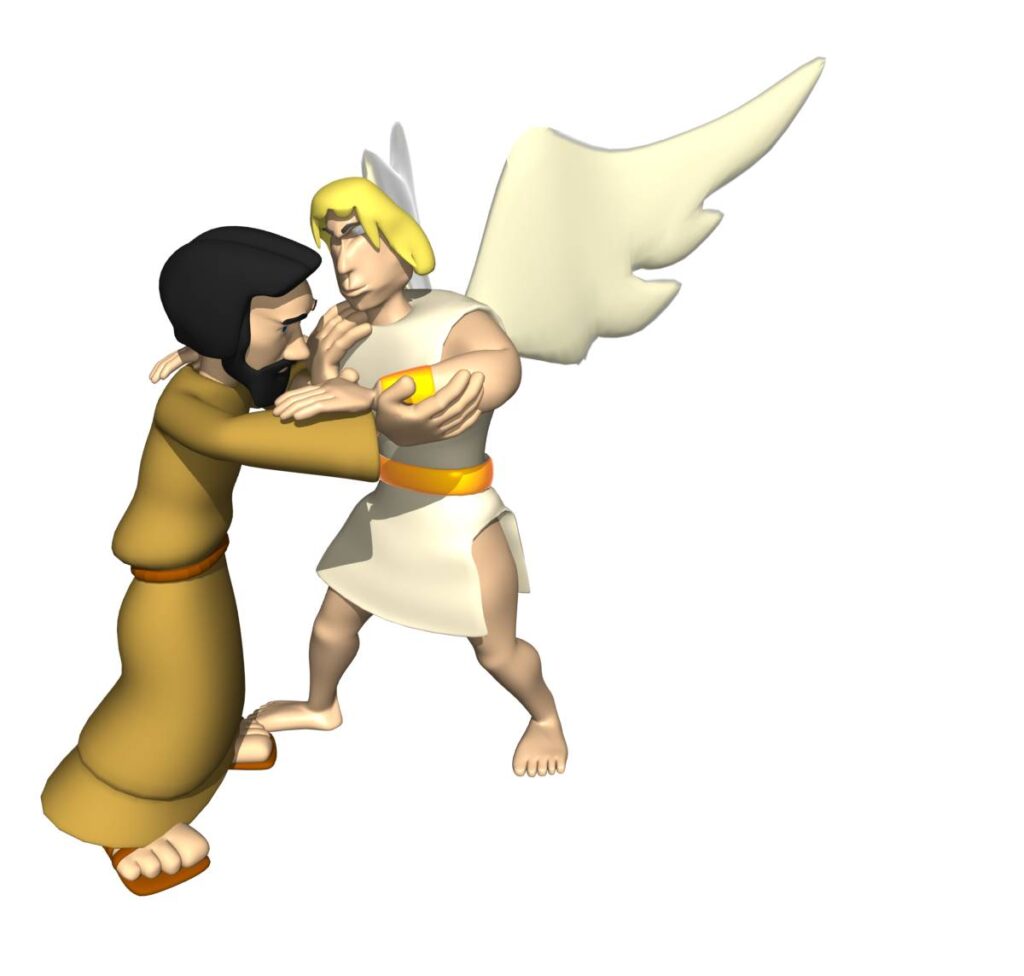
Genesis 32:24–32, A Man. This is the account of Jacob wrestling with someone, but who? In verse 24, who does it say Jacob wrestled with? Let’s read Hosea 12:3–4 for a fuller comprehension of who this divine individual was. Hosea the prophet informs us that the “angel” with whom Jacob strove was none other than Elohim himself. The Hebrew word for angel is malak, which means “messenger” whether human, angelic or divine. Thus by definition, an “angel” in the Bible can be the stereotypical angel, a human messenger or a member of the actual Godhead acting as a divine messenger to humans. In Genesis 32:30, Jacob names the spot where he wrestled with the “angel” Beth-El or House of El. Obviously, in Jacob’s mind, he had encountered Eohim, not your stereotypical angel.
So why does Scripture use a term for the Being with whom Jacob wrestled that can mean “a man, a messenger and Elohim”? Isn’t this ambiguous or confusing? Or, on the other hand, is there Someone that the Bible reveals who fits all three of these definitions, or stated otherwise, Who is the only One in all of Scripture that fits all three of these descriptions? So with whom did Jacob really wrestle? Who is the One who blessed Jacob and made covenants with him and with his father and grandfather? We find the answer turn in Isaiah chapter 53, which is the chapter that speaks about the Suffering Servant Messiah who would come to redeem man from his sins through his atoning death. Of the Messiah, in verse one we read,
Who hath given credence to that which we heard? And the arm of Jehovah, On whom hath it been revealed?
Who is the “arm of YHVH” that now sits at the right hand of YHVH in heaven (1 Pet 3:22)? If you are still not sure, read the rest of Isaiah 53 for the answer. It is none other than Yeshua the Messiah! He is the same One who led the children of Israel through the wilderness (for further proof see Acts 7:37–38 and 1 Cor 10:4 cp. John 8:58).
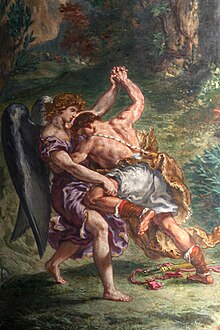
Genesis 32:24, Wrestled with him. Why did Elohim wrestle all night with Jacob? Why not just wound him early on and save the time and trouble? This teach us much about the long-suffering nature of Elohim, who will continue to strive with us and our carnal weaknesses and self-reliances, until we finally submit to him and recognize that only through him can we have real strength and victory, though we might end up physically lame in the process. Why the wrestling all night“till the breaking of the day”? Biblically night and breaking of day can metaphorically represent the struggles, trials and difficulties that humans often experience in their lives. Jacob’s night-long struggle teaches us much about faith, the struggles of this life and about not giving up until the very end when the blessings and dawning of a new day are about to break forth. Jacob’s struggle is an inspiring example about prevailing faith in Elohim and not giving up despite the spiritual darkness that surrounds us and the struggles that we face in life.
At the end of his struggle, Jacob received the new name of Israel (verse 28). Through this struggle, he took a quantum leap spiritually and became a new man with a new identity. Has this ever happened to you? Don’t we progress spiritually only out of crisis? “There is no gain where there is no pain,” as the saying goes.
What were the positive results of Jacob’s struggle? Verse 32 says of Jacob, “as he passed over Penuel the sun rose upon him, and he limped upon his thigh.” The Hebrew word penuel means “faces of El.” Taking a little poetic license (at the drash, allegorical or third level of Hebraic biblical interpretation) here, we could paraphrase this verse as follows: “As Jacob emerged out of the darkness of self-reliance, the face of Elohim shined favorably upon him as he no longer relied on the flesh.” Pause to reflect on this for a moment and take quick stock of your own spiritual walk in the light of these words.
Who are some other notable Biblical characters besides Jacob who struggled with trying to achieve their divine mission through human means? The most notable example is the patriarch Abraham who tried to fulfill YHVH’s will through his sexual relations with his mistress Hagar. Moses attempted to deliver his fellow Israelites from the hands of their enslavers when he murdered the Egyptian. Peter when he cut off the ear of the high priest’s servant in an attempt to deliver Yeshua from the hands of his captors. What did these biblical figures learn from their mistakes about walking in the Spirit versus walking in the flesh?

Now consider your own life. Have you ever struggled between doing your will versus submitting to the will and ways of Elohim? How did it go? What lessons did you learn?
Sadly most people clueless about the spiritual battle that is occurring in their lives; they just live their lives reacting impulsively to life’s situations without considering the consequences of their actions or critiquing themselves with an eye on self improvement. This is because they are unaware that there is a higher way to walk instead of simply following the natural impulses of their human nature, which is a downward spiraling slippery slope.
The only way to know that there is higher way is to walk in the Spirit of Elohim through a spiritual relationship with Yeshua the Messiah, and to learn about the heart, mind and will of the Creator. How do we accomplish this? Like Jacob, by acknowledging the fact that our ways haven’t worked out so well for us and that we need help from above. This involves repenting of our sin (i.e., going against the ways of Elohim), receiving Yeshua as our Lord and Savior, and then studying the words, ways and will of Elohim in the Bible, and by studying the lives and examples, both the failure and successes, of the people written about therein, and then by conforming our lives to the truth of the Bible. In this manner, we will begin to emerge from the darkness of sin and carnality and will become a child of the light (1 Thess 5:1–5) of YHVH’s Truth with a new awareness, a new identity as an overcomer, a conqueror, and child or prince of El, like Jacob becoming Israel.
Genesis 32:28, Jacob but Israel. Jacob/Ya’acov means “heel snatcher/holder or supplanter,”while Israel/Yisra’el means “Prince of El or El Prevails/Prevailer with El.” What can we learn about the change of Jacob’s character as reflected in the changing of his name? Who is the focal point of the name and the initiator of the action in the first name…in the second name? Now apply these principles to your own life as you learn from the lessons of Jacob’s life

Genesis 32:32, The muscle that shrank. Please notice that the sinew, representing the strength of Jacob’s, flesh only shrank. It was not removed. What does this signify spiritually with regard to the redeemed man’s old sin nature? Simply this. At the point in one’s spiritual journey when one is regenerated by the Spirit of Elohim, a person doesn’t lose their identity, personality or soul (i.e., his mind, will and emotions). Rather, they become a new man with a new spiritual identity and a new upward orientation.
In the process of dying to oneself, what then happens to a person’s soul? It must be transformed and renewed by the Spirit of Elohim to be conformed to YHVH’s perfect will (Rom 12:2). One’s soul (their mind, will and emotions or personality) will still try to assert dominance over their personal spirit that resides inside of them, but one must learn to submit their soul and spirit to the Spirit of Elohim, that is, to the mind, will, ways and Word of Elohim, their Creator.
Paul discusses the struggle between the soul and the spirit in Romans 7:14–25. This is the same struggle that Jacob faced in his dark night of the soul when wrestled not only with his own carnal limitations, but with the preincarnate Yeshua the Messiah. There he died to his own will and finally submitted totally to that of his Heavenly King. There Yeshua not only became his Savior but also his Lord and Master. Jacob’s struggle is the same struggle that each of us faces. Will we overcome and become a new person with a new spiritual identity and receive heaven’s blessing, or will we hang on to our old ways and keep beating our heads aimlessly and pointlessly against the wall of our own limitations? The choice is ours.
Genesis 33
Genesis 33:9, I have enough.
Esau—A Picture of Materialistic, Carnal and Laodicean Christian
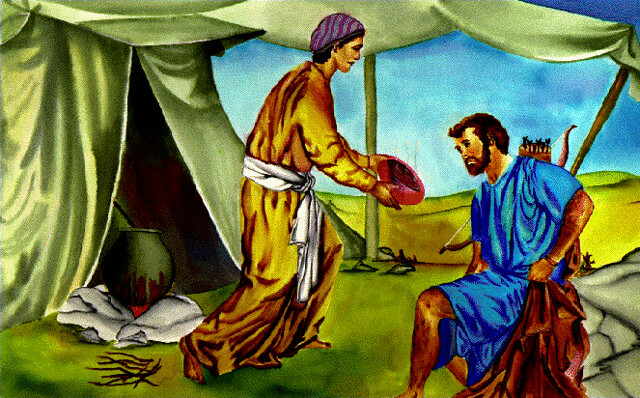
Esau’s positive response to Jacob is proof that he cared nothing for his birthright nor for the covenant that Elohim had made with Isaac his father or Abraham his grandfather. Esau was a worldly man and materialism and sensual pleasure was the chief aim of his life, and not seeking the higher spiritual rewards that come from righteous obedience to YHVH..
In the twenty years that the two brothers hadn’t seen each other, Elohim had prospered Esau who was now wealthy; he didn’t need Jacob’s gifts, which were substantial, for he already had enough wealth such that these gifts seemed a small thing to him. This is why he declared that he had enough already, and as a form of bragging over his vast wealth, he encouraged Jacob to keep the gifts.
How had Esau become wealthy? Likely, he inherited the physical wealth of Isaac, which would have gone to someone. Since Jacob was in Babylonia, Isaac’s fortune would have logically gone to Esau. So in the end, Esau inherited Isaac’s material wealth as he had longed for all along. But he did not inherit the greater riches—Isaac’s spiritual wealth, which Esau spurned. On the other hand, while Jacob did not inherit the physical wealth of his father, YHVH not only made up for his loss by prospering him through Laban, but Jacob also received the spiritual and covenantal wealth of his father and that of Abraham his grandfather. So Esau inherited earthly, temporal but no eternal, everlasting wealth, while YHVH blessed Jacob with both temporal, physical wealth as well as everlasting riches than cannot be taken away, but endure into eternity. The learned lesson is that those who put their faith in and serve and obey YHVH are blessed both in their physical life as well as into eternity. This double blessing is not a bad deal at all! Similarly, how many righteous saints have had their physical inheritances stolen from them by unscrupulous family members or other covetous people (including civil governments, “Christian” ministers and ungodly church organizations)? These have wormed their way into families through legal or illegal means and stolen what rightfully belong to the righteous. Yet despite the malfeasance and criminality of others YHVH, in his loving sovereignty, still provides for and blesses his people in unexpected and spectacular ways both materially and spiritually. Thus, we continue to hope in and wait on YHVH our Elohim, who supply all of our needs according to his riches in glory (Phil 4:19). The Bible also tells us,
Be of good courage, and he shall strengthen your heart, all ye that hope in YHVH. (Ps 31:24)
My soul waiteth for the Lord more than they that watch for the morning: I say, more than they that watch for the morning. Let Israel hope in YHVH: for with YHVH there is mercy, and with him is plenteous redemption. (Ps 130:6–7)
Trust in YHVH, and do good; so shalt thou dwell in the land, and verily thou shalt be fed. Delight thyself also in YHVH; and he shall give thee the desires of thine heart. Commit thy way unto YHVH; trust also in him; and he shall bring it to pass. And he shall bring forth thy righteousness as the light, and thy judgment as the noonday. Rest in YHVH and wait patiently for him: fret not thyself because of him who prospereth in his way, because of the man who bringeth wicked devices to pass. Cease from anger, and forsake wrath: fret not thyself in any wise to do evil. For evildoers shall be cut off: but those that wait upon YHVH, they shall inherit the earth. For yet a little while, and the wicked shall not be: yea, thou shalt diligently consider his place, and it shall not be. But the meek shall inherit the earth; and shall delight themselves in the abundance of peace. (Ps 37:3–11)
Had Esau grieved over loosing his birthright, he would still have had a grudge against Jacob. But the fact is that Esau had never cared about his spiritual inheritance in the first place, which is why he sold his birthright for a bowl of beans; he cared only about inheriting the substantial wealth of Isaac, his father, which he in fact obtained. In the course of time when substantial wealth accrued to Esau, the spiritual and covenantal birthright was no longer an issue. His dramatic act over losing his spiritual inheritance was merely pretense that revealed the true motives of his heart, which were purely physical and not spiritual, as evidenced twenty years later by his statement in this verse, “I have enough.”
In reality, though physically wealthy, Esau was spiritually a destitute man, for he lacked and even spurned the true riches of heaven. As a secular and carnally-oriented man, he preferred the immediate gratification of the material blessings of this life, rather than the delayed gratification of the higher and true riches from heaven—something both his father, grandfather and brother had chosen (Heb 11:10, 16). The beautiful thing is that because the patriarchs had all sought first the kingdom of Elohim and his righteousness, they also received physical blessings here and now (Matt 6:33). Esau, on the other hand, received only physical blessings, but lost out on heaven’s true wealth of eternal rewards and blessings.
There is more to learn from this story. Many people put on religious fronts, airs and pretenses for show to impress those around them, but it is done out of selfishness, covetousness and for personal gain. Their religiosity is merely a mask to cover their nefarious schemes and to hide the true motives of their dark and evil hearts. With their mouths they may say one thing, while their actions, reveal the true ulterior motives of their evil, nefarious and scheming hearts. That is why Scripture instructs the saints to be like their Father in heaven and not to judge people and things by their appearance, but by the fruits (Matt 7:15–20). This is called judging righteously (John 7:24; 2 Cor 2:15).
Those who put on facades are often living a lie. The church is full of such people. Elohim is not fooled. He sees who the “Esaus’ are that are sitting in the pews playing religious games. Of such people, Yeshua warns,
“I know your works, that you are neither cold nor hot. I could wish you were cold or hot. So then, because you are lukewarm, and neither cold nor hot, I will vomit you out of My mouth. Because you say, “I am rich, have become wealthy, and have need of nothing”—and do not know that you are wretched, miserable, poor, blind, and naked— I counsel you to buy from Me gold refined in the fire, that you may be rich; and white garments, that you may be clothed, that the shame of your nakedness may not be revealed; and anoint your eyes with eye salve, that you may see. As many as I love, I rebuke and chasten. Therefore be zealous and repent. Behold, I stand at the door and knock. If anyone hears My voice and opens the door, I will come in to him and dine with him, and he with Me. To him who overcomes I will grant to sit with Me on My throne, as I also overcame and sat down with My Father on His throne.” (Rev 3:15–21)
Genesis 33:17, Succoth…booths. (Heb. sukkah; LXX. skeenas) This verse shows the biblical connection between a sukkah and a manger. The implication is that though the Gospels say that Yeshua was born in a manger (Luke 2:7), it could just as well have been a sukkah during the Feast of Tabernacles or Sukkot.
Genesis 33:19, He bought. Like Abraham, Jacob had to buy a parcel of land from the Canaanites, even though this was the land YHVH had promised to him and his descendants. Despite having to buy his own land, Jacob’s faith was undeterred and he still believed YHVH’s promises, even though it appeared that these promises were not being fulfilled…at least yet. Jacob even had to flee this purchased land after the Shechem massacre (Gen 34:30–35:1).
Genesis 33:20, El Elohe Israel. Lit. El/God meaning “the (or mighty, supreme) Elohim/God of Israel.” Because Elohim had brought Jacob safely and prosperously back to Canaan, this was proof in his mind of Elohim’s reality. He knew about Elohim vicariously through his father and grandfather, but until he had seen the reality of Elohim at work in his own life and the benefits of serving the El of his fathers, he didn’t own the concept; it wasn’t in his heart. Now his faith became a reality, for his faith had gone from his head to his heart, which is why he built an altar and named the place, “the Elohim of Jacob” or, in essence, “El Is My Elohim,” not just the El of my fathers that I have heard about and is our family tradition to follow. Elohim had engineered the circumstances of Jacob’s life to bring him to this point. Jacob had to flee Haran from a man who wanted to kill him only to find himself walking into the jaws of another man who wanted to kill him. It was in this dark and tight spot that Jacob found salvation from his enemies and discovered the reality of a personal relationship with the Messenger of Elohim, that is, the Word of Elohim who became the Messiah.
Genesis 34
Genesis 34:1, Dinah…went out.
Friendship With the World Does Not Pay Off as Dinah Found Out the Hard Way!
The lure of friendship with the world is a powerful one. Youth are especially vulnerable to the alluring attractions and carnal enticements of the world, since these offers things that are new and exciting. They promise to satiate the appetites of the flesh. But this is not always for one’s ultimate good as Dinah soon and sadly discovered.
In Genesis chapter 34, we pick up this story.
And Dinah the daughter of Leah, which she bare unto Jacob, went out to see the daughters of the land. (Gen 34:1)
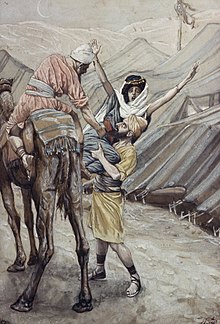
Dinah’s was drawn to forming friendships with her pagan, Canaanite neighbors resulting in a sorry affair between the sons of Jacob and the inhabitants of Shechem. Dinah’s was kidnapped and raped leading to the massacre of the Shechemites.
And when Shechem the son of Hamor the Hivite, prince of the country, saw her, he took her, and lay with her, and defiled her. (Gen 34:2)
The result was a feud between the sons of Jacob and the inhabitants of Shechem resulting the slaughter of all of the men of that city as retribution for what happened to Dinah (Gen 34:3–31).
This all could have been avoided had Dinah kept clear of the evil influences of her heathen neighbors. We all know people who have been drawn away from the protective covering and influence of godly families and fallen prey to the evil intentions of wicked people. James the apostle warns us,
Ye adulterers and adulteresses, know ye not that the friendship of the world is enmity with Elohim? Whosoever therefore will be a friend of the world is the enemy of Elohim. (Jas 4:4)
Similarly, John states,
Love not the world, neither the things that are in the world. If any man love the world, the love of the Father is not in him. For all that is in the world, the lust of the flesh, and the lust of the eyes, and the pride of life, is not of the Father, but is of the world. (1 John 2:15–16)
The lure of the world’s acceptance is a dangerous one that leads one down a slippery, spiritual slope as Paul opines.
Do not be deceived: Evil company corrupts good habits. (1 Cor 15:33)
Elsewhere, Paul warns the young Timothy,
Flee youthful lusts. (2 Tim 2:22)
If the enticements of the world weren’t such a difficult temptation to resist, then he would not have urged young people to flee them!
Furthermore, YHVH, our loving Heavenly Father would not be urging his people to come out of the world (Rev 18:4; 2 Cor 6:14–17). Moreover, Solomon, the wisest man who ever lived, and who knew something about the alluring power of sexual and lustful enticements, dedicates the first seven chapters of the Book of Proverbs to warning young people against these evil allurements. He urges the younger generation to follow the path of wisdom, truth and the fear of Elohim by fleeing the ways of the perverse woman—a metaphor for allurements evil in its every form.
The problem is that most young people feel they are powerful enough to resist the temptations of the world, the flesh and the devil—that they are an exception to the rule and immune to the subtle and deceptive allurements of the world. Sadly, this is pride based on ignorance and naiveté. As the Scriptures teach us, pride comes before a fall, which results in shame (Prov 16:18; 11:2). This is because, “
There is a way that seems right to a man, but the end thereof are the ways of death.” (Prov 14:12; 16:25)
Moreover,
He who thinks he stands, take heed lest he fall. (1 Cor 10:12)
Dinah would have saved herself, her family and the inhabitants of Shechem much grief had she heeded this advice.
So how could Jacob have protected his children from worldly influences? It is not always easy for parents to do so once children reach a certain age. After a certain point when young people become adults, the young eagles leave the nest and have to learn to fly on their own; they have to figure things out for themselves and to make their own choices one way or the other. Until then, parents can somewhat shield their children from the evil influences of the world within the protective confines of the family structure, even as they are inoculating them against the world’s ungodly mores by laying under them a strong, biblically-based spiritual foundation of Truth. After that, however, the young, like tender plants, must leave the protective “greenhouse” of the family and face the exposure of the outside elements themselves. As plants have to acclimate to wind, cold, rain, ice and snow after exiting the greenhouse, young people have to face all that this world will throw at them. Will they be a strong tree with deep roots planted in soil of truth and wisdom, or will uproot and topple over in the face of adversity?
True, it is a particular and difficult problem for young people who are raised in godly families to find righteous spouses. If they are not part of a spiritual community where the “fishing” is good, then they are forced to go searching for marriage prospects in the world around them. This is a potentially dangerous proposition and a gamble at best. This was likely the case with Dinah, and it turned out badly for her. For this reason, both Abraham and Isaac insisted that their children NOT seek marriage partners from among the pagan and demonized Canaanites around them. Both Abraham and Isaac went to great lengths to find godly spouses for their children. Jacob would have been well-advised to do the same. Perhaps, however, this was not an option for him after his difficult experience with Laban and the vow he had just made with his uncle at Mizpeh not to cross the Jordan River en route to Babylonia. It seems that this would have precluded Jacob from seeking wives for his children elsewhere, leaving them no choice but to seek mates among the local heathen populace. Evidently, Dinah’s brothers intermarried with the local girls, which may have contributed to the Israelites’ eventual apostasy and enslavement in Egypt.
Whatever the case, it is not easy for anyone to remain faithful to Elohim in this evil world. If it is difficult for parents to resist the forceful currents of spiritual declension short of divine intervention and empowerment, then how much more so for their children after them?! Many godly people have been asking this same question for a long time as we read in the Gospels,
And those who heard it said, “Who then can be saved?” But He said, “The things which are impossible with men are possible with God.” (Luke 18:26–27)
Then one said to Him, “Lord, are there few who are saved?” And He said to them, “Strive to enter through the narrow gate, for many, I say to you, will seek to enter and will not be able.” (Luke 13:23–24, emphasis added)
Ultimately, godly parents as well as their godly children must learn to walk in faith and trust that their sovereign and ever-loving Father in heaven will provide for all their needs and open doors of blessing where there appear to be none.
Genesis 34:9, Make marriages with us. After the Dinah and Shechem incident, the local Canaanites wanted to intermarry with Jacob’s children and steal their inheritance (Gen 34:23). It is the desire of worldly people to pollute and desecrate YHVH’s set-apart people. The world is never content just to live and let live—to leave the saints alone. This world pollutes and destroys everything it touches by pulling those of a higher spiritual level down to its low spiritual level. Jacob and his sons, however, remained firm and refused to assimilate with the Canaanites.
Had Jacob succumbed to the alluring offers of the devil, he would have lost his spiritual standing with Elohim as well as his future, promised and covenantal inheritance.
The devil offered Jacob the small reward of temporary peace and prosperity by making assimilating alliances with the heathens in exchange for his spiritual birthright. Esau made this mistake years earlier, and Jacob knew better than to fall for the enemy’s lies by doing the same.
The devil tempted Yeshua in the same way after his forty day fast in Matthew chapter four. Satan promised Yeshua temporal and immediate fame, glory and prosperity if he would only submit to him. To do so, Yeshua would have forfeited his future higher glory. Instead Yeshua chose the better reward of the delayed gratification that his Father offered him as opposed to the instant carnal gratification the devil offered.
We too must follow the example of Jacob and Yeshua and resist the enemy’s overtures that appeal to our base, carnal nature. Instead, we must aggressively fight off the enemy who wants to steal and destroy our inheritance and, in the process, condemn us to death because of our sin.
No good can come from intermarrying literally or spiritually with the heathen!
Be not deceived: Evil company corrupts good habits. (1 Cor 15:33)
Ye adulterers and adulteresses, know ye not that the friendship of the world is enmity with Elohim? whosoever therefore will be a friend of the world is the enemy of Elohim. (Jas 4:4)
Be ye not unequally yoked together with unbelievers: for what fellowship hath righteousness with unrighteousness? and what communion hath light with darkness? And what concord hath Messiah with Belial? or what part hath he that believeth with an infidel? And what agreement hath the temple of Elohim with idols? for ye are the temple of the living Elohim; as Elohim hath said, I will dwell in them, and walk in them; and I will be their Elohim, and they shall be my people. Wherefore come out from among them, and be ye separate, saith the Lord, and touch not the unclean thing; and I will receive you, and will be a Father unto you, and ye shall be my sons and daughters, saith the Lord Almighty. (1 Cor 6:15–18)
Genesis 35
Genesis 35:1–15, Go up to Bethel. Jacob, twenty years earlier, had left Canaan in disgrace fleeing eastward into exile (as his descendants would do generations later), where in captivity to Laban he pays the price for being a deceiver. In captivity, Jacob prospers and finally is able to return to the Promised Land.
En route westward back to Canaan, he goes through a wilderness experience, as the children of his namesake would do several generations later. What type of individuals does YHVH not permit and permit to enter into the Land of Promise?
The answers are in Hebrews 4:1–11 where the writer speaks of doubt and unbelief, faith, hardness of heart versus resting in YHVH and not in the works of our flesh. (Read it.) To come home, like the prodigal son, to the home of his earthly parents and to that of his Heavenly Father (Beth-el or House of El) what was required of Jacob? He had to manifest brokenness, humility, a new identity, repentance, and make restitution for past sins committed against others (Gen 34). Will YHVH not similarly break our stiff necks, refine and purify us to become suitable use in his spiritual house?
Are you fighting this same process that YHVH is working out in your life to prepare you for your spiritual Bethel—your place of eternal habitation with him? Jacob got hit again and again until his carnal will was finally broken, and his heart was circumcised. He was forced to die to the willfulness of his flesh and his scheming tendencies to bring YHVH’s will to pass in his life. (Have not other notable personages of Scripture tried the same things and had their will broken before they were useful to YHVH? Remember Moses when he murdered the Egyptian? What did YHVH do with him for 40 years?)
Remember this. Neither the uncircumcised of the heart nor of the flesh will enter into the temple or spiritual house of Elohim (Ezek 44:9), which is the ultimate Promised Land of the saints’ spiritual inheritance.
Where are you in this spiritual process? The Promised Land belongs to those (i.e., the seed of Jacob by faith) who pass the wilderness tests of YHVH (Gen 35:12). Who is that seed? You are the seed or child of Abraham if you are in Yeshua. (Read Rom 4:16; 9:8, 11; Gal 3:7, 9, 14, 28, 29.)
YHVH Elohim is now calling all the modern saints to follow exactly in our father Jacob’s footsteps by leaving our exile and captivity in spiritual Babylon (i.e., false religious systems, which contain a mixture of both good and evil, see Rev 18:4), and return westward across the Jordan River into the land of Promise, to our spiritual inheritance, to the ancient and good paths of the Torah faith (Jer 6:16, 19), which is defined in terms of YHVH’s “covenants [plural] of promise” with Israel (Eph 2:12–14). Can you see how Jacob’s life is a prophetic road map of the spiritual journey that each individual believer must go through to obtain his or her spiritual inheritance? Jacob’s journey back to Beth-El (literally, the house of El) is a prophetic picture of what all the saints collectively and individually must go through as well.
Genesis 35:2, Foreign gods [Heb. teraphim]. (See notes at Gen 31:19.) Genesis 35:2, “Foreign gods” is the Hebrew word teraphim. The necessary prerequisites to coming up to Bethel (v. 1, in Heb. Bethel means “the house of El”) included the putting away of the pagan idols that were among Jacob’s family members, purifying or cleansing themselves (physically and ceremonially), and changing into clean clothing (v. 2), and removing jewelry with any pagan connotations (v. 4). Bethel (i.e., the house of El), in this case, is to be distinguished from two other towns by the same name, according to the Jewish sages. This was where the Temple of Solomon was eventually built (i.e., on the present day Temple Mount).
Because of this act of consecration, the terror or fear of Elohim came upon the Canaanite inhabitants of the surrounding region (v. 5). Because of Jacob’s total act of surrender to the Creator and his unconditional devotion to serve and obey his Heavenly Master, YHVH went before Jacob and his family and protected them.
What else can we learn from what Jacob did? Namely this. When coming into the presence of Elohim, we would be prudent to purify and consecrate ourselves physically and spiritually, for Elohim is in heaven, and we are on earth; therefore, let us be careful not to come into his set-apart Presence carelessly and indifferently and end up offering up the sacrifice of fools (see Eccl 5:1–2). For example, the children of Israel spent two days consecrating themselves at the foot of Mount Sinai in preparation for their encounter with Elohim (Exod 19).
Moreover, the psalmist asks YHVH this question, “Who may abide in your tabernacle, and who may dwell in your holy hill” (Ps 15:1) and again, “Who may ascend unto the hill of YHVH, and who may stand in his holy place?” (Ps 24:3). Not just anyone! Only those who have properly prepared themselves spiritually by cleansing themselves and walking righteously. Therefore, let us walk righteously and cleanly before Elohim, devoid of all pagan appearances and practices, and uncleanliness of all kind both physical and spiritual.
Genesis 35:4, Strange gods…earrings. The word strange in Hebrew means “foreign or alien gods or mighty ones.” Before going up to Bethel to worship Elohim, Jacob instructed the men to put away their idols and remove their earrings, which this passage links to idol worship. It was acceptable for women to wear earrings as simple ornaments (Ezek 16:12), but here, strange gods and earrings are linked.
These earrings were not worn as mere ornaments, but for superstitious purposes perhaps as amulets or charms. They were first consecrated to some false god, or formed under some constellation, and stamped with magical characters. Maimonides, the ancient Jewish sage and Torah scholar, mentions rings and jewels of this kind, with the image of the sun, moon, etc., impressed upon them; and Augustine, the church father, describes them (Epist. 73,) as used for this execrable purpose.
In the Scriptures, wearing earrings is often connected to paganism. Note the following Bible passages:
And Aaron said unto them, “Break off the golden earrings, which are in the ears of your wives, of your sons, and of your daughters, and bring them unto me.” And all the people brake off the golden earrings which were in their ears, and brought them unto Aaron. And he received them at their hand, and fashioned it with a graving tool, after he had made it a molten calf: and they said, “These be thy gods, O Israel, which brought thee up out of the land of Egypt.” (Exod 32:2)
And Gideon said unto them, “I would desire a request of you, that ye would give me every man the earrings of his prey.” (For they had golden earrings, because they were Ishmaelites.) And they answered, “We will willingly give them.” And they spread a garment, and did cast therein every man the earrings of his prey. And the weight of the golden earrings that he requested was a thousand and seven hundred shekels of gold; beside ornaments, and collars, and purple raiment that was on the kings of Midian, and beside the chains that were about their camels’ necks. And Gideon made an ephod thereof, and put it in his city, even in Ophrah: and all Israel went thither a whoring after it: which thing became a snare unto Gideon, and to his house. (Judg 8:24–27)
The main point of this brief study is that YHVH demands that his people put off the idolatrous practices of the heathen nations around them including their practices and lifestyles.
Genesis 35:5, The terror of Elohim. As discussed previously, the terror of Elohim came upon the surrounding heathens when Jacob’s family consecrated themselves spiritually by removing all vestiges of paganism from their lives, and by (presumably) rededicating themselves to YHVH’s service and obedience as they made their way, as an act of devotion and worship, to Bethel.
At the same time, it cannot be overlooked that Jacob’s requirement that his family repent of idolatry and consecrate themselves to YHVH also acted as a form of spiritual warfare against the enemies of Israel at bay by putting the terror of Elohim in them. How was this? Spiritual consecration leads to spiritual revival, worship of, devotion and obedience to YHVH. When YHVH’s people rise up spiritually in such a manner, this sends spiritual seismic shock waves among the satanic forces that empower and control the human enemies of YHVH’s people. Make no mistake, praise, worship, devotion, obedience and spiritual consecration all leading to revival are powerful weapons against the powers of darkness. The Scriptures are full of examples of YHVH’s people defeating their enemy in this manner. This is because YHVH comes to the rescue of his people and the enemy flees at the presence of YHVH when they wholeheartedly obey him!
So shall they fear the name of YHVH from the west, and his glory from the rising of the sun. When the enemy shall come in like a flood, the Spirit of YHVH shall lift up a standard against him. (Isa 59:19)
Let the high praises of El be in their mouth, and a twoedged sword in their hand; to execute vengeance upon the heathen, and punishments upon the people; to bind their kings with chains, and their nobles with fetters of iron; to execute upon them the judgment written: this honour have all his saints. Praise ye YHVH. (Ps 149:6–8)
Other notable examples of YHVH coming to the aid of his people when they worshipped him include:
- YHVH killing the first born of the Egyptians when Israel offered up their Passover lambs (Exod 12:1ff)
- Moses raising his arms in surrender and worship leading to the defeat of the Amalekites (Exod 17:8ff).
- The Israelites marching around Jericho (Josh 6:1ff).
- The Israelites through praise and worship went into battle resulting in the defeat of its enemies (2 Chron 20:14ff).
- Paul and Silas singing praises in prison resulting in the prison doors opening resulting in a spiritual revival (Acts 16:1ff).
Genesis 35:7, El Beth-el. Lit. “God [El] of the House of God [El].”
Genesis 35:1, 6–7, 9–10, 15 (cp. 32:23–31), Elohim said unto Jacob. This account of the encounter between Elohim and Jacob is so matter-of-fact and is written in such a manner as to be familial, if not almost casual. There are no embellishments or hyperbole, just statement of literal fact. Again, the plain (pashat) meaning of the text seems clear: Elohim spoke with man face-to-face. This was not the only time Jacob had experienced such a divine encounter as we have previously noted in is encounter with Elohim in Genesis 32.
It could be said that Elohim spoke to Jacob in some sort of a vision form, until we come to verse 13 and 14, which states that “Elohim went up from [Jacob] where he talked with him. And Jacob set up a pillar in the place where he talked with him.” These verses indicate that Elohim was literally there at that place, and when finished, he “went up from [Jacob].” The word place in verse 13 is the Hebrew word maqowm, which is a “performative noun [which] represents the physical location where something is or ought to be…so it is translated ‘place, home, room’…” (The TWOT, vol 2, p. 794). The well-respected Brown, Driver and Briggs Lexicon Hebrew-English, like The TWOT, defines maqowm as “a literally physical place, spot or locality” (p. 879). The word maqowm is used 402 times in the Tanakh and only four times does it refer to YHVH’s heavenly dwelling place (1 Kgs 8:30; 2 Chr 6:21; Hos 5:15 and Mic 1:3). All other scriptural passages where the word is used is referring to a literal or figurative place on earth including Genesis 35:13. The evidence is clear: YHVH Elohim was on this earth, speaking to Jacob in some form of diminished glory so that man could see him and still live to tell about it.
Genesis 35:22, Reuben went and lay with Billah his father’s concubine. This was likely a power-play on Reuben’s part as the eldest son to assert and secure his right as primogeniture over any attempts by his younger brothers to do so. Absalom performed a similar act when attempting to usurp King David’s throne (2 Sam 16:21–22).
Genesis 35:23, The sons of Jacob. There exists some wonderful prophetic types and shadows in the sons of Jacob as pointed out by Andrew Jukes in his book, The Law of the Offerings which we want to note here.
Joseph is the eldest son of the younger and best-loved wife. Leah, the elder wife, has all her children before Rachel, the younger, has any. Judaism as it came to be known had all of its spiritual children before the message of the gospel was preached to the Gentile people of the nations. Similarly, Yeshua, the firstborn from the grave was the firstborn of the Rachel dispensation. Joseph, the beloved of his father, is cast out by his brethren, the children of the elder wife, and cast into Egypt, the type of the Gentile world. There, after a season of suffering and shame, Joseph is exalted to be head over the Gentile kingdom. His wife is given to him out of the Gentiles, and then his brothers, the children of the first wife, discover his true identity. This is the backstory of Romans chapter 11. The sin of the Jews, the elder brother, is made the riches of the Gentiles for a season, until the elder brothers in need are brought to know and to worship the younger brother, and are reconciled to him. In summary, the history of Joseph is that of Messiah Yeshua. Both were rejected by their Israelite or Jewish family, were accepted by the Gentiles, and Joseph was reconciled to his brothers and Yeshua will be to the Jews (ibid., pp. 28–29).
Genesis 36
Genesis 36:6–7, Their riches.Even though Esau rejected the path of righteousness that had been laid out before him by his father and grandfather for heathen women and material gain, YHVH still blessed him because of his godly parents. Perhaps this was Elohim’s merciful attempt to draw Esau back to him. If so, this effort on YHVH’s part failed to produce good spiritual fruit due to the hardness and rebelliousness of Esau. From that point on, Scripture notes that YHVH hated Esau (Mal 1:3) and his Edomite descendants are not discussed in a favorable light (e.g., Ezek 25:12–14; 35:1–15; Obad 1:1–21).
The Descendants of Esau Were Israel’s Arch-Enemies in Bible Times & Will Be In the End Times

Genesis chapter 32 is the account of Esau and his army standing in the way preventing Jacob, his brother, from returning to his homeland in the land of Israel. This event is prophetic of what will happen in the end times.
Elsewhere the Scriptures inform us who the sons of Jacob are, and how they became divided into two camps, or two houses, and two kingdoms or nations (the northern kingdom of Israel and the southern kingdom of Israel). But who are the descendants of Esau?
Many, if not most of the modern Moslems (especially the Arabs) trace their lineage back if not biologically then spiritually to Ishmael, the son of Abraham by Hagar. Islam in its religious book, the Koran, claims that it was Abraham and Ishmael who founded the religion of Islam and built the Kaaba, which is the small building containing a stone that supposedly fell from heaven. This shrine is located in the midst of great mosque in Mecca, Saudi Arabia. Of Ishmael and his descendants, the Bible prophesies in Genesis 16:11–12,
The angel of YHVH said to her further, “Behold, you are with child, and you shall bear a son; and you shall call his name Ishmael, because YHVH has given heed to your affliction. And he will be a wild donkey of a man, his hand will be against everyone, and everyone’s hand will be against him; and he will live to the east of all his brothers.”
The Koran has further twisted the biblical account to declare that the patriarchs (i.e., Abraham, Isaac and Jacob) were actually Muslims, and that Abraham gave the birthright blessing to Ishmael instead of Isaac. Both Israelites and Arabs, therefore, believe that they have a right to the Promised Land of Canaan, and, hence, this disagreement is at the roots of the modern Arab-Israeli conflict.
The Scriptures further record that Esau (or Edom), the disinherited son of Isaac, also had ought against his brother Jacob, who, in a sense, stole the birthright promise from him. Furthermore, Esau married the daughter of Ishmael (Gen 28:9). Thus, some of Ishmael’s and Esau’s descendants merged becoming a people-group, who continued the jealous feud with the sons of Jacob or Israel.
The Bible has more to say prophetically about the descendants of Esau, who scripturally are referred to as Edom (Esau’s nickname) than about those of Ishmael. Edom is portrayed as an aggressive and bloodthirsty people, who are opposed to Israel at every step. We will discover what the Scripture have to say about this below.
In the mean time, let’s take a closer look at Edom.
- Esau and Edom (meaning “red”) are synonymous (see Gen 25:25, 30; 36:1, 8–9, 19, 43).
- Esau intermarried with the descendants of Ishmael (Gen 28:9).
- Seir is another name for the land of Edom (Gen 32:3; 33:16; 36:8).
- Esau intermarried with the people of Canaan (Gen 36:2), the Hittites, the Hivites, as well as the Ishmaelites.
- His descendants included the Amalekites (Gen 36:12, 16), who fought against the children of Israel upon leaving Egypt and as soon as they had entered the wilderness en route to the Promised Land (Exod 17:1).
- Esau’s sons were dukes or chieftains (or leaders of clans) and became kings (Gen 36:15–16, 40–43).
- Although Esau’s direct lineage was confined to the area of the traditional land of Edom, it is clear from the biblical record that he and his descendants intermarried with many of the neighboring nations, so that his descendants were scattered far and wide over the region that later became known as the Holy Land.
The entire one-chapter Book of Obadiahis a prophecy against Edom. Let’s note several key points in Obadiah’s prophecy that give us insights who the modern descendants of Edom are in light of end-time Bible prophecy. This will in turn help us to understand end-time world politics and give us a further clue to identifying America in prophecy. Let’s analyze some key verses in Obadiah in light of end-time events.
Verse 2, The descendants of Edom are greatly despised (scorned, held in contempt, disdained).
Verse 3, They dwell in the clefts (places of concealment, retreats) of the rocks. They are proud and view themselves as invincible.
Verse 4, YHVH promises to bring Edom down.
Verse 7, Edom has a confederacy (league, alliance) of nations, which include many of the modern Moslem and Arab nations.
Verse 11, Edom’s eyes are on Jerusalem. Edom along with his foreign allies will cast lots for Jerusalem (seek to divide it among the nations/religions of the world as an international city under the control of the United Nations?).
Verse 13, Edom has entered into the gates of the land of Israel in the day of her calamity or disaster.
Verse 14, Edom will kill Jewish refugees trying to escape the land of Israel in her time of distress.
Verse 15, The time frame of the fulfillment of these prophecies is “near” the day of YHVH, when he will judge Edom and the other heathen nations that have come against his people.
Verse 16, Edom will be drinking (celebrating?) on the Temple Mount or YHVH’s “holy mountain,” and, as a result, they shall drink the cup of YHVH’s wrath.
Verse 17, The house of Jacob will eventually retake possession of the Temple Mount.
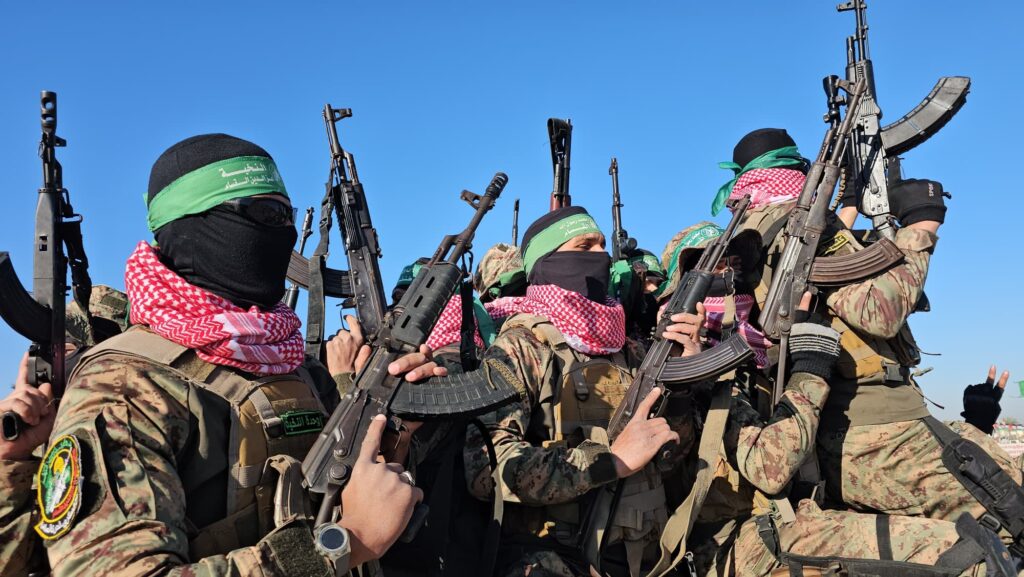
How many descriptions of the modern Palestinian and other Islamic terrorists do we see in prophecies of Obadiah? What other people-group fits this description? Is Edom not a picture of many modern-day Palestinians and their Moslem backers who hate the Jews, the state or nation of Israel and America as well as Christians and Jews in general?
Elsewhere have discussed who Jacob represents in end-time Bible prophecy. Now we are discovering from the Scriptures who the arch-enemy of Jacob’s biological and spiritual descendants will be, and who will attempt to prevent them from returning to the land of Israel. This will happen in the end times before the coming of the Messiah. (I discuss this issue in more detail in my commentary on Genesis chapter 32 about “Jacob’s Trouble” as he encountered Esau when returning to the land of Canaan.)
Edom Has a Perpetual Hatred for Jacob (Judah and Ephraim)
As we have noted, Edom’s hatred for Israel has its roots in the antagonism between Ishmael and Isaac, and then afterwards between Esau and Jacob. The hatred that Esau had for Israel has been passed on down to successive generations of Edomites to modern times. The biblical prophets discusses this murderous antagonism on Edom’s part as being carried down generation to generation to the very end times. Let’s review some of these biblical prophecies.
Ezekiel 36 speaks about the conflict between end-times Edom and end-times Israel. In verse two, we see that the enemies of Israel have regarded the “ancient high [or declared, promised] places” of Israel as “ours in possession.” This is a clear reference to the holy places in Israel (e.g., the Temple Mount for the Jews and Bethlehem for the Christians—only in recent years have the Palestinians taken Bethlehem and forced—out of persecution and intimidation—the majority of the large Christian population of that city to leave). “High places” can also refer to the militarily strategic high places such as the Golan Heights, Mount Hermon and the ridges surrounding the eastern shores of the Sea of Galilee.
Next, let’s look at Ezekiel 35, which is another prophecy against Edom. In verses four through five, we see that end-times Edom will be devastated because of its perpetual hatred for the children of Israel. They have killed their enemies by the power of the sword. This is how Islam has traditionally spread—by the curved scimitar sword. Advancing Moslem armies force its captives to leave, covert or die. According to Ezekiel 35:5, this will be occurring during the time of the punishment (of the children of Israel?) at the time of the end (NAS) or the end of time (lit. Hebrew). This is another example of YHVH’s using Edom (Esau) to bring Ephraim and Judah to its knees in the time of the end.
In verses six through nine of the same chapter, we see that YHVH will punish Edom for its blood-thirstiness against Israel and will devastate its cities and slay large numbers of its people. Other biblical prophecies indicate that the militaries of Judah (the State of Israel) and Ephraim (the USA among other Western nations) will be the means by which YHVH accomplishes this.
Finally, in verse 10, Edom (Islam) wants to take over or possess the two countries, nations or lands (Heb. eretz) of Israel: Judah (the State of Israel) and Ephraim (the USA) even though YHVH was there (in the lands of his people). Their anger and hatred against Israel is based on their envy or jealousy against YHVH’s people (verse 11).
The Koran, the religious book of Islam, has taken Edom’s historic and prophesied hatred and literally formed a religion around it. The Koran was written by Mohammed, a Jew and Christian hater, more than one thousand years after the prophecies of Ezekiel and Obadiah were written. Here are some quotes from the Koran that confirm the prophecies of the Bible with regard to Edom.
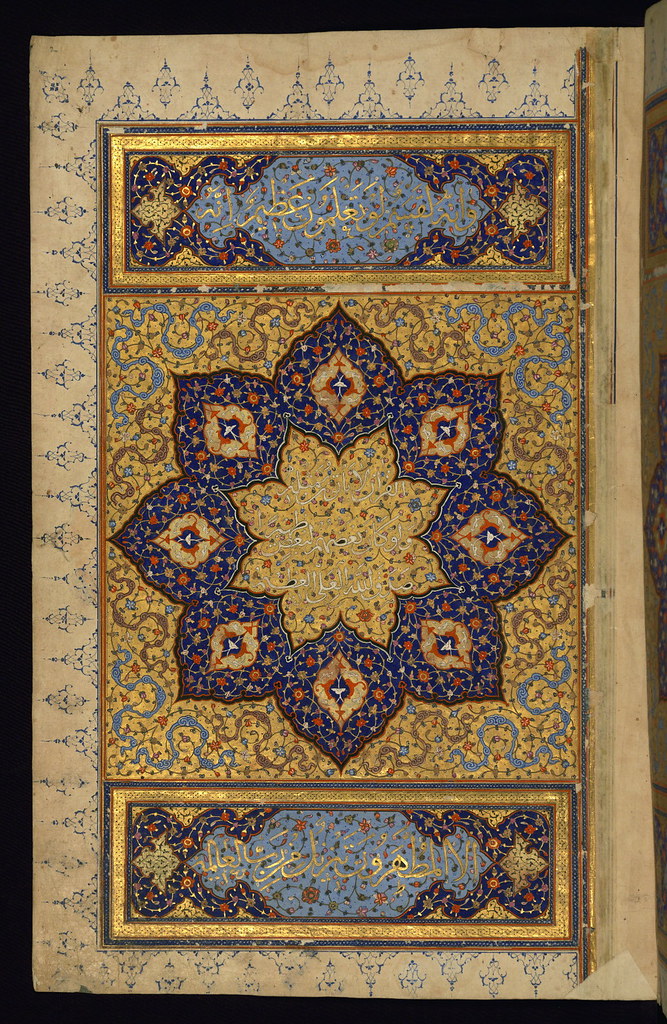
Make war upon those to whom the Scriptures have been given as believe not in God [Allah] … and who forbid not that which God and His Apostle [Mohammed] have forbidden, and who profess not the profession of the truth, until they pay tribute out of hand, and they be humbled. The Jews say, “Ezra in a son of God”; and the Christians say, “The Messiah is a son of God.” Such sayings in their mouths. They resemble the sayings of the infidels of old! God do battle with them! How they are misguided! (Sura 9:29–30)
When thy Lord spake unto the angels, “I will be with you: therefore stablish ye the faithful I will cast a dread into the heart of the infidels.” Strike off their heads then, and strike off from them every finger-tip. (Sura 8:12)
“O people of the Book! … Can I announce to you any retribution worse than that which awaiteth them with God? They whom God hath cursed and with whom He hath been angry—some of them hath he changed into apes and swine; and they who worship Thagout are in evil plight, and have gone far astray from the right path. (Sura 5:64–65)
Only recompense of those who war against God and His Apostle, and go about to commit disorders on the earth, shall be that they shall be slain and crucified, or have their alternate hands and feet cut off, or be banished from the land …(Sura 5:37)
YHVH Will Use Edom as a Giant Paddle to “Spank” Apostate Ephraim
As noted above, YHVH will drive Ephraim (the USA and other formerly western Christian nations) and Judah (the Jews) to a place where in their state of spiritual apostasy they will be forced to bend their knees before the Almighty Elohim. They have forgotten who they are as YHVH’s people, they have forsaken their covenants and spiritual heritage believing instead that their power, wealth, and world prestige has been gained through their own efforts. Out of the depths of spiritual, economic, political and military despair, they will be forced to look up to the Elohim of their forefathers and acknowledge that their blessings have only been a result of his grace and his promises to their forefathers.
Getting Ephraim and Judah to acknowledge this will not be an easy task. They will both have to endure great hardships and will doubtless face near annihilation before they acknowledge their sin of apostasy and repent and turn back to YHVH. The Scripture verses that follow substantiate this understanding.
In Ezekiel 35:15, we see that the house of Israel (America and other Christian nations) will become desolate (devastated, wasted), but so will Edom. YHVH will be glorified in the midst of all this.
As you rejoiced over the inheritance of the house of Israel because it was desolate, so I will do to you. You will be a desolation, O Mount Seir, and all Edom, all of it. Then they will know that I am YHVH.
Ezekiel 38 gives us much detail concerning end-times prophecy that is yet to occur about a nation called Gog, which seems to represents all the Satanic forces of an Antichrist figure. Many of the nations of Gog are Muslim. Let’s look at some of these prophecies verse-by-verse.
Verses 2, 5–6, We see here a confederation of peoples from Turkey and north of Turkey extending into the southern Russia area, along with the countries of northeastern Africa along with Iran and Iraq. All are Islamic or totalitarian states today, or have tendencies in that direction.
2 “Son of man, set your face toward Gog of the land of Magog, the prince of Rosh, Meshech, and Tubal, and prophesy against him, 3 and say, ‘Thus says Adonai YHVH, “Behold, I am against you, O Gog, prince of Rosh, Meshech, and Tubal. 4 “And I will turn you about, and put hooks into your jaws, and I will bring you out, and all your army, horses and horsemen, all of them splendidly attired, a great company with buckler and shield, all of them wielding swords; 5 Persia, Ethiopia, and Put [Libya] with them, all of them with shield and helmet; 6 Gomer with all its troops; Beth-togarmah from the remote parts of the north with all its troops—many peoples with you. (emphasis added)
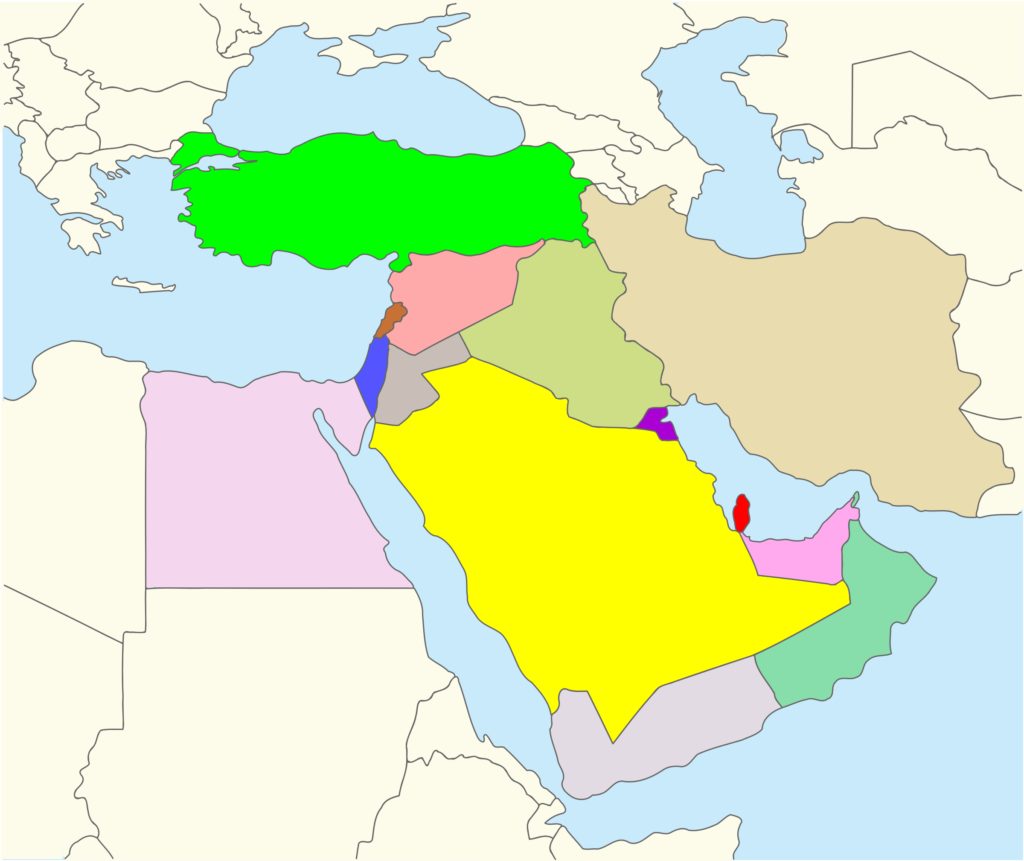
Verses 15–23, Edom and their allies are to come upon the mountains (nations) of Israel out of the north. Many Bible scholars believe that Turkey is Gog and Russia is greater Gog. Both nations are north of Israel, and Russia is also north of America (over the North Pole). They shall come militarily against YHVH’s people and YHVH shall sanctify his name among his people when this happens. In this incident, it seems very likely that both Judah and Ephraim will be judged. In the world today, we are seeing the formation of political, military and economic alliances between Russia and many of the Islamic and communist nations.
Verses 15–16, These prophecies are to occur “in the latter days.”
And you will come from your place out of the remote parts of the north, you and many peoples with you, all of them riding on horses, a great assembly and a mighty army; and you will come up against my people Israel like a cloud to cover the land. It will come about in the last days that I shall bring you against my [YHVH’s] land, in order that the nations may know me [YHVH] when I shall be sanctified through you before their eyes, O Gog. (emphasis added)
Verses 21–23, Nuclear holocaust will come upon Edom and its allies.
21 “And I shall call for a sword against him on all my mountains,” declares Adonai YHVH. “Every man’s sword will be against his brother. 22 “And with pestilence and with blood I shall enter into judgment with him; and I shall rain on him, and on his troops, and on the many peoples who are with him, a torrential rain, with hailstones, fire, and brimstone. 23 “And I shall magnify myself, sanctify myself, and make myself known in the sight of many nations; and they will know that I am YHVH.”’ (emphasis added)
Next, let’s note Hosea 11:8–9.
“How can I give you up, Ephraim? How can I hand you over, Israel? How can I make you like Admah? How can I set you like Zeboiim? My heart churns within me; my sympathy is stirred. I will not execute the fierceness of my anger; I will not again destroy Ephraim. For I am El [God], and not man, the Holy One in your midst; and I will not come with terror. (emphasis added)
In verse eight, we see YHVH’s attempts to force through disciplinary actions backslidden Ephraim to return to him. It appears that he may even allow (nuclear) fire to come down upon some cities of Ephraim, though it grieves him greatly to do so. Verse nine tells us that Ephraim will not experience the full fierceness of YHVH’s anger and be totally destroyed.
YHVH’s Judgment to Fall on Edom
YHVH Will Use Ephraim and Judah to Destroy Edom
YHVH is the Just Judge of the universe. The enemies of YHVH’s people will be punished for their arrogance against YHVH and his anointed people.
The nation of Assyria (an ally and backer of Edom), one of the terrorist ringleaders who has continuously and arrogantly defied YHVH and his people, will have Damascus, its pride and joy, destroyed. Damascus, one of the oldest and longest continually inhabited cities on earth, which has never been destroyed, will in the end times become a ruinous heap (Isa 17:1). This prophecy has not been fulfilled yet. Because of this fact, the prophecy of Isaiah 17 is for the end times.
Ezekiel confirms Isaiah’s prophecy about Edom’s destruction. In Ezekiel 35:4, we read that Edom’s cities have yet to be laid waste (ruined) and made desolate (devastated), and Edom has yet to learn who YHVH is, even as Damascus has yet to be made a ruinous heap (Isa 17:1).

Then in Ezekiel 35:5 the prophet declares that Edom will be devastated because of its perpetual hatred for the children of Israel. They have killed the children of Israel by the power of the sword. This is how Islam has historically spread it religion—by the curved scimitar sword. Moslems force their captives to leave, covert to Islam or die. This is to be occurring at the time of the end (see the NAS translation of this verse) or at the end of time (according to the literal Hebrew). This is another example of YHVH’s using Edom (with a reference to Islam) to bring Ephraim and Judah to their knees in the end times before the second coming of Yeshua the Messiah.
But then YHVH will turn the tables on Edom, for in Ezekiel 35:6–9, we read that YHVH will punish Edom for its blood-thirstiness against Israel and will devastate its cities and slay large numbers of its people. Other biblical prophecies indicate that the militaries of Judah (the State of Israel) and Ephraim (primarily the USA) will be the means by which YHVH will accomplish this.

YHVH will judge Edom (Islam and its allies) because it wants to take over or possess the two countries (nations or lands) of Israel (i.e., Judah and Ephraim) even though YHVH was there (in the lands of his people) (Ezek 35:10). Their anger and hatred against Israel is based on Edom’s envy or jealousy (verse 11) toward Israel.
Then in Ezekiel 38:16, we read about a confederacy of nations coming up against the mountains (or nations) of Israel (verse 8) in the last days (or the end times), but that it is YHVH who will bring greater Edom up to Israel so that YHVH may be sanctified in Israel in the eyes of Israel’s enemies. What will be the end result? Either horrific conventional weaponry will be unleashed against Edom, or a nuclear holocaust. YHVH says of Edom,
And I will plead against him with pestilence and with blood, and I will rain upon him, and upon his bands, and upon the many people that are with him, an overflowing rain, and great hailstones, fire, and brimstone. Thus will I magnify myself, and sanctify myself; and I will be known in the eyes of many nations, and they shall know that I am YHVH. (Ezek 38:22–23)
There is some question as to the time frame of the fulfillment of the Gog prophecy of Ezekiel 38 and 39. This prophecy could have an end-time (i.e., just prior Yeshua’s return) fulfillment, or an end of the Millennium fulfillment, since in both cases Gog is destroyed by fire from heaven (see Ezek 39:6 cp. Rev 20:9).
We believe that the Ezekiel 38 and 39 has an end-time fulfillment because in the final verses of chapter 39 there is a discussion about the return of the house of Israel to the land of Israel. Perhaps not all Israel will have returned by the end of the Millennium and some will still need to be flushed out of the nations where they have resided for millennia, but in light of other prophetic passages pertaining to the regathering of Israel (e.g., Ezek 37), we believe that this is an end-times prophecy. Whatever the case, Satan and his human forces will array his armies against the saints and Yeshua at the second coming. They will also repeat this move at the end of the Millennium just prior to the White Throne Judgment of Revelation 20:7–10.
Assuming the fulfillment of Ezekiel 38 and 39 is premillennial, we see that YHVH will turn Gog and the confederacy of nations accompanying it back and five-sixth of them will be slaughtered upon the mountains of Israel (verses 2–6). As a result, YHVH’s name will be glorified among the isles (verse 7). The isles could well be a reference to Christian Ephraim of which America is the spiritual leader.
The little Book of Obadiah is a one-chapter indictment against Edom. After judgment comes upon Edom, verse 17 says that the Temple Mount will return to YHVH’s people! Verse 18 then prophesies that Ephraim and Judah as a unified force will destroy Edom with fire. This is confirmed by the prophet Zechariah as well (Zech 9:13). Ephraim and Judah in their time of despair will rise up (by YHVH’s grace) and will defeat Edom. Few if any from the house of Edom will survive (verse 18).
Obadiah nineteen says that those Israelites of the south or Negev desert area of Israel will possess Mount Seir (the land of Edom), the plain of the Philistines (Gaza) along with the country of Ephraim and Samaria.
In Zechariah 9:13, we read that Ephraim and Judah will destroy their enemies. Judah will be the bow, and Ephraim the arrow against Greece, which may very well be a biblical metaphor for western non-Christian Europe. This is YHVH’s arrow of judgment that will go forth like lightning and he shall sound the shofar, and like the storm winds or a whirlwind of the south, he will go forth (verse 14). (It is possible that his whirlwind of the south may be a reference to the fight between the king of the south and the king of the north of Daniel 11.) Judah and Ephraim will be in YHVH’s hand to destroy their enemies (verse 15; see also 10:5).
Then in Zechariah 14:12, we have the well-known passage that many Bible commentators believe is a direct reference to nuclear war that YHVH will use as a means to defend his people and destroy the enemies of Israel. All this is to occur in the time period called “the day of YHVH” (verse 1), and in the general time period of the second coming of Yeshua, when his feet will touch the Mount of Olives (verse 4), and when YHVH will be king over all the earth (verse 9).
Genesis 36:41, Chief Aholibamah.This was one of Esau’s wives (verse 18), who was apparently the matriarchal head of clan. Was Esau an early originator of the feminist movement?
