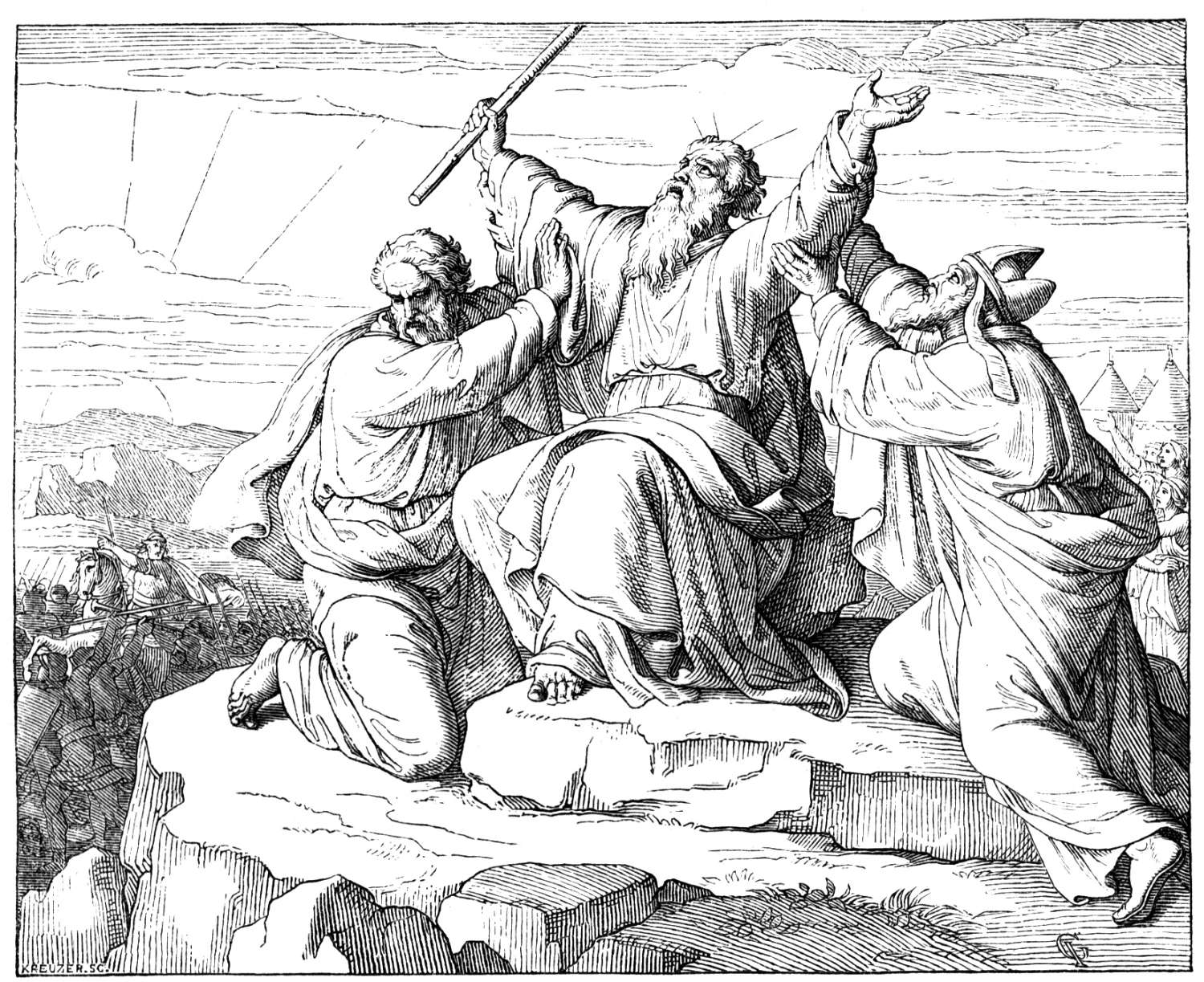
Outline of Sefer Devarim/Deuteronomy: Moses’ Farewell Address
Chapter 1:1–5, Introduction
Chapters 1:6–4:40, First Discourse
Moses gives a veiled rebuke for sin and disobedience, and gives a review of the journey from Mount Sinai to Kadesh with exhortations to obedience.
Chapters 4:44–11, Second Discourse, Part 1
The religious foundations of the covenant, the spirit in which it is to be kept and the motives to right obedience are discussed. Moses shows how the covenant defines the relationship between YHVH and Israel and emphasizes the basic spiritual demands that such a relationship imposes upon Israel.
Chapters 12–26, Second Discourse, Part 2
- The code of law dealing with:
- Worship, Chapters 12:1–16:17
- Government, Chapters 16:18–18
- Criminal Law, Chapters 19:1–21:9
- Domestic Life, Chapters 21:10–25
- Rituals and the Sanctuary, Chapter 26
Chapters 27–30, Third Discourse
The enforcement of the Torah-law with its blessings and curses; establishment of a fresh covenant between YHVH and Israel (i.e. the younger generation).
Chapters 31–34, The Last Days of Moses
- Chapter 31, Committal of the law to the keeping of the priests.
- Chapter 32, The Song of Moses (a prophecy about Israel’s future).
- Chapter 33, Moses’ patriarchal blessing over the tribes of Israel.
- Chapter 34, The death of Moses.
Overview of the Book of Deuteronomy/Devarim from Various Commentators
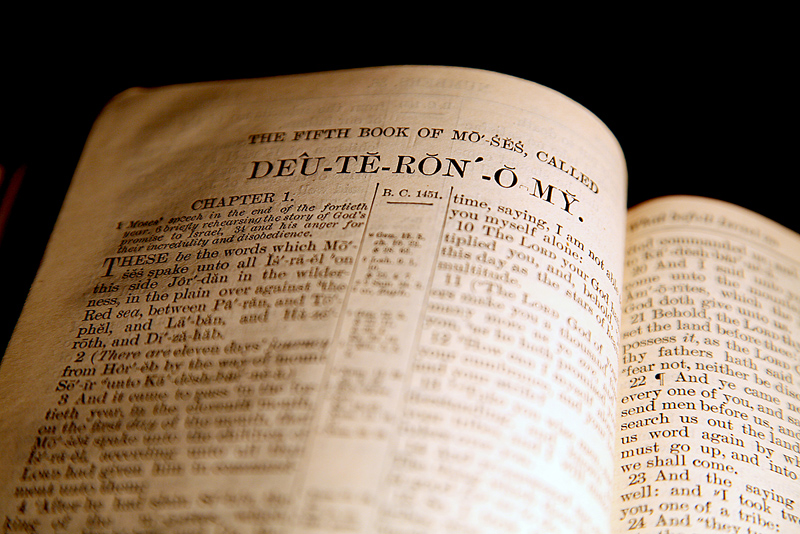
This last book of the Torah starts out with “These are the words which Moses spoke ….” The Hebrew name for Deuteronomy is Devarim meaning “words,” which is the plural form of devar meaning “word, speech, a matter or thing, a commandment, a report, a message, promise.” Note the similarity in meaning between the Hebrew word devar and the Greek word logos from John 1:1 (“In the beginning was the Word, and the Word was with Elohim, and the Word was Elohim.”). Logos means “speech, word or thing.” From this connection, we see that Yeshua was the Word of both the Old Testament (OT or Tanakh) and the New Testament (NT or Testimony of Yeshuah). He is the message of the entire Bible (Spirit Filled Life Bible, from the “Word Wealth” at Deut 1:1).
Deuteronomy is written similarly to the vassal-treaties formulated between captor and captive nations prior to 1000 B.C. It contains historical information, enumerates laws, and concludes with threats and promises (Hebrew Greek Key Study Bible, from the Introduction to Deuteronomy). From a general survey of Deuteronomy, it is sufficiently evident that the exposition of the commandments, statutes, and rights of the law had no other object than this: to pledge the nation in the most solemn manner to an inviolable observance, in the land of Canaan, of the covenant, which YHVH had made with Israel at Horeb (Deut 28:29, Keil and Delitzsch Commentary of the Old Testament, from the introductory note to Deut).
In Deuteronomy, Moses speaks like a dying father giving a farewell song to his children, all the while he celebrates Elohim as the spiritual Rock of Israel. While the eyes of the Israelites may have fixated too much upon Moses their physical leader (instead of Elohim) for forty years, Moses now attempts to redirect their eyes, trust and allegiance heavenward and onto YHVH, their real spiritual Leader who had been behind Moses—a mere human leader—all the time.

Deuteronomy is Moses’ last word and final admonition to Israel before his death. It is a review of the main points found in the first four books of the Torah. This review is for the benefit of the younger generation who has been born and/or grown up in the wilderness and who are about to enter the Promised Land. The first few chapters of Deuteronomy includes several themes that are mentioned over and over again underscoring their importance in YHVH’s eyes. They are:
- Teach the children YHVH’s instructions in righteousness (i.e. the Torah).
- Teach the children about their historical and spiritual roots.
- Fear YHVH.
- Remember the giving of the Torah at Mount Sinai and the supernatural occurrences surrounding that event.
- Do not allow yourself to become involved in idolatry and the practices of the heathen nations.
- Keep Torah and all will be well with you.
- YHVH’s Torah commandments are eternal.
- Don’t forget YHVH nor turn from the Torah—YHVH’s instructions in righteousness.
Consider these admonitions of YHVH to his people. Are we heeding these instructions and grounding our people in these things? What are you doing in your own life to take YHVH’s wise admonitions seriously?
The words of Deuteronomy are earnest and impressive. Moses looks back over the whole of the forty years of Israel’s wandering in the desert, reminds the people of all the blessings they had received, of the ingratitude with which they had so often repaid Elohim, and of the grace, mercy, love and judgments of Elohim. Furthermore, Moses explains the laws of Torah again and again, and adds to the Torah some 70 new laws, which were necessary to complete it. He never wearies of urging obedience to the Torah in the warmest and most emphatic words, because the very life of the nation was bound up with this; he surveys all the storms and conflicts which they passed through, and, beholding the future in the past, takes a survey also of the future history of the nation, and sees, with mingled sorrow and joy, how the three great features of the past—that is to say, apostasy, punishment, and pardon—continue to repeat themselves in the future also (Keil and Delitzsch Commentary on the OT, from the introductory note to Deut).
Deuteronomy is a unique book—distinct from the narrative and historical, the legal, prophetic, and devotional writings of the Scriptures, though it has affinities with each of them. In its literary aspect, it is an oratory; and as such it is unsurpassed in its rush of rhythmic sentences, its ebb and flow of exalted passion, its accents of appeal and denunciation: Moses’ speech shines as well as his face. And this noble language gives utterance to truths which are always and everywhere sovereign—that Elohim is one, and that man must be wholly his; that Elohim is righteous and faithful, merciful and loving. Elohim’s proclamation in Deuteronomy stands in relation to Israel and humanity not merely as Judge or Ruler, but as Friend and Father. “And thou shalt love YHVH your Elohim with all thy heart, and with all they soul, and with all they might.” This whole-soul love and devotion to Elohim is to be accompanied by a large-hearted benevolence towards man, and indeed towards all sentient beings; by the recognition of the retributive righteousness of El; and by the insistence on the vital importance of family life, and of religious instruction within the home. The influence of the Book of the Farewell Discourses of Moses on both domestic and personal religion in Israel throughout the millennia has never been exceeded by that of any other book in the Scriptures (Soncino Edition of the Pentateuch and Haftorahs, from the introductory note to Deuteronomy).
In this book, YHVH can also be viewed as a husband asking his bride to give her whole heart to him, to follow him and to obey him. Sadly, in the rest of the story (after Joshua), we see chronicled the sad saga of a bride having a difficult time being a good wife. In the end, Israel becomes a rebellious and adulterous wife to the point that YHVH was forced to divorce her despite his patience and mercy. Then YHVH promised to do a new thing and comes in a human form (namely, Yeshua) like Moses—so that his people would learn to relate better to him. He wanted to set his people back on the right and good path (of Torah), and to restore them as his bride. He has now betrothed himself to his people (the saints) once again (this occurred with Yeshua at the last supper), given them his Holy Spirit as their engagement ring (on the Day of Pentecost), and since then it has been a long betrothal period (2000 years), so that those saints (i.e. redeemed Israel or the one new man; Eph 2:11–19) through trials and tribulations can be spiritually refined so that she can be a good wife for him. YHVH wants to see what is actually in her (our) heart. He wants a faithful companion forever.
Moses was the first to prophesy the coming of the Messiah (Deut 18:15), and Moses is the only person to which Yeshua compared himself (John 5:46–47).
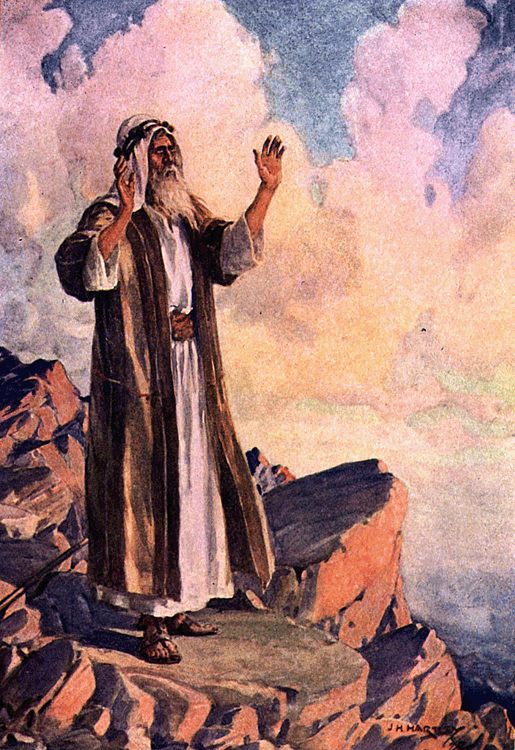
Yeshua often quoted from Deuteronomy. When asked what was the most important commandment in the Torah, he quoted Deuteronomy 6:5 and included this verse as part of his summation of the whole Torah. In his temptation in the wilderness, he quoted exclusively from Deuteronomy when resisting the devil (Deut 8:3; 6:16; 6:13; 10:20).
Deuteronomy teaches more of the heart and spirit of the Torah, and that the relationship of Elohim to his people encompasses much more than just a legalistic observance of the Torah. Israel’s covenant relationship with Elohim involves obedience and loyalty as well as love, affection and devotion, which should be the true foundation of all of our action. Success, victory, prosperity and happiness all depend upon our obedience to YHVH. The book is a must-read for an understanding of man’s obedience to Elohim based on love and fear (Deut 10:12, 13, Spirit Filled Life Bible, from the introductory note to Deut).
In a sense, Deuteronomy is not only a synopsis, but a commentary on the first four books of the Torah. This book along with the Epistle to the Hebrews contain the best comment on the nature, design, and use of the Torah (Adam Clarke’s Commentary on Deuteronomy, from the introductory note to Deut).
The Book of Deuteronomy contains not so much a recapitulation of the things commanded and done as related in Exodus, Leviticus and Numbers, as it is a compendium and summary of the whole law and wisdom of the people of Israel, wherein those things that related to the priests and Levites are omitted, and only such things are included as the people are generally required to know. Much more than a being a repetition of what preceded it, Deuteronomy is an oratory description, explanation, and enforcement of the most essential contents of the covenant revelation and covenant laws, with emphatic prominence given to the spiritual principle of the law and its fulfilment, and with a further development of the ecclesiastical, judicial, political, and civil organization, which was intended as a permanent foundation for the life and well-being of the people of Israel in the Promised Land of Canaan. There is not the slightest trace throughout the whole book of any intention whatever to give a new or second law (Keil and Delitzsch, from the introductory note to Deut).
The covenant of Deuteronomy contains all these parts. The first eleven chapters are generally a summary of the adventures of Israel beginning from the covenant they confirmed at Mt. Sinai. The actual stipulations or terms of this new covenant start with chapter 12 and go to chapter 26. Chapter 27:10-28 detail the blessings and punishments that will come depending on Israel’s compliance. Later chapters instruct how the covenant will be perpetuated.
As part of their compliance Moses instructed Israel to write this law on large stones when they crossed into the Promised Land. Likely they wrote only the instruction of chapters 12-26:15. Since they recited the blessings and curses of chapter 27-28 they probably didn’t write those or anything following with the law (Deu 27:11-14).
More Insights About the Book of Deuteronomy

In stark terms, YHVH warns the Israelites in Deuteronomy of the struggles Israel will have as it walks between two world: the lower world that attaches itself to man’s soul and attempts to pull him downward, and the upper world that pulls the spirit in man heavenward.
Deuteronomy presents Torah (as does Ps 119) as the way to be spiritually, physically, mentally, emotionally, materially elevated before Elohim and in the eyes of the surrounding nations (Deut 4:6).
In Deuteronomy, YHVH lays out two extremes: blessings for obedience and curses for disobedience; curse for following the ways of this world, and blessings for following the Word of YHVH. But seldom do individuals find themselves in one extreme or the other, for few are either totally worldly or totally heavenly in the orientation of their lives. They are usually caught up somewhere in the middle ground between the two: not totally evil and not totally good. Their lives are a mixed bag of good and evil, blessings and curses, and a double-orientation toward the heaven and the world. The Bible calls this double-mindedness (Jas 1:8; 4:8), and Yeshua decries such an individual (Matt 6:24, “one can’t serve both God and mammon”). The Bible also calls this being lukewarm—being neither hot nor cold, and YHVH hates this as well (Rev 3:15–16). Such an individual, if he isn’t careful, can find himself feeding spiritually more from the tree of the knowledge of good and evil rather than the tree of life.
YHVH lays out the highest spiritual ideal for Israel: to be wisdom in the sight of the nations (Duet 4:6), to be the head and not the tail, to be the greatest and not the least, and to be the lender and not the borrower. Such a position of status is possible thanks to following the Torah. He wants the best for his people, but achieving such is conditional on their obeying him. Many people make claim to believe in the God of the Bible, to love him and many even claim to follow and to obey him—just ask them! But in reality, do they? What are the fruits of their lives? Their true spiritual status is based on what they do, not what they profess with their mouths!
Deuteronomy affirms the sufficiency of Torah. The Torah is the Word of Elohim and nothing more needs to be added to it. It is the full revelation of YHVH when it says not to add to the Word of Elohim (Deut 4:2; 12:32). It is the bedrock of the Scriptures and the bedrock of truth. If Torah is the bedrock of YHVH’s word, then the Ten Commandments are the cornerstone in that foundation of truth, which Moses reiterates in Deuteronomy five. The rest of the Scriptures are just commentary or elucidations on Torah, or admonitions for YHVH’s people to return to Torah. The truths of the Testimony of Yeshua (the New Testament) stand firmly on the Torah and never once contradicts Torah. The Torah is the flower bud that contains the full flower, while the Testimony of Yeshua is the open flower in its full glory.
Torah keeps YHVH’s people on the straight and narrow path and from falling into the ditches on either side of the road. Those ditches are legalism and license, the letter and the spirit of the law (Deut 5:32).
Deuteronomy stresses man’s need to fear Elohim. Though loving, personal, merciful, and full of bountiful goodness, he is at the same time a consuming fire of jealousy, wrath and judgment against those who disobey him, and he will bring all men to account for their wickedness and sin (Deut 4:24; 6:15; 9:3). He warns his people not to tempt or to push him (Deut 6:16). He is also a consuming fire against Israel’s enemies (9:3).
The absolute preeminence of YHVH is stressed again and again in Deuteronomy.Putting him first in our lives starts with fearing him always (Deut 6:24), and doing what is right and good in his sight that you may be blessed and live victoriously (Deut 6:18). All this is based on YHVH’s love for his people and vice versa.
Deuteronomy defines and elucidates the true meaning of love. The Shema of Deuteronomy 6:5 declares that man is to love YHVH 1000 percent. Likewise, YHVH set his love unconditionally upon his people (Deut 7:7–9). That love is inviolate for 40,000 years, or 1000 generations (Deut 7:9).
Deuteronomy stresses the importance of relationship. Numerous passages in Deuteronomy enumerate the importance of relationships at all levels: between humans and between humans and Elohim. The horizontal and vertical aspects of love come together at the seven annual biblical feasts where YHVH’s people are commanded to gather together where he has placed his name and at the times he has set to celebrate and rejoice before him (Deut 12; 14:23ff; 16:1ff).
Deuteronomy constantly repeats and stresses Israel’s history and emphasizes the importance of understanding our history including both the defeats and victories of our forefathers. History is a great teacher, and many mistakes can be avoided by having a thorough understanding of and a healthy respect for history, and by learning the lessons of history.
Deuteronomy instructs men to circumcise or cut way the barriers of their hearts(Deut 10:16; 30:6; see also Lev 26:41). Deuteronomy is the first place YHVH commands his people to circumcise their hearts.
Deuteronomy emphasizes the need to teach Torah to our children. We are not only to be concerned about our past history, but to be future-minded people also by passing on our legacy (YHVH’s Torah instructions from heaven) to future generations (Deut 6:7; 11:19).
Deuteronomy is a song or poem where the Creator passionately woos his creation. It almost sometimes seems that YHVH is pleading with his people to follow him, to keep his commands, to enter into a forever love relationship with him so that they can be blessed abundantly and victorious, though he forcefully stresses their need for him, the curses that will come upon them if they turn away from him, the fact remains that the choice to follow him is still up to them (Deut 11:26; 30:15). The only thing over which man remains sovereign is his own heart; therefore, man has to choose to love and serve YHVH with his whole heart.